
A company’s website reflects its strategic maturity more than any other digital asset. It is often the first point of interaction between your brand and potential customers, investors, partners, and even future employees. In today’s competitive digital economy, your website is no longer a brochure, it is a revenue-generating platform, a trust-building engine, and a strategic business tool.
According to Stanford Web Credibility Research, 75% of users judge a company’s credibility based on its website design. Additionally, Google reports that 53% of mobile users abandon a site if it takes longer than three seconds to load. These statistics highlight a simple truth: an outdated website silently erodes growth opportunities.
This is why website redesign services are no longer optional. They are a strategic investment that directly influences revenue, valuation, and brand equity. Partnering with a professional website redesign service provider or a website redesign services company ensures your digital presence evolves alongside your business strategy.
Website redesign is not a cosmetic refresh. It is a business transformation initiative.
Why Website Redesign Is a CEO-Level Business Decision
For today’s CEOs, digital presence is inseparable from business performance. The website is no longer a supporting marketing asset it is a primary engine of growth, trust, and competitive positioning. Every strategic initiative, from market expansion to product launches, ultimately relies on how effectively the company communicates and converts online.
A high-performing website acts as a strategic driver of business growth by attracting the right audience, shaping perception, and guiding prospects through their buying journey. When the website experience is outdated, inconsistent, or difficult to navigate, it silently undermines marketing investments, slows sales cycles, and weakens customer confidence.
Leadership decisions directly affect brand credibility and reputation. A modern, well-structured website signals that the organization is forward-thinking, reliable, and operationally strong. Conversely, a poorly designed or underperforming website sends an unintended message that the business may also be behind the curve.
Website strategy also plays a central role in revenue generation. From first impression to final conversion, the website influences lead quality, conversion rates, and deal velocity. It determines whether visitors become engaged prospects or abandon the brand entirely.
For CEOs, this reframes the website as a digital asset, not just a cost. Like any high-value asset, it requires continuous investment, optimization, and alignment with business goals. Treating website redesign as a CEO-level decision ensures it supports long-term growth, scalability, and enterprise value rather than remaining a cosmetic or tactical exercise.

Website Redesign as a Strategic Business Investment
Website redesign delivers its greatest impact when viewed through a business lens rather than a design lens. A strategic approach ensures the website directly contributes to organizational objectives and measurable outcomes.
➔ Aligns Digital Presence with Business Goals
As companies grow, their goals evolve whether that involves entering new markets, targeting new customer segments, or repositioning within the industry. A strategic website redesign ensures the digital presence reflects these changes accurately and convincingly.
A modern website:
• Supports expansion into new markets by clearly communicating offerings and value propositions to diverse audiences
• Reinforces premium positioning through refined design, messaging, and user experience
• Communicates strategic vision effectively, helping stakeholders understand where the company is headed
• When digital presence and business goals are aligned, the website becomes a powerful extension of leadership strategy.
➔ Supports Revenue, Marketing, and Scalability
A well-executed redesign strengthens the entire growth ecosystem.
It improves lead quality and conversion rates by guiding visitors toward high-intent actions and removing friction from the user journey. At the same time, it enables seamless CRM and marketing automation integration, allowing sales and marketing teams to track, nurture, and convert leads more efficiently.
Additionally, a scalable website architecture provides flexibility for future campaigns, product launches, and content expansion. Instead of rebuilding every time the business evolves, the organization gains a digital foundation that can grow with it.
➔ Delivers Long-Term ROI Beyond Design
The true value of website redesign lies in its long-term business impact.
A strategically redesigned website contributes to:
• Lower customer acquisition costs through improved organic visibility and conversion efficiency
• Higher engagement and retention by delivering better user experiences
• Stronger brand equity by consistently reinforcing trust and authority
Rather than a one-time expense, website redesign becomes an investment that compounds in value over time driving sustainable growth and competitive advantage.
Also Read: Top 10 WordPress Platforms to Empower Your Business
10 Website Redesign Strategies That Drive Business Growth
1. Align Digital Presence with Corporate Strategy
Your corporate strategy defines where the business is going. Your website must clearly communicate that direction.
As organizations evolve, brand positioning often shifts, new markets are entered, new solutions are launched, and new customer segments are targeted. When the website fails to reflect these changes, a disconnect forms between strategic intent and market perception.
A strategic redesign ensures the website reflects an evolving brand identity through modern brand storytelling and a consistent messaging hierarchy. Every page should reinforce the company’s value proposition and differentiate it from competitors.
Equally important is strengthening executive positioning. The website should showcase leadership vision, strategic priorities, and industry perspective. This builds credibility with customers, partners, and investors while positioning the organization as a serious, future-ready enterprise.
Business impact: Clear positioning, stronger differentiation, and improved trust.
2. Improve Conversion Performance Across Sales Funnels
Traffic has limited value if it does not convert.
A conversion-focused redesign prioritizes user experience around buyer intent. Clear calls-to-action guide visitors toward meaningful actions, whether that is requesting a demo, downloading a resource, or speaking with sales. Friction in inquiry flows, such as long forms, confusing navigation, or unclear messaging is systematically removed.
Data-backed optimization is critical. Heatmaps, session recordings, and funnel tracking reveal how users actually interact with the website. These insights inform continuous improvements, turning the website into a conversion optimization engine rather than a static destination.
Business impact: Higher conversion rates, better lead quality, and faster sales cycles.
3. Strengthen Brand Authority in Competitive Markets
In crowded markets, authority drives preference.
A modern website must clearly demonstrate why your organization is the right choice. Case studies, testimonials, and proof-driven content provide tangible evidence of results. Thought leadership sections highlight expertise, perspectives, and innovation.
Industry-specific positioning further strengthens relevance by speaking directly to the challenges of target verticals rather than using generic messaging.
Together, these elements transform the website into a credibility-building platform that pre-sells prospects before a sales conversation begins.
Business impact: Increased trust, stronger differentiation, and higher close rates.
4. Enhance Customer Experience (CX)
Customer experience begins long before a prospect becomes a customer.
A mobile-first experience is essential, as the majority of users now access websites from smartphones. Responsive layouts and optimized page speed ensure the experience is fast, intuitive, and frustration-free.
Streamlined user journeys are equally important. Logical site architecture and clear information flow help users find what they need quickly. When navigation is simple and content is well-organized, engagement increases and bounce rates decrease.
Business impact: Better engagement, longer session durations, and higher conversions.
5. Boost SEO & Organic Visibility
Organic search remains one of the most cost-effective growth channels.
A strategic redesign includes technical SEO improvements such as clean code, optimized site structure, and fast loading times. Core Web Vitals optimization improves both search rankings and user experience.
This is where website redesigning services play a critical role by embedding SEO best practices into the foundation of the site. Structured data implementation improves how search engines understand content, while AI-search readiness ensures the website can perform well in evolving search environments.
Business impact: Increased organic traffic, lower acquisition costs, and sustainable visibility.
6. Enable Marketing & Sales Alignment
When marketing and sales operate in silos, revenue suffers.
A redesigned website acts as a shared platform for both teams. CRM integration ensures leads captured on the website flow directly into sales systems. Marketing automation support enables nurturing campaigns based on user behavior.
Campaign-ready landing pages allow marketing teams to launch initiatives quickly, while clear analytics and reporting provide visibility into performance across the funnel.
Business impact: Better pipeline visibility, improved collaboration, and higher revenue efficiency.
7. Improve Website Performance & Speed
Speed directly affects business outcomes.
Faster load times reduce bounce rates and improve search rankings. Users are more likely to stay, explore, and convert when pages load quickly.
Performance optimization also improves perceived professionalism. A fast website signals operational excellence and technical competence.
Business impact: Higher engagement, better rankings, and improved conversions.
8. Strengthen Security & Compliance
Trust is a competitive advantage.
A modern redesign updates security protocols, strengthens data protection, and ensures compliance with relevant privacy regulations. This reduces exposure to cyber risks and protects customer information.
Beyond risk mitigation, visible security measures reassure users and strengthen brand credibility.
Business impact: Reduced risk, increased trust, and stronger reputation.
9. Support Scalable Technology Infrastructure
Growth requires flexibility.
A scalable website is built on a flexible CMS, supports API integrations, and uses cloud-ready architecture. This enables the organization to add new features, integrate new tools, and expand functionality without rebuilding from scratch.
Scalability ensures the website remains an asset as the business grows.
Business impact: Lower long-term costs, faster innovation, and future readiness.
10. Maximise ROI from Digital Investments
Every digital initiative ultimately leads back to the website.
A high-performing website multiplies the impact of paid advertising, content marketing, SEO, and partnerships. Higher lead quality and lower acquisition costs improve overall ROI.
Improved sales velocity and consistent performance create sustainable long-term growth.
Business impact: Better returns on marketing spend and stronger revenue outcomes.
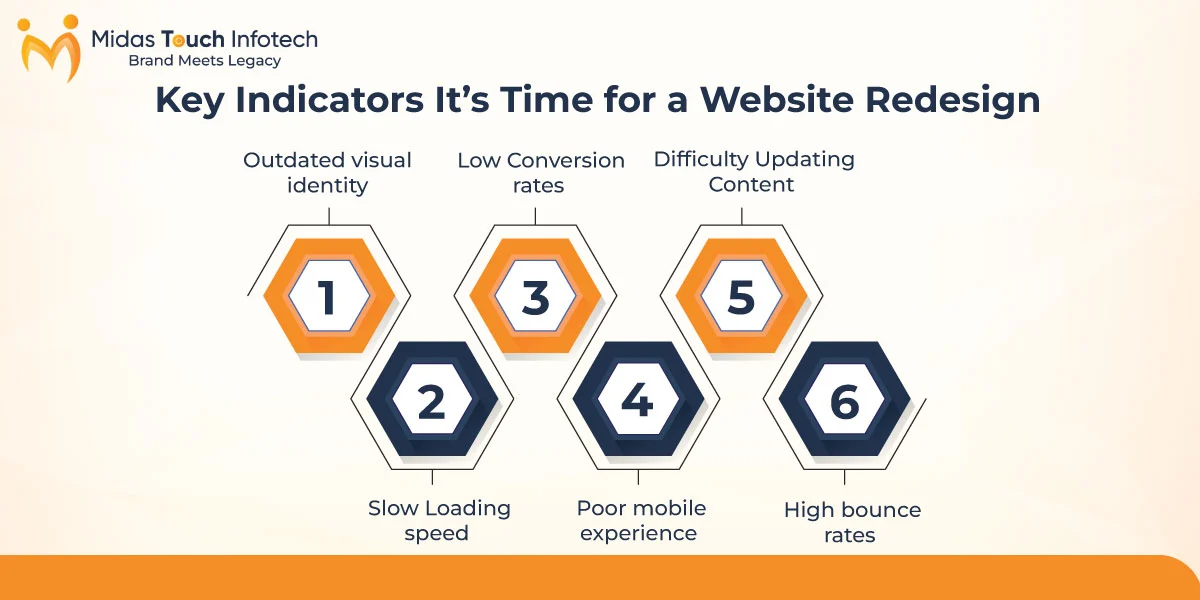
Key Indicators It’s Time for a Website Redesign
Website performance issues rarely appear overnight. They build gradually, often going unnoticed while silently eroding growth potential. For CEOs and leadership teams, recognizing the early warning signs is critical. The following indicators signal that a website redesign is no longer optional it is necessary for continued competitiveness.
⇒ Outdated Visual Identity
Brand perception is formed within seconds. If your website looks dated, inconsistent with current branding, or misaligned with your market positioning, it immediately weakens credibility. As companies evolve, their visual identity, messaging, and tone also change. When the website does not reflect this evolution, it creates a gap between who the organization is today and how it is perceived.
An outdated visual identity suggests stagnation even if the business itself is innovative. A redesign ensures the digital presence accurately represents your brand’s maturity, ambition, and professionalism.
⇒ Slow Loading Speed
Speed directly impacts user behavior, search rankings, and conversions. If pages take too long to load, visitors leave before engaging with content. This not only increases bounce rates but also wastes marketing spend by driving traffic to a poor experience.
Slow performance is often caused by outdated code, unoptimized images, or legacy infrastructure. A strategic redesign addresses these issues at the foundation level, delivering faster load times and smoother interactions across devices.
⇒ Low Conversion Rates
If your website attracts traffic but generates few inquiries, demos, or sign-ups, the issue is rarely traffic volume it is experience and messaging.
Low conversion rates indicate problems such as unclear value propositions, weak calls-to-action, confusing navigation, or friction-heavy forms. A redesign focused on conversion architecture restructures user journeys around buyer intent, turning visits into measurable business opportunities.
⇒ Poor Mobile Experience
Mobile traffic now represents the majority of web usage for many industries. If your website is difficult to use on smartphones or tablets, you are effectively alienating a large portion of your audience.
Common symptoms include unreadable text, broken layouts, slow mobile performance, and hard-to-click elements. A mobile-first redesign ensures consistent, intuitive experiences across all screen sizes.
⇒ Difficulty Updating Content
When publishing or updating content requires technical intervention, marketing and communication teams become bottlenecked. This slows campaigns, limits experimentation, and reduces agility.
A modern website should be built on a user-friendly CMS that allows teams to manage content independently. If updates are painful or risky, it is a strong signal that the underlying system is outdated.
⇒ High Bounce Rates
High bounce rates indicate that visitors are leaving quickly without engaging further. This often results from poor first impressions, irrelevant messaging, slow speed, or confusing layout.
While bounce rate alone does not tell the full story, consistently high bounce rates across key pages point to deeper experience issues. A strategic redesign addresses these root causes by improving clarity, structure, and performance.
Also Read: Top 10 Logo Design Company in Chennai for Strategic Brand Growth
What CEOs Should Look for in Website Redesign Services
Not all website redesign services are created equal. Many providers focus primarily on aesthetics, delivering visually appealing websites that fail to move the business forward. For CEOs, the selection of a website redesign partner should be treated as a strategic decision, not a creative one.
The right partner does more than redesign pages, they help architect a digital growth engine. The following criteria define what leadership teams should prioritize when evaluating website redesign services.
➨ Strategy-First Approach
A redesign should never begin with colors, fonts, or layouts. It should begin with business understanding.
A strategy-first partner takes the time to deeply understand your organization’s goals, target markets, competitive landscape, and growth priorities. They translate these insights into a website structure that supports revenue, positioning, and scalability.
This approach ensures that every design and development decision is tied to a business outcome whether that is increasing lead quality, improving conversion rates, or strengthening brand authority.
For CEOs, this means the redesign becomes a strategic initiative aligned with corporate objectives rather than a surface-level refresh.
➨ Industry Understanding
Every industry has unique buying behaviors, decision cycles, and credibility requirements.
A strong website redesign partner brings experience within your sector or demonstrates a proven ability to quickly understand industry dynamics. This allows them to craft messaging, user journeys, and content structures that resonate with your specific audience.
Industry understanding also enables better competitive differentiation. Instead of producing generic websites, the partner helps position your organization in a way that clearly stands out in your market.
For leadership teams, this reduces risk and accelerates time-to-impact.
➨ SEO + Performance Integration
Visibility and speed are fundamental to digital success.
CEOs should prioritize website redesign services that embed SEO and performance optimization into the core of the project not as add-ons. This includes technical SEO architecture, clean code, fast loading times, and mobile-first optimization.
When SEO and performance are integrated from the start, the website is built to rank, load quickly, and convert effectively. This creates a foundation for sustainable organic growth and better user experiences.
For CEOs, this translates into lower acquisition costs and higher returns on digital investments.
➨ Clear ROI Framework
A strategic redesign must be measurable.
The right partner defines clear success metrics from the outset such as conversion rate improvements, lead quality benchmarks, engagement targets, and performance KPIs. They connect redesign outcomes to business impact, not just design deliverables.
This ROI-driven approach gives CEOs confidence that the investment is justified and accountable. It also enables leadership teams to track progress and make informed optimization decisions post-launch.
➨ Post-Launch Optimisation Support
Website redesign is not a one-time event.
User behavior, market conditions, and business priorities evolve. A strong partner provides ongoing optimization, testing, and performance monitoring after launch.
This includes analyzing user data, running conversion experiments, refining messaging, and improving technical performance over time.
For CEOs, post-launch support ensures the website continues to improve and deliver increasing value rather than becoming outdated again.
Selecting the right website redesign services partner is about choosing a long-term growth collaborator, not just a vendor. When these five criteria are met, website redesign becomes a powerful lever for revenue, brand strength, and enterprise value.
Ready to Transform Your Website into a Revenue Engine?
For today’s CEOs, website redesign is no longer a tactical marketing project, it is a strategic leadership decision with enterprise-wide impact. Your website influences how your brand is perceived, how effectively you generate demand, how efficiently sales converts opportunities, and how confidently stakeholders view your organization’s future.
At the leadership level, redesign matters because it directly supports growth priorities: revenue acceleration, market expansion, brand authority, and operational scalability. When treated as a strategic initiative, website redesign becomes a powerful lever for removing friction across the customer journey and strengthening the entire digital ecosystem.
The goal is not simply to have a better-looking website. The goal is to turn your website into a revenue-driven business asset one that attracts the right audience, converts high-intent prospects, and supports long-term business objectives.
Partnering with the right website redesign company enables you to move beyond surface-level improvements and build a platform designed for performance. A strategically redesigned website helps:
• Improve lead quality by attracting and engaging the right buyers
• Increase conversions through optimized user journeys and messaging
• Enhance user experience across all devices and touchpoints
• Create a scalable digital foundation that grows with your business
Your website should be more than a digital presence.
It should be a growth engine.
For CEOs committed to building resilient, future-ready organizations, investing in website redesign is not about keeping up with trends, it is about creating a competitive advantage that compounds over time.
If your website is not actively driving revenue, it is time to reimagine what it can become.

Mit Thakkar
Mit Thakkar, CEO of Midas Touch Infotech and a recognized LinkedIn SEO influencer, possesses extensive expertise in branding, website development, and digital marketing. He excels in transforming ideas into impactful digital strategies.