The global digital economy is expanding at an unprecedented pace. According to Statista, the number of websites worldwide surpassed 1.11 billion in 2024, and more than 65% of businesses report that they rely heavily on advanced frameworks to accelerate their web development cycles. In India alone, the demand for professional website development services India is expected to grow at a CAGR of 12.8% by 2027, driven by startups, eCommerce, and enterprise digital transformation.
In this rapidly evolving environment, frameworks play a crucial role. They streamline coding, reduce redundancy, and allow developers to focus on innovation rather than reinventing the wheel. Whether you are building a personal portfolio, a business website, or a complex SaaS platform, choosing the right framework can make or break your project.
This guide is created specifically for beginners who want clarity on the top web development frameworks in 2025. By the end, you’ll understand how frameworks work, how to choose one, and which options dominate the industry this year.
What is a Web Development Framework?
➤ Definition
A web development framework is a collection of tools, libraries, and pre-written code that simplifies the process of building web applications. Instead of writing everything from scratch, developers can leverage existing structures and components to build faster, safer, and more scalable applications.
Frameworks handle routine tasks such as:
○ Database connections
○ User authentication
○ Routing and APIs
○ UI rendering
This reduces repetitive work and ensures consistent results across projects.
➤ Types of Web Frameworks
➥ Frontend frameworks – Handle user interface and design (e.g., React, Vue, Svelte).
➥ Backend frameworks – Manage server-side logic, APIs, and database interactions (e.g., Django, Node.js, Laravel).
➥ Full-stack frameworks – Combine frontend and backend capabilities into one solution (e.g., Next.js, Nuxt, Remix).
How to Choose the Right Framework (As a Beginner)
With dozens of frameworks available, beginners often feel overwhelmed. Here are key factors to consider:
● Learning Curve: How beginner-friendly is the syntax?
● Community Support: Is there a large community to solve doubts?
● Documentation: Does the framework provide clear guides and tutorials?
● Performance: Does it scale efficiently for large applications?
● Use Case: Is it suitable for frontend, backend, or full-stack projects?
● Job Market Demand: Will learning it improve your career opportunities?
For example, React remains dominant because of its massive ecosystem and job opportunities, while Svelte is gaining attention for its simplicity.
➥ Top Frontend Frameworks in 2025

1) React (Meta)
● Still the most widely used frontend library globally.
● Over 42% of developers reported using React in 2024 (Stack Overflow Developer Survey).
➣ Features:
○ Component-based architecture
○ Strong TypeScript support
○ Large ecosystem (Redux, Next.js, React Native)
● Ideal for: Scalable apps, enterprise dashboards, and SPAs.
2) Vue.js 4
● Known as one of the top frontend frameworks for web development.
● Beginner-friendly syntax with a gentle learning curve.
● Offers modern tooling such as Vue CLI and Vite.
● Best for: Small to mid-sized projects, startups, and interactive UIs.
3) Svelte / SvelteKit
● Compiles directly to efficient JavaScript — no virtual DOM.
● Results in extremely fast performance and lightweight apps.
● Developers love it for simplicity and minimal boilerplate.
● Perfect for: Beginners, performance-driven apps, and creative projects.
4) SolidJS
● Rising star in 2025 with a reactivity-first approach.
● Delivers high performance with fine-grained reactivity.
● Gaining strong adoption among developers who want something lighter than React but equally powerful.
➥ Top Backend Frameworks in 2025
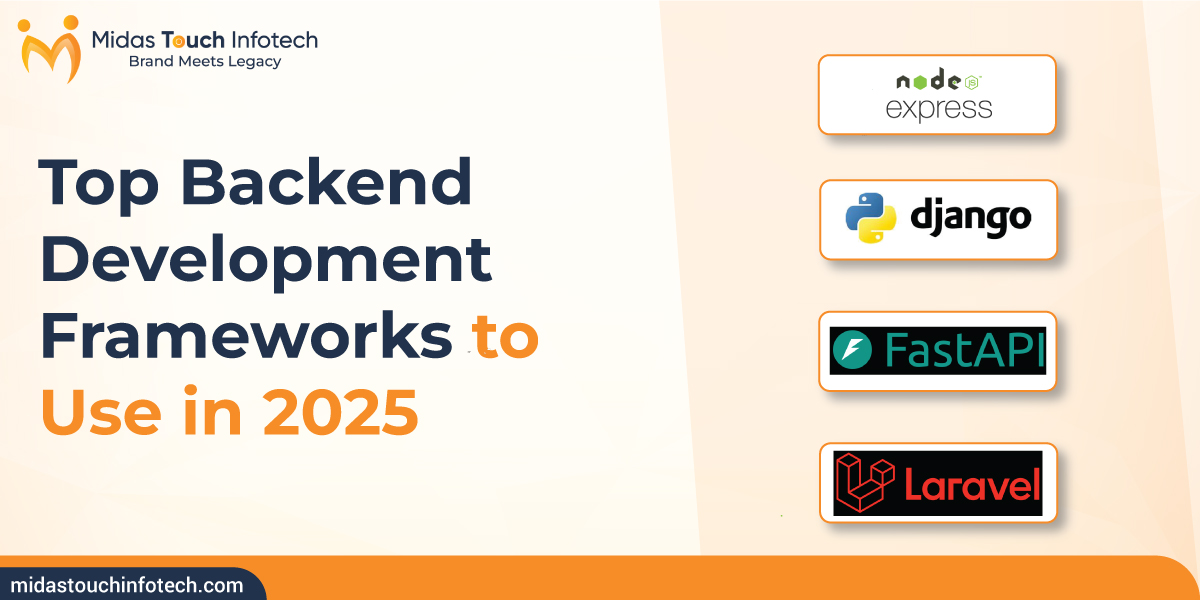
1) Node.js with Express
● Still one of the top backend frameworks for web development.
● Lightweight, fast, and powered by JavaScript (easy transition from frontend).
● Massive NPM ecosystem.
● Best for: APIs, real-time applications, and startups.
2) Django (Python)
● A batteries-included framework with authentication, ORM, and admin panel built-in.
● Trusted by companies like Instagram and Pinterest.
● Great for rapid development with strong security features.
● Best for: Enterprise apps, data-heavy platforms, and secure applications.
Also Read: Web Development for Startups: How to Build a Cost-Effective Website
3)FastAPI (Python)
● Modern, async, and lightning-fast.
● Ideal for APIs and machine learning-based apps.
● Comes with automatic documentation via Swagger/OpenAPI.
● Perfect for: AI-driven projects, APIs, and data science teams.
4)Laravel (PHP)
● Known for clean and expressive syntax.
● Still among the top 5 frameworks for web development globally in 2025.
● Ecosystem includes tools like Laravel Forge, Nova, and Vapor.
● Best for: Traditional web apps, CMS platforms, and eCommerce.
➥Top Full-Stack Frameworks in 2025
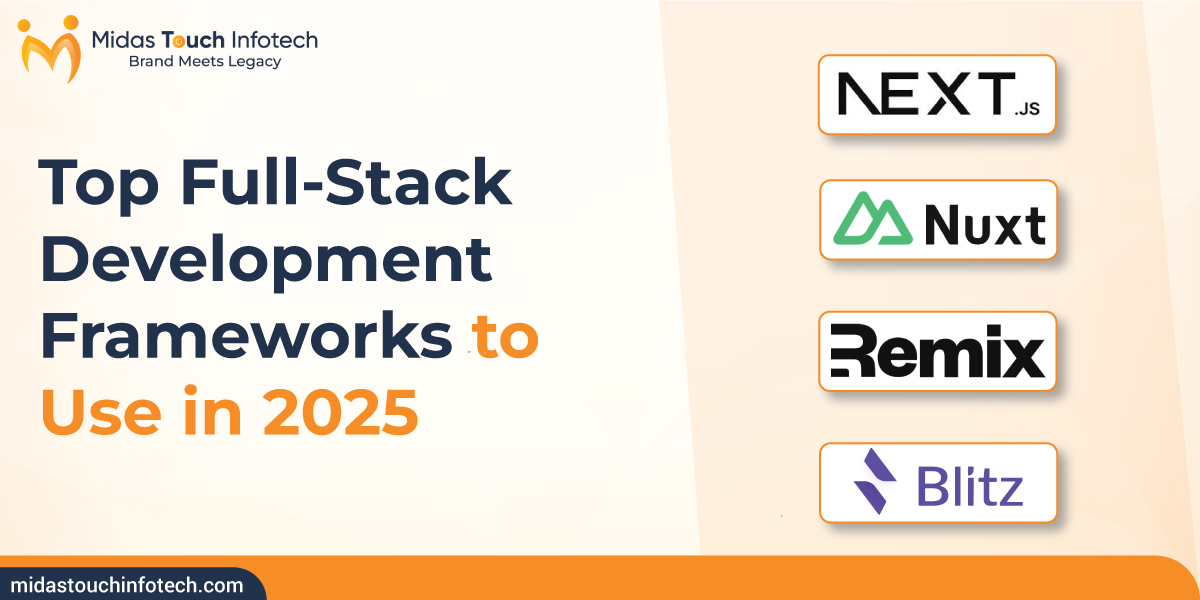
1) Next.js (React-based)
● The most popular full-stack framework in 2025.
● Offers server-side rendering (SSR) and static site generation (SSG).
● Provides API routes for backend logic.
● Best for: Scalable, SEO-friendly applications.
2) Nuxt 4 (Vue-based)
● Combines the power of Vue.js with SSR/SSG.
● File-based routing and improved performance.
● Great for: Vue fans building full-stack apps.
3) Remix
● Focuses on performance and web standards compliance.
● Provides server-rendered pages with client-side interactivity.
● Perfect for: Developers who value progressive enhancement.
4) Blitz.js
● Built on Next.js but includes a full-stack database layer.
● Designed for startups and MVPs needing rapid launches.
Emerging Frameworks to Watch
❑ Qwik – Prioritises instant loading by breaking code into small chunks.
❑ Bun – A new JavaScript runtime with a built-in bundler and test runner.
❑ RedwoodJS – Combines GraphQL, JAMstack, and React for modern app development.
These are not yet mainstream but could redefine the top frameworks for web development 2025.
Also Read: How AI in Web Development is Reducing Development Time and Costs
Which Framework Should You Learn First?
➤ For Frontend-Focused Beginners:
○ Start with React (most job demand) or Vue.js (easiest to learn).
➤ For Backend-Focused Beginners:
○ Node.js with Express if you know JavaScript.
○ Django or FastAPI if you prefer Python.
➤ For Full-Stack Beginners:
○ Next.js for modern app development.
○ Or combine Django + React for a robust setup.

Still Unsure Which Framework Fits Best? Let’s Simplify It Together
At the end of the day, there’s no universal “best” framework. The top web development frameworks change over time, but your goals remain the key decision point.
● Want to build interactive UIs? Pick React or Vue.
● Interested in backend APIs? Go with Node.js or FastAPI.
● Prefer a one-stop solution? Choose Next.js or Nuxt.
Whether you are seeking website development service providers or planning to learn frameworks yourself, remember this: technologies evolve, but core web development skills are timeless. Master the basics, experiment with the top 5 frameworks for web development, and adapt to industry shifts.
For businesses, having a responsive website is no longer optional—it directly impacts user experience, SEO, and customer trust. If you’re considering professional help, here are some of the key reasons to hire web development company to ensure your website stays modern, scalable, and competitive in today’s digital landscape.

Mit Thakkar
Mit Thakkar, CEO of Midas Touch Infotech and a recognized LinkedIn SEO influencer, possesses extensive expertise in branding, website development, and digital marketing. He excels in transforming ideas into impactful digital strategies.