Summarize this blog post with:


- Best GEO Tools for Tracking AI Search Visibility in 2026
- What Are GEO Tools?
- 🢧 Meaning of GEO Tools
- 🢧 How GEO Tools Are Different from Traditional SEO Tools
- Why AI Search Visibility Tracking Matters in 2026
- ➥ AI Search Is Changing Brand Discovery
- ➥ Google AI Overviews and AI Assistants Are Reshaping Search
- Key Features to Look for in the Best GEO Tools
- ✦ AI Search Visibility Tracking
- ✦ Citation Tracking
- ✦ Competitor Benchmarking
- ✦ Prompt-Level Analysis
- ✦ Reporting and Dashboards
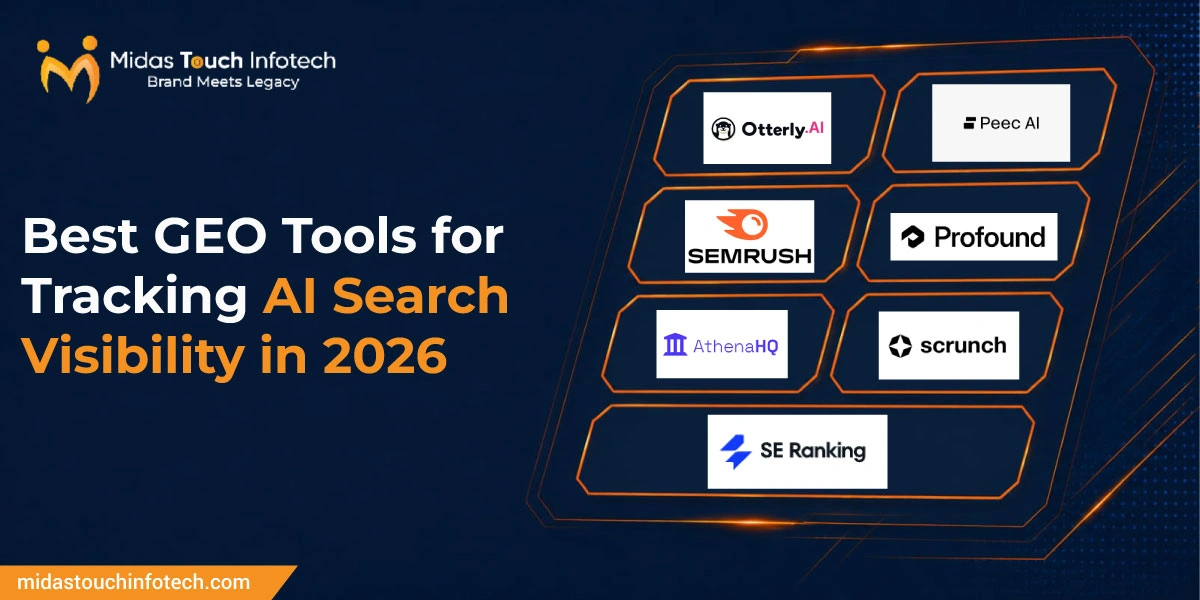
- Best GEO Tools for Tracking AI Search Visibility in 2026
- 1. OtterlyAI
- 2. Peec AI
- 3. Semrush
- 4. Profound
- 5. AthenaHQ
- 6. Scrunch AI
- 7. SE Ranking / SE Visible
- How to Choose the Right GEO Tool for Your Business
- ▶ For Startups
- ▶ For Agencies
- ▶ For Enterprises
- Ready to Track Your AI Search Visibility Smarter?
Best GEO Tools for Tracking AI Search Visibility in 2026
AI visibility is therefore becoming a measurable business priority. A 2026 study that issued 55,393 trending queries across 19 categories found that Google AI Overviews appeared for 13.7% of all queries and 64.7% of question-form queries. This shows how strongly conversational searches can trigger AI-generated results.However, GEO tools show whether a brand is mentioned, recommended, linked, or cited inside AI-generated answers. They also reveal which competitors are winning valuable customer prompts.
Regular measurement is essential because AI answers are not fixed. Responses may change when a prompt is reworded, submitted later, or tested on another platform. A 2026 paper found substantial citation variability across repeated samples from Perplexity, SearchGPT, and Gemini, concluding that single-run measurements can present a misleadingly precise picture of visibility using generative engine optimization services should therefore track a consistent prompt set over time.
Companies comparing GEO Agencies in India should also ask how an agency measures repeated responses, citations, competitors, and content gaps.
This guide explains the features that matter and reviews the best GEO tools 2026 teams can consider for tracking AI search visibility.
What Are GEO Tools?
🢧 Meaning of GEO Tools
GEO stands for Generative Engine Optimization. It is the practice of improving how clearly and frequently a brand, product, service, expert, or website appears in answers created by AI systems.
In simple words, generative engine optimization GEO tools help businesses understand what AI platforms know and say about them. Instead of showing only where a webpage ranks, they examine generated responses and identify brand mentions, cited sources, competitor references, sentiment, and prompt-level visibility.
GEO tools can help businesses:
» See whether their brand appears in AI-generated answers.
» Track visibility across major AI search platforms.
» Discover which pages and third-party sources are cited.
» Find questions where competitors appear but the brand does not.
» Improve content, authority signals, factual clarity, and citation potential.
» Measure changes after GEO campaigns or content updates.
The best generative engine optimization (GEO) tools connect visibility scores with the prompts, sources, topics, competitors, and content gaps behind the result.
🢧 How GEO Tools Are Different from Traditional SEO Tools
SEO tools and GEO tools support related goals, but they measure different discovery experiences.
Traditional SEO tools track:
✤ Keyword rankings, organic traffic, and clicks.
✤ Backlinks and referring domains.
✤ Technical and on-page SEO issues.
✤ Competitor rankings and content gaps.
GEO tools track:
✤ Brand mentions in generated answers.
✤ Website citations and linked sources.
✤ Prompt visibility and AI share of voice.
✤ Competitor recommendations and sentiment.
SEO focuses on earning positions in search results. GEO focuses on being understood, cited, and recommended in an AI answer. A complete strategy needs both because AI systems still use web content, brand authority, structured information, and sources influenced by strong SEO.
Why AI Search Visibility Tracking Matters in 2026
➥ AI Search Is Changing Brand Discovery
Buyers now use AI assistants for product research, vendor comparisons, recommendations, and shortlisting. An assistant can suggest several brands in one response without requiring the user to open multiple websites.
This creates important risks:
» A competitor may be recommended while your brand is absent.
» AI may describe your offer using old or incomplete information.
» Third-party sources may shape your positioning.
» Your site may rank organically but fail to earn an AI citation.
GEO tracking reveals which prompts mention the brand, which competitors dominate, and which sources influence recommendations. Teams can then improve service pages, product content, comparisons, FAQs, research, case studies, digital PR, and external brand signals.
The objective is not to manipulate AI answers. It is to make accurate, useful, well-supported information easier for systems and users to discover.
➥ Google AI Overviews and AI Assistants Are Reshaping Search
Google AI Overviews often appear above organic results, while ChatGPT, Perplexity, Gemini, and Google AI Mode are becoming key discovery channels. Strong SEO rankings may not guarantee visibility in AI-generated answers. Generative AI optimization services help brands improve mentions across AI summaries, comparisons, and recommendations.
Key Features to Look for in the Best GEO Tools
✦ AI Search Visibility Tracking
A capable platform should track brand mentions across the AI systems relevant to your audience. It should show whether the brand appears for priority prompts and whether visibility is improving.
Look for metrics such as:
✧ Mention frequency and average answer position.
✧ AI share of voice.
✧ Visibility by platform, topic, market, or product.
✧ Historical visibility trends.
Consistent scheduled tracking is more useful than a one-time audit because AI responses can vary.
Also Read : Top 13 GEO Agencies in India Helping Brands Rank in Generative Search
✦ Citation Tracking
A mention and a citation are different. AI may name a company without linking to it or cite a page without prominently mentioning the brand.
Citation reports should show:
✧ Which owned and third-party pages are cited.
✧ Which prompts trigger each citation.
✧ How citations change over time.
✧ Which competitor pages win the same topics.
✧ Where citation opportunities are missing.
This helps teams identify whether service pages, blogs, reports, documentation, media coverage, or other sources are driving visibility.
✦ Competitor Benchmarking
GEO performance needs context. A 20% mention rate may look positive until a competitor appears in 70% of the same answers.
Useful competitor analysis shows:
✧ Which competitors appear most often.
✧ Which prompts and topics they win.
✧ Comparative visibility or answer share.
✧ How AI describes each brand.
✧ Which sources support competitor mentions.
These insights help teams prioritise real gaps instead of creating content based on assumptions.
✦ Prompt-Level Analysis
AI search is conversational. Users add details about budget, industry, location, business size, use case, risk, and expected outcome.
Prompt-level analysis shows which buyer questions trigger a brand and which do not. It is valuable for B2B, SaaS, ecommerce, healthcare, finance, professional services, and local businesses. The best tools for generative engine optimization GEO should let teams group prompts by intent, funnel stage, audience, location, and product.
✦ Reporting and Dashboards
A good dashboard turns complex response data into clear actions. Marketing teams need weekly or monthly reports showing gains, losses, citation trends, competitor movement, and priority content gaps.
Agencies and larger companies should look for:
✧ Multi-brand tracking.
✧ Platform, topic, location, date, and competitor filters.
✧ Scheduled reports and exports.
✧ Client-ready dashboards and user permissions.
✧ Reporting or analytics integrations.
A generative engine optimization service can use these reports to show progress without relying only on referral traffic, which may not capture every AI-influenced interaction.
Best GEO Tools for Tracking AI Search Visibility in 2026
1. OtterlyAI

OtterlyAI is an AI search monitoring platform for brand mentions, website citations, prompt tracking, and competitor comparisons. Its official website says it monitors ChatGPT, Perplexity, Google AI Overviews, and AI Mode. Users create conversational prompt libraries and monitor which brands and sources appear over time. The prompt-library approach also helps teams repeat the same important searches and compare movement over time instead of relying on occasional manual checks.
Best for:
⚉ SEO teams.
⚉ Agencies.
⚉ Marketing teams.
⚉ Brands tracking AI mentions and citations.
2. Peec AI

Peec AI is an AI search analytics platform for marketing teams. It measures brand performance across ChatGPT, Perplexity, Gemini, Google AI Overviews, and AI Mode, including visibility, position, sentiment, competitor benchmarks, and cited sources. Position and sentiment metrics can also help marketers understand not only whether a brand appears, but how prominently and positively it is presented.
Best for:
⚉ Marketing and growth teams.
⚉ SaaS companies.
⚉ Brands focused on AI discovery.
⚉ Teams needing competitor analysis.
3. Semrush

Semrush combines traditional digital marketing features with AI visibility measurement. Its AI Visibility Toolkit helps marketers see how their brand and competitors appear in AI-generated answers. Semrush also supports SEO, content, PPC, social media, and broader online visibility workflows. This combined view can make it easier to compare conventional organic performance with emerging visibility across AI-generated results.
Best for:
⚉ SEO professionals.
⚉ Enterprises.
⚉ Digital agencies.
⚉ Existing Semrush users.
4. Profound

Profound is an AI visibility and answer engine optimisation platform. Its capabilities include visibility monitoring, source citations, brand sentiment, competitive benchmarking, and content optimisation insights. Its focus on citations, answer-engine visibility, and content opportunities can support teams that need deeper analysis than a basic brand-mention checker.
Best for:
⚉ Enterprise brands.
⚉ AI visibility teams.
⚉ Competitive intelligence teams.
⚉ Organisations requiring advanced reporting.
5. AthenaHQ

AthenaHQ is a GEO platform for tracking mentions and answer share while identifying content opportunities. Its materials describe visibility analytics, content-gap analysis, citation-focused recommendations, and AI-oriented content workflows.This can help reduce the gap between discovering a visibility problem and creating or improving the content needed to address it.
Best for:
⚉ B2B brands.
⚉ Content teams.
⚉ Growth marketers.
⚉ Teams seeking integrated GEO actions.
6. Scrunch AI

Scrunch AI helps brands monitor and improve their presence in AI search. Its platform covers citations, competitive blind spots, sentiment, and content gaps. It can detect missing or thin content for tracked prompts and help teams prioritise improvement opportunities. Its content-gap and competitor features can help teams connect brand perception issues with specific topics and pages that need attention.
Best for:
⚉ Brand teams.
⚉ Product marketing teams.
⚉ SaaS companies.
⚉ Teams focused on brand perception.
7. SE Ranking / SE Visible

SE Ranking’s AI Search Toolkit tracks mentions, website links, answer positions, competitors, and visibility trends across ChatGPT, Perplexity, Gemini, AI Mode, and Google AI Overviews. SE Visible provides a focused dashboard for visibility, sentiment, competitors, and important sources. Teams can use the toolkit for detailed prompt monitoring while using SE Visible for a simpler strategic view of brand performance.
Best for:
⚉ Small businesses.
⚉ SEO teams.
⚉ Agencies.
⚉ Mid-market brands.
Also Read : Best SEO Agency in Dubai for Startups, SMEs, and Enterprises
How to Choose the Right GEO Tool for Your Business
There is no universal winner among the best generative engine optimization GEO tools. The right choice depends on company size, target markets, prompt volume, platform coverage, reporting requirements, and who will act on the data.
Ask these questions before selecting a platform:
✦ Which AI platforms do our customers use?
✦ Which products, services, locations, and competitors must we track?
✦ How frequently should prompts be tested?
✦ Are citations, sentiment, share of voice, or content gaps most important?
✦ Do we need exports, integrations, permissions, or client reporting?
✦ Does the tool provide actions as well as measurements?
Testing shortlisted platforms with real customer prompts is more reliable than choosing only from a feature list.
During a trial, review more than the headline visibility score. Check whether the tool captures the platforms, countries, languages, and prompt types that matter to your customers. Inspect the underlying answer text and cited URLs, confirm that competitor names are identified correctly, and test how easily the data can be exported or shared.
The most useful platform is the one your team can operate consistently and translate into clear content, SEO, PR, and brand actions.
▶ For Startups
Choose an affordable tool that is easy to configure. Begin with high-intent prompts covering product categories, problems, use cases, alternatives, and comparisons.
Focus on:
✦ Commercial brand mentions.
✦ Competitor gaps.
✦ Incorrect descriptions.
✦ Cited pages and third-party sources.
✦ Prompts connected to revenue opportunities.
A small, consistent prompt set is more useful than tracking thousands of low-value questions.
▶ For Agencies
Agencies should prioritise multiple-brand management, separate prompt libraries, competitor groups, scheduled reports, exports, and client-friendly dashboards.
Businesses searching for the best GEO agency should review more than the agency’s software. They should examine its prompt methodology, content strategy, SEO knowledge, digital PR capability, implementation process, and reporting standards. Good providers combine reliable evidence with practical action.
▶ For Enterprises
Enterprises need large prompt capacity, multi-market tracking, governance, sentiment analysis, source intelligence, competitive answer share, integrations, and custom reporting.
Enterprises comparing platforms or the best GEO SEO company should also ask how data quality is handled. Because AI responses vary, reporting should use repeated measurements and avoid treating small single-run changes as definite trends.
Ready to Track Your AI Search Visibility Smarter?
AI answers now influence brand discovery, research, vendor comparisons, and buying decisions. Businesses can no longer evaluate visibility only through organic rankings and website traffic.
The best GEO agency monitor mentions, citations, prompt performance, competitors, sentiment, and answer share. A startup may need simple prompt tracking. An agency may require multi-client reporting. An enterprise may need source intelligence, international coverage, and governance.
SEO teams should not wait for traffic to fall before monitoring AI discovery. In 2026, geo optimization tools should sit alongside technical SEO, useful content, trustworthy third-party coverage, and accurate brand information.
A tool identifies the opportunity, but execution creates progress. Sustainable AI visibility comes from relevance, authority, clarity, strong sources, and genuine value for users.

Mit Thakkar
Mit Thakkar, CEO of Midas Touch Infotech and a recognized LinkedIn SEO influencer, possesses extensive expertise in branding, website development, and digital marketing. He excels in transforming ideas into impactful digital strategies.