
Summarize this blog post with:


- Web Design Cost in USA: Ecommerce, Corporate and Small Business Websites
- Why Professional Web Design Matters for US Businesses
- Website Design Cost Breakdown in the USA
- ▶ UI/UX Design Cost
- ▶ Website Development Cost
- ▶ Content and SEO Costs
- ▶ Website Maintenance and Support Cost
- Ecommerce Website Design Cost in the USA
- ➥ Understanding Ecommerce Website Requirements
- ➥ Essential Features of Ecommerce Websites
- Corporate Website Design Cost in the USA
- ➥ Why Corporate Websites Require a Strategic Approach
- ➥ Key Features of Corporate Websites
- Web Design Cost for Small Business Websites in the USA
- ☸ Understanding Small Business Website Requirements
- ☸ Essential Features for Small Business Websites
- How to Choose the Right Web Design Approach for Your Business
- ➥ Define Your Business Goals
- ➥ Select the Right Development Partner
- ➥ Focus on Long-Term Website Performance
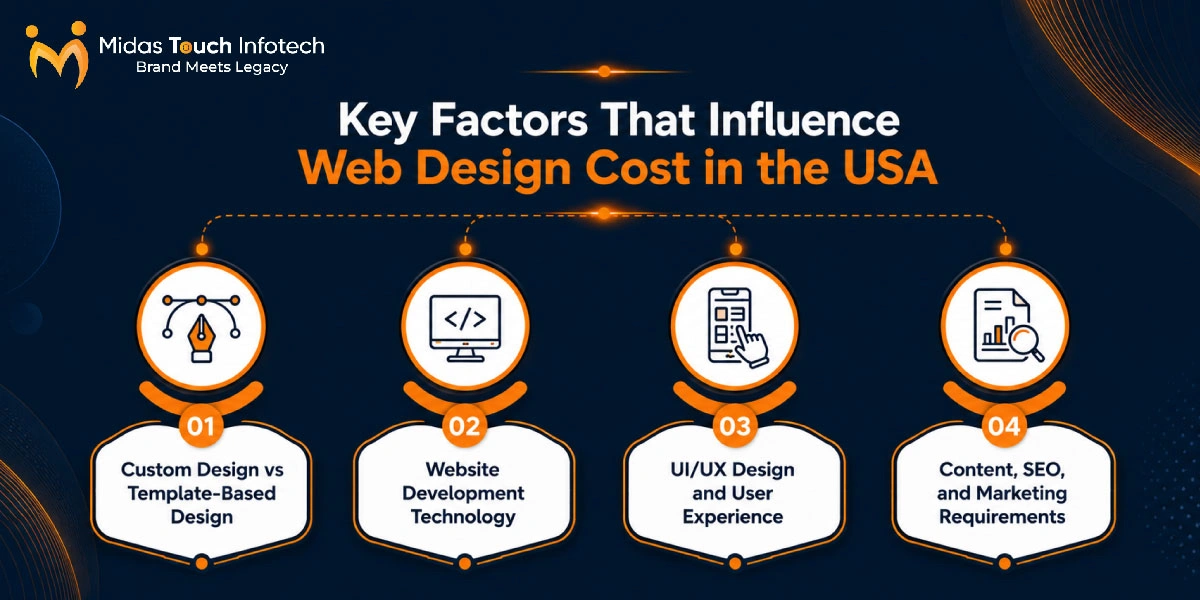
- Key Factors That Influence Web Design Cost in the USA
- ❏ Custom Design vs Template-Based Design
- ❏ Website Development Technology
- ❏ UI/UX Design and User Experience
- ❏ Content, SEO, and Marketing Requirements
- Ready to Choose the Web Design Solution for Your Business?
Web Design Cost in USA: Ecommerce, Corporate and Small Business Websites
A professionally designed website is no longer simply an online brochure. For businesses in the United States, it can function as a sales channel, lead-generation platform, customer support resource, brand credibility tool, and central point for digital marketing. Whether a company sells products online, provides professional services, or operates across multiple locations, the quality of its website can directly influence how potential customers perceive the business.
The investment required to create that website, however, varies considerably. According to Clutch’s July 2026 Web Design Pricing Guide, web design agency projects can range from approximately $2,000 to $100,000 – a cost difference of up to 4,900%, depending on project size, design complexity, functionality, and provider. Clutch also reports that most web design projects reviewed on its platform cost less than $10,000, while the average project value across its reviewed data was about $38,105. Web design companies listed on the platform commonly charge around $100 to $149 per hour.
This wide range shows why businesses should not evaluate web design cost through one universal figure.
A five-page website for a local consultancy has very different requirements from an ecommerce platform containing hundreds of products or a corporate website requiring custom integrations, multilingual content, advanced analytics, and multiple stakeholder approvals.
Businesses looking for the best web design services should therefore focus on what is included in the investment rather than choosing a provider based entirely on the lowest quotation.
Design complexity, functionality, content requirements, technology, SEO, integrations, scalability, and long-term business goals can all influence the final cost of web design.
This guide explains the main factors affecting the web design price in USA, along with the requirements and likely investment considerations for ecommerce, corporate, and small business websites.
Why Professional Web Design Matters for US Businesses
Your website is often one of the first places prospective customers interact with your company. A poorly organised or outdated website can create uncertainty, while a professional experience can communicate credibility before a visitor ever contacts your sales team.
Professional web design matters because it helps businesses create a strong first impression.
Visual consistency, typography, navigation, imagery, page structure, and messaging all contribute to how visitors perceive a brand. A website should immediately communicate what the company offers, who it serves, and what users should do next.
Professional design also builds customer trust and credibility. Secure browsing, clear contact information, transparent content, logical navigation, customer testimonials, case studies, and consistent branding can make visitors more comfortable interacting with the business.
User experience is equally important. Visitors should be able to move from information to action without unnecessary friction.
Professional websites therefore focus on:
✧ Clear navigation
✧ Responsive layouts
✧ Fast-loading pages
✧ Accessible content
✧ Logical calls to action
✧ Mobile usability
✧ Consistent branding
✧ Conversion-focused user journeys
Good design also supports SEO. Search-friendly architecture, mobile responsiveness, content hierarchy, internal linking, technical optimisation, and performance can make it easier for search engines to discover and understand important pages.
For businesses choosing a web design company, design should therefore be viewed as a combination of appearance, usability, performance, marketing, and business strategy.

Website Design Cost Breakdown in the USA
▶ UI/UX Design Cost
UI and UX design determine how the website looks and how users interact with it.
This phase may include:
» Wireframing:
Designers at web design firms create structural layouts that define the placement of page elements, navigation, content, calls to action, and key features.
» User research:
For larger projects, research may involve customer profiles, user behaviour, competitor analysis, usability expectations, and customer journey mapping.
» Visual design:
The design team creates colours, typography, imagery, icons, page components, layouts, and visual systems aligned with the company’s branding.
» User experience optimisation:
Designers consider how easily visitors can complete important actions such as requesting a quote, purchasing a product, submitting a form, or locating information.
More research, custom layouts, prototypes, revisions, and user journeys generally increase the custom web design cost.
▶ Website Development Cost
Once the designs are approved, developers transform them into a functional website.
Development costs may include:
» Frontend development
» Backend development
» Content management system integration
» Database development
» Forms
» APIs
» CRM integrations
» Ecommerce functionality
» Custom calculators
» Membership functionality
» Third-party integrations
A simple informational website using an established CMS normally requires less development than a custom platform.
The technology also matters. The wordpress web design cost, for example, can vary significantly depending on whether the project uses an existing theme, customised theme, custom WordPress design, specialised plugins, WooCommerce, or custom functionality.
▶ Content and SEO Costs
A beautiful website still needs strong content.
Depending on the project, content-related expenses may include:
» Website copywriting
» Keyword research
» On-page SEO
» Page titles and meta descriptions
» Product descriptions
» Service page content
» Image optimisation
» Internal linking
» Technical SEO setup
» Conversion-focused copy
» Content migration
Businesses should confirm whether these activities are included when comparing the cost of web design services.
A lower design quote may appear attractive until the company discovers that content creation, SEO, image preparation, redirects, analytics, and migration are charged separately.
▶ Website Maintenance and Support Cost
Website expenditure does not necessarily end at launch.
Ongoing costs may include:
» CMS updates
» Plugin updates
» Security monitoring
» Backups
» Hosting
» Technical support
» Performance improvements
» Content updates
» Bug fixes
» New functionality
WordPress hosting may range roughly from $5 to $100 per month, while maintenance covering activities such as backups, security, and plugin updates may add recurring costs.
Businesses should therefore consider both initial development and long-term ownership costs.
Also Read : Top 11 Web Design Agency in Dubai to Choose for Your Next Project
Ecommerce Website Design Cost in the USA
Ecommerce websites typically require more planning and functionality than informational websites because visitors must be able to discover products, evaluate options, make payments, and manage transactions securely.
Most standard ecommerce projects may fall below $10,000, although complex ecommerce solutions can require substantially larger investments.
➥ Understanding Ecommerce Website Requirements
A successful ecommerce website needs to make purchasing simple.
The design should guide visitors smoothly through the following journey:
Product discovery → Product evaluation → Cart → Checkout → Payment → Confirmation
Poor navigation, confusing filters, weak product information, or complicated checkout experiences can create unnecessary barriers.
Scalability is another major consideration.
A business launching with 30 products may eventually manage hundreds or thousands. The selected ecommerce platform, information architecture, search functionality, inventory system, and integrations should support that growth.
➥ Essential Features of Ecommerce Websites
Common ecommerce requirements include:
❖ Product catalogue management
❖ Shopping cart functionality
❖ Secure payment gateway integration
❖ Customer accounts
❖ Product search
❖ Category navigation
❖ Product filtering
❖ Reviews and ratings
❖ Inventory management
❖ Shipping calculations
❖ Order notifications
❖ Discount codes
❖ Analytics tracking
Additional integrations with ERP, CRM, warehouses, accounting software, marketplaces, subscription systems, or marketing platforms can increase development complexity.
As a practical planning approach, a relatively straightforward ecommerce website may sit toward the lower end of professional agency pricing, whereas extensively customised ecommerce experiences can move into tens of thousands of dollars.
Businesses should obtain a scope-based quotation rather than selecting an ecommerce platform solely around an advertised starting price.
Corporate Website Design Cost in the USA
Corporate websites usually have different priorities from ecommerce websites.
Instead of supporting direct product transactions, they may need to communicate brand positioning, explain complex services, support lead generation, provide investor or stakeholder information, publish resources, and integrate with enterprise systems.
➥ Why Corporate Websites Require a Strategic Approach
Corporate websites frequently serve several audiences simultaneously.
These can include:
✧ Prospective customers
✧ Existing customers
✧ Employees
✧ Job candidates
✧ Investors
✧ Partners
✧ Media
✧ Industry stakeholders
The website therefore needs a clear information architecture that enables different visitors to reach relevant information quickly.
A corporate project may also require multiple design concepts, stakeholder approvals, content migration, accessibility considerations, custom components, analytics setup, CRM integration, advanced forms, and stronger governance.
These requirements can increase the overall professional web design cost.
➥ Key Features of Corporate Websites
Common corporate website requirements include:
✧ Custom UI/UX design
✧ Company profile pages
✧ Service and solution pages
✧ Industry pages
✧ Case studies
✧ Portfolio sections
✧ Leadership profiles
✧ Blog and resource centres
✧Lead-generation forms
✧ Careers sections
✧ CRM integration
✧ Analytics integration
✧ Marketing automation
✧ Multilingual functionality
Corporate projects should be budgeted according to their actual scope.
A moderately sized marketing website and a global enterprise platform cannot be evaluated under the same pricing model. Custom projects involving extensive strategy, UX, integrations, and development can extend well beyond basic website-design budgets.
Web Design Cost for Small Business Websites in the USA
For small companies, the goal is usually to establish professional visibility without adding unnecessary technical complexity.
The web design cost for small business can therefore be more manageable than large corporate or ecommerce projects.
Professional website design for a small business may start around $1,500, while costs can increase substantially when businesses need custom design, integrations, advanced functionality, or larger websites.
☸ Understanding Small Business Website Requirements
A small business website often needs to answer a few important questions immediately:
❖ Who are you?
❖ What services do you provide?
❖ Where do you operate?
❖ Why should customers choose you?
❖ How can someone contact you?
Local businesses, consultants, contractors, healthcare providers, professional services organisations, and other small companies generally benefit more from a focused, conversion-friendly website than from unnecessary advanced features.
☸ Essential Features for Small Business Websites
Common requirements include:
❖ Responsive website design
❖ Homepage
❖ About page
❖ Service or product pages
❖ Contact forms
❖ Phone and email links
❖ Google Maps integration
❖ Customer testimonials
❖ Social media integration
❖ Basic analytics
❖ Local SEO foundations
❖ SSL security
❖ CMS functionality
A small business using a professionally customised template may spend considerably less than one requiring completely bespoke layouts, advanced booking systems, multiple locations, customer portals, or integrations.
The right budget should reflect the website’s role in generating leads and supporting business growth.
How to Choose the Right Web Design Approach for Your Business
Price should be important, but it should not be the only consideration.
➥ Define Your Business Goals
Start by identifying exactly what the website needs to achieve.
For example:
➔ Generate leads
➔ Sell products
➔ Increase enquiries
➔ Build credibility
➔ Support recruitment
➔ Educate customers
➔ Enter new markets
➔ Improve organic visibility
Clear objectives help determine the functionality required and prevent unnecessary expenditure.
Also Read : Best Web Design Agencies in California in 2026
➥ Select the Right Development Partner
When selecting a professional website design company, review more than visual portfolios.
Evaluate:
➔ Relevant industry experience
➔ UX capabilities
➔ Development expertise
➔ SEO knowledge
➔ Project process
➔ Communication
➔ Testing approach
➔ Support options
➔ Case studies
➔ Previous results
The cheapest provider does not necessarily offer the lowest long-term cost of web design.
Poor development can later require redesigns, technical repairs, SEO corrections, or expensive platform migrations.
➥ Focus on Long-Term Website Performance
Your website should continue supporting the business after launch.
Ask whether the chosen solution can:
➔ Scale with traffic
➔ Support new pages
➔ Add integrations
➔ Maintain strong performance
➔ Remain secure
➔ Support SEO
➔ Adapt to changing business requirements
A slightly higher initial investment can sometimes reduce future redevelopment costs.
Key Factors That Influence Web Design Cost in the USA
Several variables can significantly affect the final project quotation.
❏ Custom Design vs Template-Based Design
Template websites usually require less design and development time.
Custom websites require designers and developers to create layouts, components, interactions, and experiences around specific business requirements.
As a result, custom web design cost is generally higher, but customisation can provide greater branding flexibility and support more specialised customer journeys.
❏ Website Development Technology
Technology decisions affect both upfront and ongoing expenditure.
Common options include:
∘ WordPress
∘ Shopify
∘ Webflow
∘ WooCommerce
∘ Custom frameworks
∘ Headless CMS platforms
∘ Enterprise content management systems
Businesses should select technology based on requirements rather than trends.
❏ UI/UX Design and User Experience
More detailed UX research, wireframes, prototypes, usability testing, custom interactions, and responsive variations require additional time.
However, good UX should be treated as an investment because it influences how effectively visitors interact with the website.
❏ Content, SEO, and Marketing Requirements
Website pricing also increases when projects include:
∘ SEO research
∘ Professional copywriting
∘ Content strategy
∘ Graphic design
∘ Video production
∘ Photography
∘ Landing pages
∘ Analytics
∘ Conversion tracking
∘ CRM integration
When comparing the web design price in USA, businesses should request itemised proposals so they understand exactly what services are included.
Ready to Choose the Web Design Solution for Your Business?
Choosing the right web design solution starts with understanding your business goals, target audience, required features, and long-term growth plans. Ecommerce, corporate, and small business websites all have different design and development requirements, so the right approach should be based on functionality, scalability, and user experience.
Working with the best web design company can help you plan a website that supports your brand, improves usability, and delivers better business results. A professional team can guide you through design, development, SEO, content, integrations, and performance optimisation based on your specific requirements.
Whether you need an ecommerce store, corporate website, or small business website, investing in a scalable and user-focused solution can create stronger digital visibility and long-term value. The right website should not only look professional but also support lead generation, customer engagement, conversions, and future business growth.

Mit Thakkar
Mit Thakkar, CEO of Midas Touch Infotech and a recognized LinkedIn SEO influencer, possesses extensive expertise in branding, website development, and digital marketing. He excels in transforming ideas into impactful digital strategies.