Summarize this blog post with:


Quick Summary
Discover the key differences between AEO vs GEO and learn which AI search optimisation strategy B2B companies should prioritise in 2027. AEO focuses on providing clear answers to user queries, while GEO improves brand visibility and credibility across AI platforms like ChatGPT, Gemini and Perplexity.
This guide explores the benefits of AEO and GEO, when to prioritise each strategy, and how combining SEO, AEO and GEO can improve AI search visibility, strengthen brand authority and generate qualified B2B leads in 2027.
- Key Takeaways
- AEO vs GEO: Which Strategy Should B2B Companies Prioritise in 2027?
- What Is Answer Engine Optimisation (AEO)?
- How Does AEO Work?
- What Is Generative Engine Optimisation (GEO)?
- How Does GEO Work?
- AEO vs GEO: What Are the Key Differences?
- 1. Main Objectives
- 2. Target AI Platforms
- 3. Content Optimisation Methods
- 4. Brand Authority and Visibility
- 5. Performance Metrics
- 6. B2B Business Benefits
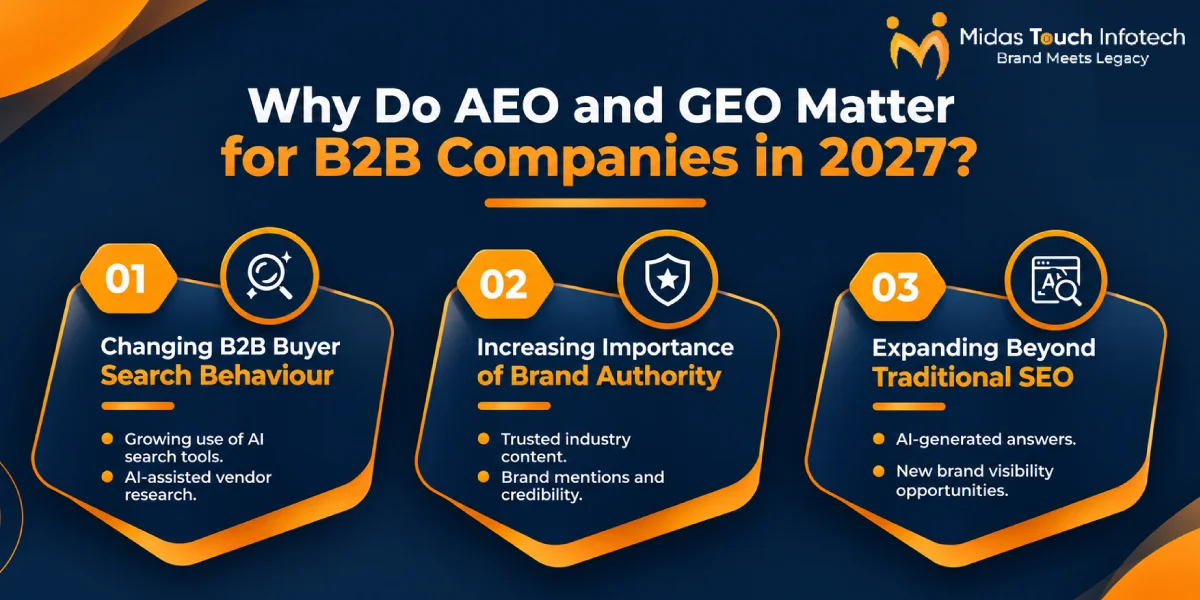
- Why Do AEO and GEO Matter for B2B Companies in 2027?
- ✯ Changing B2B Buyer Search Behaviour
- ✯ Increasing Importance of Brand Authority
- ✯ Expanding Beyond Traditional SEO
- AEO vs GEO: Which Should B2B Companies Prioritise?
- When Should You Prioritise AEO?
- When Should You Prioritise GEO?
- Why Should B2B Companies Combine AEO and GEO?
- How to Build a Successful AEO and GEO Strategy for B2B Companies
- Step 1: Understand Your Target Audience
- Step 2: Optimise Content for AI Search
- Step 3: Build Brand Authority
- Step 4: Improve AI Platform Visibility
- Step 5: Measure AEO and GEO Performance
- What Is the Future of AEO and GEO for B2B Marketing?
- 1. Greater Adoption of AI-Powered Search
- 2. Higher Value for Authoritative Content
- 3. Closer Integration of SEO, AEO and GEO
- 4. More Focus on AI-Driven Lead Generation
- 5. Continuous Optimisation Will Become Essential
- Ready to Improve Your B2B Visibility with AEO and GEO?
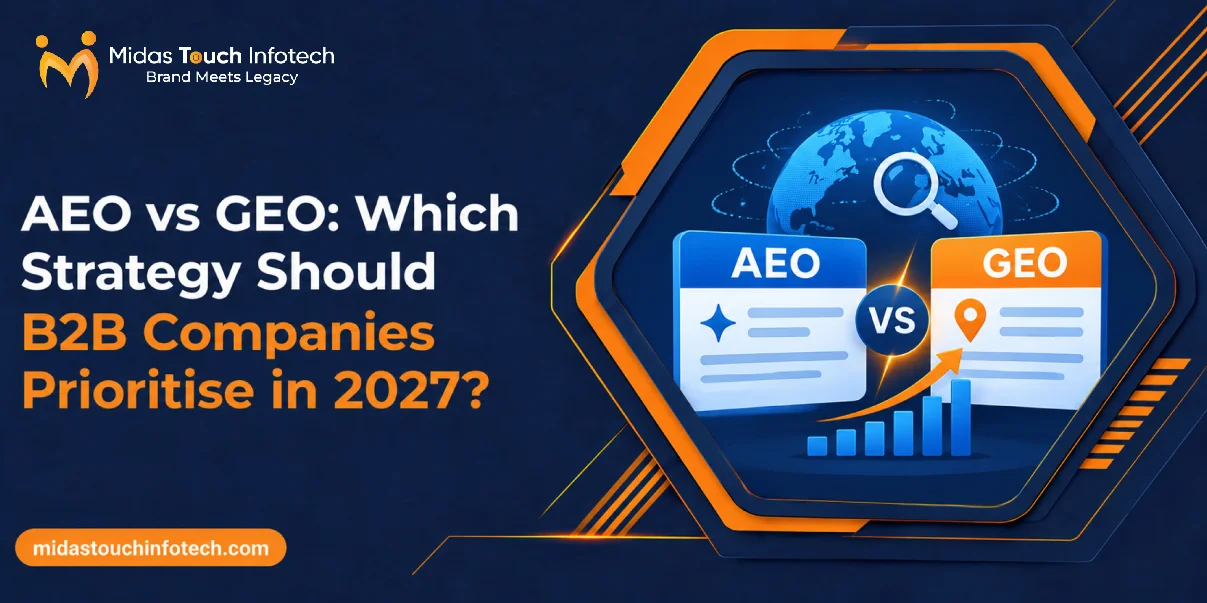
AEO vs GEO: Which Strategy Should B2B Companies Prioritise in 2027?
The way B2B buyers search for information, evaluate vendors and make purchasing decisions is changing rapidly. Traditional search engines are no longer the only platforms businesses rely on to discover products and services. AI-powered platforms such as ChatGPT, Google Gemini, Perplexity and Google AI Overviews are becoming important sources of business information. As a result, companies must rethink their digital marketing strategies to stay visible throughout the buyer’s journey.
According to a 2026 Semrush B2B AI research survey, 66% of surveyed B2B professionals who use AI for work regularly use it to research products, vendors or business solutions. This highlights how AI is influencing business research and creating new opportunities for companies to connect with potential customers.
For businesses looking to adapt, investing in answer engine optimization services can help make website content clearer, more structured and suitable for direct AI-powered answers. At the same time, Generative Engine Optimisation (GEO) focuses on improving brand visibility and authority within AI-generated recommendations and responses.
Although both approaches support AI search visibility, they have different objectives and optimisation methods. Understanding AEO vs GEO is becoming essential for B2B companies that want to remain competitive.
In 2027, businesses should focus on combining both strategies rather than treating them as separate marketing investments. An integrated approach can improve content discoverability, establish brand credibility and create more opportunities to attract qualified B2B leads.
What Is Answer Engine Optimisation (AEO)?
Answer Engine Optimisation (AEO) is the process of optimising website content so search engines and AI-powered platforms can understand, retrieve and potentially present it as a direct answer to user questions.
Unlike traditional SEO, which primarily focuses on improving website rankings and organic traffic, AEO places greater emphasis on answering specific questions accurately and clearly.
For example, when a business owner searches for “What is the cost of ERP implementation?”, an AI-powered search experience may provide a direct explanation with information gathered from relevant sources.
If your website offers a clear, useful and well-organised explanation, it may become one of the sources considered for that response.
For B2B businesses, AEO offers several advantages:
- Improved answer visibility: Helps useful content become easier for answer systems to identify.
- Better customer experience: Gives potential buyers quick access to relevant information.
- Stronger subject expertise: Demonstrates knowledge through accurate explanations.
- Relevant website traffic: Encourages interested buyers to explore detailed content.
- Buyer journey support: Addresses questions during research and evaluation.
AEO is particularly valuable for companies offering complex services where customers need detailed information before contacting a provider.
How Does AEO Work?
AEO works by making content easy for users and machine-powered systems to interpret.
Businesses can improve their AEO readiness through several methods.
1. Question-Based Content
Create content around questions buyers commonly ask during their research.
Examples include:
- What is cloud migration?
- How much does software testing cost?
- What are the benefits of AI automation?
- How do managed IT services work?
Providing direct answers helps visitors understand your services without searching through lengthy explanations.
2. Clear and Structured Answers
Use descriptive headings, short paragraphs and straightforward explanations.
Place the most relevant answer near the beginning of each section before expanding on supporting details.
This structure can improve readability for both users and automated retrieval systems.
3. Relevant Schema Markup
Structured data helps eligible search engines understand certain details about website content.
Businesses can implement suitable schema types, such as Organization, Article, Product and Service, where appropriate and supported.
However, schema markup does not guarantee that content will appear in AI-generated answers. Google’s guidance confirms that its AI search features do not require special additional markup beyond established SEO practices.
4. Content Accuracy and Relevance
Review website content regularly to maintain accurate information, updated service descriptions and relevant examples. Clear, useful content provides a stronger foundation for answer engine visibility.
Also Read: Complete List of Digital Marketing Services Every Business Should Know in 2027
What Is Generative Engine Optimisation (GEO)?
Generative Engine Optimisation (GEO) focuses on improving how a brand, website or business is represented in AI-generated search responses.
While AEO concentrates on providing direct answers, GEO focuses more broadly on building a brand’s discoverability, relevance and credibility within generative AI search experiences.
For example, a CTO might ask an AI platform:
“Which companies provide enterprise cloud migration services for Australian businesses?”
Rather than presenting a traditional list of websites, the AI platform may generate recommendations, compare providers and explain their capabilities.
GEO aims to increase the likelihood that a business is accurately represented when AI systems generate relevant responses.
The strategy involves creating useful content, establishing industry expertise and strengthening a brand’s presence across credible digital sources.
For B2B organisations, GEO can support:
- Greater brand visibility in AI-generated recommendations.
- Stronger recognition within a specialised industry.
- Improved credibility through independent references.
- More opportunities to appear in vendor comparisons.
- Better engagement with buyers researching complex solutions.
GEO is especially important for B2B companies competing in industries where purchasing decisions involve significant investments, multiple stakeholders and detailed vendor evaluations.
How Does GEO Work?
GEO involves building a strong digital presence that AI-powered platforms may discover and reference when generating responses.
1. Expert-Led Content
- Publishing accurate, detailed content demonstrates industry knowledge.
- Businesses can strengthen their content by including:
- Expert opinions and technical insights.
- Real-world business examples.
- Detailed product or service comparisons.
- Practical implementation guidance.
For example, a cybersecurity provider could publish an article explaining how businesses should evaluate managed security service providers.
This gives potential customers useful information while demonstrating the provider’s expertise.
2. Brand Mentions and Citations
Independent mentions can help buyers and AI systems discover information about a business.
Relevant opportunities include:
- Industry publications.
- Professional directories.
- Expert interviews.
- Industry association websites.
- Reputable comparison platforms.
These references should be accurate and earned through genuine expertise rather than artificial link-building or promotional tactics.
3. Original Research and Industry Insights
Original information can make content more distinctive and valuable.
B2B companies can publish:
- Industry surveys.
- Market research reports.
- Customer success stories.
- Benchmarking studies.
- Original data and performance insights.
For example, a software testing company publishing research about application performance challenges may create a valuable resource for buyers researching testing strategies.
However, inclusion in AI answers is not guaranteed. GEO helps strengthen the quality and visibility of the information available about a business.
AEO vs GEO: What Are the Key Differences?
Understanding the aeo vs geo difference is important for businesses planning their AI search marketing investments.
Although both strategies aim to improve visibility, they approach AI-powered search from different perspectives.
1. Main Objectives
AEO focuses on helping search and answer systems identify clear responses to specific questions.
GEO focuses on improving how a company is discovered, described and potentially referenced in generative AI responses.
For example:
- AEO: Answering “What is robotic process automation?”
- GEO: Building visibility for “Leading robotic process automation providers for enterprises.”
Both objectives are valuable, but they support different stages of the buyer’s research journey.
2. Target AI Platforms
AEO commonly targets answer-oriented search experiences, including Google AI Overviews and AI assistants that provide concise explanations.
GEO also considers broader generative AI platforms such as ChatGPT, Gemini, Perplexity and Microsoft Copilot.
However, these platforms are not exclusive to either strategy. The same well-optimised content may support both AEO and GEO.
An experienced answer engine optimization agency can help businesses evaluate where their audiences search and develop an appropriate content strategy.
3. Content Optimisation Methods
AEO usually prioritises:
- Question-based headings.
- Concise explanations.
- Logical content structures.
- Suitable schema markup.
- Search intent alignment.
GEO places greater emphasis on:
- Original research.
- Industry expertise.
- Brand mentions.
- Independent citations.
- Detailed comparisons and insights.
For many businesses, these practices overlap and should work together.
4. Brand Authority and Visibility
AEO can make individual pages more useful for answering specific search queries.
GEO takes a broader perspective by strengthening the brand’s identity and reputation across relevant digital sources.
For example, AEO may help a cloud consulting company’s article explain different cloud migration models.
GEO may support the same company’s presence when AI systems discuss cloud migration vendors or compare their capabilities.
5. Performance Metrics
AEO and GEO also require different measurement approaches.
AEO performance may involve monitoring:
- Organic impressions and clicks.
- Visibility for question-based searches.
- Engagement with informational pages.
- Search referrals and conversions.
GEO performance may involve monitoring:
- Brand mentions in AI responses.
- Citations and source references.
- Accuracy of AI-generated brand descriptions.
- AI platform referral traffic.
- Qualified leads influenced by AI search.
Because AI systems generate dynamic responses, businesses should evaluate performance across multiple prompts and over time.
6. B2B Business Benefits
AEO helps businesses communicate solutions clearly and attract users who need specific information.
GEO helps strengthen brand discovery and credibility during vendor research.
The practical aeo vs geo optimization for ai search decision should therefore depend on whether a company needs stronger informational visibility, greater brand recognition or both.
For B2B organisations, combining the two approaches is generally more effective than treating them as competing strategies.
Why Do AEO and GEO Matter for B2B Companies in 2027?
AI-powered search is changing how businesses discover information, compare services and develop vendor shortlists.
For B2B marketers, this shift creates opportunities to influence purchasing decisions before buyers visit a website or contact a sales representative.
✯ Changing B2B Buyer Search Behaviour
Traditional B2B research often involves searching Google, comparing websites, downloading reports and contacting vendors.
AI tools are changing this process by helping buyers summarise complex information and compare possible solutions.
For example, a business leader evaluating CRM software may ask an AI platform to compare Salesforce and Microsoft Dynamics 365 based on integration requirements, costs and implementation complexity.
The platform may provide an overview without requiring the buyer to visit multiple websites immediately.
According to Gartner’s May 2026 B2B buyer survey, 45% of surveyed B2B buyers used generative AI during a recent purchase, primarily to research vendors and products.
This growing adoption makes AI search visibility an important consideration for businesses preparing their 2027 marketing strategies.
✯ Increasing Importance of Brand Authority
B2B purchasing decisions often involve high budgets, long sales cycles and multiple decision-makers.
Customers want evidence that a provider understands their industry and can deliver reliable solutions.
AI-generated recommendations may introduce buyers to potential vendors, but they do not replace independent verification.
Brand authority can be strengthened through:
- Expert-written industry content.
- Verified customer testimonials.
- Detailed case studies.
- Independent media coverage.
- Relevant professional certifications.
- Consistent business information.
The stronger and more credible a company’s digital presence, the easier it becomes for customers to evaluate its capabilities.
✯ Expanding Beyond Traditional SEO
Traditional SEO remains essential for helping businesses improve search visibility and attract relevant website visitors.
However, the growing use of AI-generated answers means companies should also consider how their content appears within AI-powered experiences.
A business may rank well for certain keywords but still have limited visibility in AI-generated vendor recommendations.
Similarly, a brand may receive mentions in AI responses without generating immediate website clicks.
This is why businesses should evaluate the aeo vs geo ai search optimization difference alongside traditional SEO performance.
An integrated approach helps companies address informational searches, brand discovery and commercial research more effectively.
AEO vs GEO: Which Should B2B Companies Prioritise?
Choosing between AEO and GEO depends on your business objectives, target audience, content maturity and current digital presence.
Some businesses need to improve the quality of their informational content, while others need stronger brand recognition across AI search platforms.
Understanding these priorities can help B2B companies allocate their marketing resources more effectively.
When Should You Prioritise AEO?
AEO should be a priority when your business wants to answer common customer questions and improve the discoverability of informational content.
It is particularly useful for businesses offering technical services that require detailed explanations.
Consider prioritising AEO when:
- Targeting informational searches: Your customers regularly search for definitions, benefits, processes and pricing information.
- Improving service pages: Your website needs clearer service descriptions and structured explanations.
- Answering buyer questions: Potential customers require detailed information before requesting a consultation.
- Supporting early research: You want to attract buyers who are still exploring available solutions.
- Improving content clarity: Your existing content lacks organised headings and direct answers.
For example, an IT consulting company could optimise content around “How much does cloud migration cost?” or “What are the benefits of managed IT services?”
These topics address specific customer concerns while introducing relevant business solutions.
AEO can be a practical starting point for companies that already have established websites but need to improve their content structure and usefulness.
When Should You Prioritise GEO?
GEO becomes particularly important when your business wants to strengthen its reputation and improve visibility during AI-assisted vendor research.
A generative engine optimization consultant can help identify gaps in your brand’s online presence and recommend ways to improve its representation across relevant AI platforms.
Consider prioritising GEO when:
- Building brand authority: Your company wants to establish credibility within a competitive industry.
- Targeting complex B2B queries: Buyers frequently compare multiple solutions or service providers.
- Increasing AI citations: You want your research and expertise to be considered as potential sources.
- Improving vendor discovery: Your business needs greater exposure during supplier evaluation.
- Strengthening market positioning: You want AI-generated descriptions to reflect your actual capabilities.
For example, a data analytics company may want to improve its visibility for queries such as “Best data analytics consulting companies for enterprise businesses.”
Publishing original industry research, detailed case studies and expert comparisons can help build the credibility needed to compete for this type of visibility.
GEO is particularly relevant for companies operating in industries where trust, technical expertise and vendor reputation strongly influence purchasing decisions.
Why Should B2B Companies Combine AEO and GEO?
For most B2B companies, the strongest long-term approach is to combine AEO and GEO.
Both strategies support different but connected parts of the customer journey.
AEO helps businesses explain what they do, while GEO helps potential buyers discover why they may be worth considering.
Combining them can provide several advantages.
1. Better AI Search Visibility
Businesses can target both direct informational questions and broader vendor-related queries.
2. Stronger Buyer Engagement
Useful explanations help customers understand their challenges, while trustworthy brand information supports further evaluation.
3. More Lead Generation Opportunities
Content aligned with different buying stages can create additional opportunities to attract qualified prospects.
4. Consistent Brand Messaging
Combining both approaches encourages businesses to maintain accurate, relevant information across their websites and external platforms.
5. Long-Term Marketing Value
A connected SEO, AEO and GEO strategy can help businesses adapt as search experiences continue to evolve.
Rather than focusing exclusively on the aeo vs geo optimization differences, companies should identify how the two approaches can support their wider marketing objectives.
Also Read: Top 15 Web Design Companies in Ahmedabad for 2027
How to Build a Successful AEO and GEO Strategy for B2B Companies
Building an effective AEO and GEO strategy requires more than adding keywords or publishing articles.
Businesses need to understand their audiences, improve content quality, strengthen brand credibility and measure performance consistently.
The following steps provide a practical starting point.
Step 1: Understand Your Target Audience
Start by identifying who makes purchasing decisions and what information they need.
B2B buying groups may include CEOs, CTOs, marketing directors, IT managers, procurement teams and other stakeholders.
Each audience may use different search terms and evaluation criteria.
For example:
- CEOs may prioritise business growth and return on investment.
- CTOs may focus on technical capabilities and integrations.
- Procurement teams may compare pricing and vendor reliability.
- Marketing leaders may evaluate performance and scalability.
Research the questions these audiences ask during different stages of their buying journey.
Analyse informational, commercial and comparison-based search intent to identify relevant content opportunities.
This research provides a foundation for both AEO and GEO.
Step 2: Optimise Content for AI Search
Once you understand your audience, focus on creating useful, structured content.
Start by reviewing existing service pages, blogs, case studies and landing pages.
Look for opportunities to improve clarity, accuracy and relevance.
Important optimisation practices include:
-
- Use clear H1, H2 and H3 headings.
- Answer important questions directly.
- Include practical examples and relevant supporting evidence.
- Add appropriate structured data where applicable.
- Strengthen internal links between related pages.
- Keep service information accurate and updated.
- Ensure important pages can be crawled and indexed.
Avoid adding unnecessary keywords or creating large amounts of repetitive content.
Google’s guidance for AI search continues to emphasise fundamental SEO practices and genuinely useful content rather than special techniques designed exclusively for AI results.
The objective should be to make content genuinely helpful to buyers while maintaining a technically accessible website.
Step 3: Build Brand Authority
Brand authority plays an important role in how potential customers evaluate B2B service providers.
Businesses should demonstrate expertise through reliable information and verifiable evidence.
Effective approaches include publishing:
- Original industry research.
- Customer success stories.
- Detailed implementation guides.
- Expert interviews and insights.
- Product comparisons.
- Relevant industry reports.
For example, a software development company could publish a detailed case study showing how it helped a business modernise an outdated application.
Including the project challenges, implementation approach and measurable outcomes can make the content more valuable to potential buyers.
Businesses should also seek legitimate opportunities to contribute to industry publications and professional communities.
Independent references can strengthen brand credibility and create additional ways for potential customers to discover your services.
Step 4: Improve AI Platform Visibility
After developing relevant content and strengthening brand authority, businesses should evaluate how they appear across AI-powered search platforms.
Start by identifying questions potential customers might ask ChatGPT, Google Gemini, Perplexity and other relevant services.
Examples include:
-
- What are the best cloud consulting solutions for enterprises?
- Which companies offer AI automation development?
- How should businesses compare data analytics providers?
- What should companies consider before choosing a cybersecurity partner?
Test relevant queries periodically and document the results.
Evaluate whether your company is mentioned, how accurately its services are described and which sources are cited.
Also examine competitor visibility to understand where your brand may be missing useful content or independent references.
When exploring aeo vs geo optimization tools platforms, businesses can consider Google Search Console, GA4, traditional SEO research tools and dedicated AI visibility monitoring solutions.
However, no single tool provides a complete picture of every AI-generated response. AI outputs can vary depending on context, location, personalisation and platform behaviour.
Step 5: Measure AEO and GEO Performance
Measuring performance helps businesses understand whether their optimisation efforts support meaningful commercial outcomes.
Traditional SEO metrics remain useful, but AEO and GEO require additional observations.
Key performance indicators to monitor
| Metric | What to Measure |
|---|---|
| AI Answer Visibility | Relevant prompts where your content or brand appears |
| Brand Citations | Instances where AI responses reference your website |
| AI Referral Traffic | Visits attributed to identifiable AI platforms |
| Organic Performance | Impressions, clicks and engagement |
| Qualified Leads | Relevant enquiries and sales opportunities |
| Lead Conversions | Enquiries that become customers |
Businesses should also track whether their services are described accurately in AI-generated responses.
Where possible, connect AI referral activity to CRM records and conversion data to evaluate commercial impact.
It is important to recognise that AI visibility does not always result in measurable website traffic. Some users may discover a company through an AI response and contact it later through another channel.
Consistent measurement can help businesses identify trends without relying on individual AI-generated answers as definitive performance indicators.
Ultimately, the goal is not simply to increase mentions. It is to improve qualified buyer engagement and generate valuable business opportunities.
What Is the Future of AEO and GEO for B2B Marketing?
The future of B2B digital marketing is likely to involve closer integration between traditional search optimisation and AI-powered discovery.
As AI platforms continue developing, businesses will need to ensure their content remains relevant, accessible and trustworthy.
Several developments are expected to influence AEO and GEO strategies in 2027.
1. Greater Adoption of AI-Powered Search
AI tools are becoming part of everyday business research.
Buyers increasingly use them to explore solutions, understand technical concepts and compare service providers.
This creates opportunities for businesses that maintain comprehensive and accurate digital information.
However, traditional search will remain important, so companies should avoid abandoning established SEO practices.
2. Higher Value for Authoritative Content
Generic content alone may become less effective at distinguishing one B2B provider from another.
Businesses that publish original research, demonstrate industry expertise and provide verifiable insights will have stronger opportunities to differentiate their brands.
The focus should move beyond content volume towards accuracy, usefulness and credibility.
3. Closer Integration of SEO, AEO and GEO
Rather than operating as separate marketing activities, SEO, AEO and GEO will increasingly support shared business objectives.
Traditional SEO provides a foundation for website discoverability and technical accessibility.
AEO strengthens the usefulness and clarity of content.
GEO focuses on brand representation and discoverability within generative AI experiences.
Understanding the aeo vs geo ai search optimization differences will help marketers allocate resources appropriately while building a connected strategy.
4. More Focus on AI-Driven Lead Generation
B2B companies will increasingly evaluate AI visibility based on commercial results rather than mentions alone.
Marketing teams should focus on understanding whether AI discovery contributes to:
- More qualified website visitors.
- Higher-quality sales enquiries.
- Greater brand consideration.
- Improved vendor shortlist inclusion.
- Stronger marketing-generated revenue.
This approach will help connect AI search activities with measurable business objectives.
5. Continuous Optimisation Will Become Essential
AI search experiences are still evolving, and no optimisation method can guarantee inclusion or consistent placement.
Businesses will need to review content, monitor brand representation and adapt their strategies as platforms change.
Companies that invest in useful content, reliable information and credible industry relationships will be better positioned to respond to these developments.
Ready to Improve Your B2B Visibility with AEO and GEO?
The discussion around AEO vs GEO is not simply about choosing one strategy over another. Both approaches serve different purposes in the changing B2B search landscape. AEO focuses on delivering clear, relevant answers to customer questions, while GEO helps businesses strengthen their brand presence within AI-generated responses and recommendations.
For B2B companies preparing for 2027, combining these strategies can support better search visibility, stronger credibility and more meaningful customer engagement. Investing in professional generative engine optimization services alongside AEO and traditional SEO can help businesses develop a connected digital marketing strategy that addresses different stages of the buyer journey.
Success in AI search requires more than appearing in generated answers. Businesses must provide valuable information, demonstrate genuine expertise and create reasons for potential customers to trust their solutions. By investing in a balanced AEO and GEO strategy, B2B companies can build a stronger foundation for long-term visibility, qualified lead generation and sustainable business growth.
Key-Takeaways
- Understand AEO vs GEO: AEO focuses on answering user queries, while GEO improves brand visibility and credibility in AI-generated responses.
- Improve AI Search Visibility: Use structured content, clear headings, relevant answers, and expert insights to increase discoverability across AI platforms.
- Build Brand Authority with GEO: Publish original research, case studies, and expert content to strengthen brand credibility and earn AI citations.
- Combine SEO, AEO, and GEO Strategies: Integrate all three approaches to improve organic visibility, AI search presence, and qualified B2B lead generation.
- Track AI Search Performance and ROI: Monitor AI brand mentions, citations, referral traffic, qualified leads, and conversions to optimise your B2B marketing strategy for 2027.

Mit Thakkar
Mit Thakkar, CEO of Midas Touch Infotech and a recognized LinkedIn SEO influencer, possesses extensive expertise in branding, website development, and digital marketing. He excels in transforming ideas into impactful digital strategies.