Summarize this blog post with:


Quick Summary
AI referral traffic is becoming an important source of website visitors as more people use platforms like ChatGPT, Google Gemini, Perplexity and Claude to research products, compare services and discover businesses. This creates new opportunities for companies to improve brand visibility, attract high-intent visitors and generate qualified leads beyond traditional search engines.
This guide explains how businesses can optimise their websites for AI referral traffic through SEO, AEO and GEO strategies. It covers AI-friendly content, technical website improvements, brand authority, conversion-focused landing pages and tracking AI referrals using Google Analytics 4 (GA4) to turn AI-driven traffic into business opportunities.
- Key Takeaways
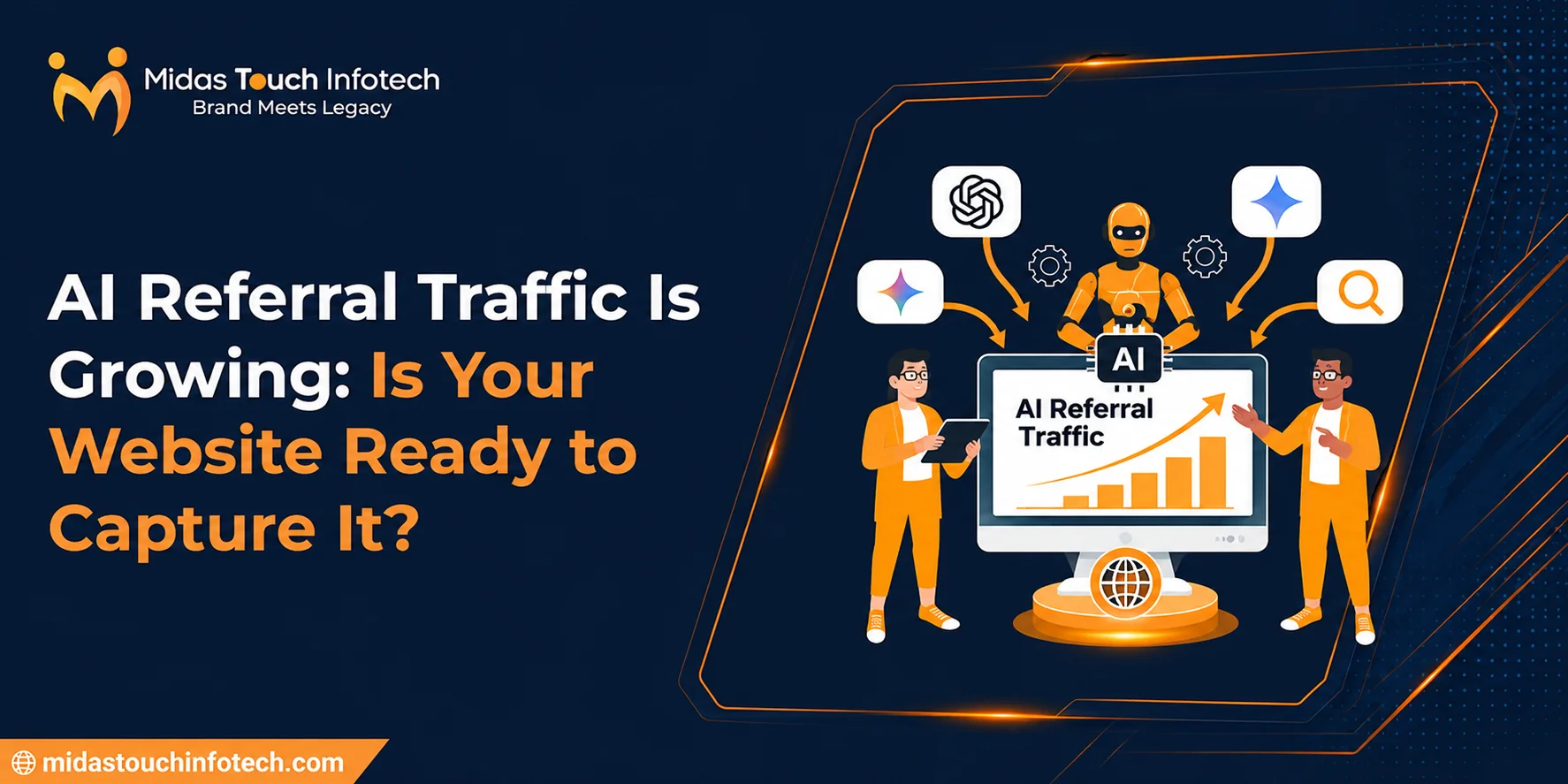
- AI Referral Traffic Is Growing: Is Your Website Ready to Capture It?
- What Is AI Referral Traffic and How Does It Work?
- Where Does AI Referral Traffic Come From?
- 1. ChatGPT
- 2. Google Gemini
- 3. Perplexity AI
- 4. Microsoft Copilot
- 5. Claude AI
- Why Is AI Referral Traffic Growing So Quickly?
- How Can AI Referral Traffic Benefit Your Business?
- ✦ Reach High-Intent Website Visitors
- ✦ Improve Brand Visibility Across AI Platforms
- ✦ Generate More Qualified Leads
- ✦ Discover New Traffic Opportunities
- Is Your Website Ready to Capture AI Referral Traffic?
- 1. Is Your Website Content AI-Friendly?
- 2. Can AI Search Platforms Access Your Website?
- 3. Does Your Website Build Trust and Authority?
- 4. Are Your Landing Pages Ready to Convert Visitors?
- 5. Are You Tracking AI Referral Traffic?
- How to Optimise Your Website for More AI Referral Traffic
- ◈ Create Content That Answers User Questions
- ◈ Strengthen Your Website’s SEO and GEO Strategy
- ◈ Publish Original and Trustworthy Content
- ◈ Improve Technical Website Performance
- ◈ Build Brand Authority Beyond Your Website
- How to Convert AI Referral Traffic into Qualified Leads
- ✦ Match Landing Page Content with Visitor Intent
- ✦ Use Clear and Action-Oriented CTAs
- ✦ Build Confidence Through Trust Signals
- ✦ Simplify the Conversion Journey
- How to Track and Measure AI Referral Traffic
- ◈ Track AI Referral Sources in Google Analytics 4
- ◈ Monitor Brand Mentions and AI Search Visibility
- ◈ Measure AI Referral Traffic Conversions
- Ready to Turn AI Referral Traffic into Business Opportunities?
AI Referral Traffic Is Growing: Is Your Website Ready to Capture It?
The way people search for information, discover businesses and make purchasing decisions is changing rapidly. Traditional search engines are no longer the only platforms driving visitors to websites. AI-powered tools such as ChatGPT, Google Gemini, Perplexity and Claude are becoming important channels for online discovery, helping users compare products, research services and find relevant business solutions through conversational searches.
According to a 2026 Adobe Brand Visibility report, ChatGPT referral traffic increased by approximately 60% per website from April to May 2026, based on an analysis of referral traffic across multiple analytics sources. The report highlights how clickable brand mentions and AI-generated links are creating new opportunities for businesses to attract website visitors.
For businesses investing in answer engine optimization services, this shift creates an opportunity to expand visibility beyond traditional search results. Instead of focusing only on keyword rankings, businesses must also consider how their content appears in AI-generated answers, brand recommendations and source citations.
AI referral traffic is becoming an important consideration for companies looking to improve brand awareness, generate qualified leads and increase website conversions. However, appearing in an AI-generated response is only the beginning. Websites must also provide relevant information, clear navigation and effective conversion opportunities to turn visitors into potential customers.
As AI-powered search continues to evolve, businesses that combine traditional SEO, Generative Engine Optimisation (GEO) and conversion-focused website improvements can build a stronger foundation for digital growth.
This guide explains how AI referral traffic works, why it is growing and how businesses can prepare their websites to attract relevant visitors and convert them into valuable business opportunities.
What Is AI Referral Traffic and How Does It Work?
AI referral traffic refers to website visits that originate from AI-powered platforms when users click links provided in AI-generated responses, recommendations or source citations.
Unlike traditional search engines, which primarily display ranked lists of websites, AI platforms can generate conversational answers that combine information from different sources. Depending on the platform and search experience, these answers may include clickable citations, website references or links to recommended businesses.
For example, a business owner might ask ChatGPT:
“What are the best CRM solutions for a growing B2B company?”
The AI platform may explain different CRM options, highlight relevant features and provide links to supporting websites.
When a user clicks one of those links and visits a website, that visit can be recorded as AI referral traffic.
The main difference between traditional organic traffic and AI referrals is how users discover the website.
Traditional Organic Traffic: Visitors generally arrive after clicking a search engine result.
AI Referral Traffic: Visitors arrive through links included in AI-powered responses or recommendations.
AI-Assisted Discovery: Users may discover a brand through AI and visit its website later through another channel.
This distinction matters because not every AI-influenced visit can be directly attributed to an AI platform.
Businesses need to evaluate both measurable referral visits and the broader role AI search plays in brand discovery.
Where Does AI Referral Traffic Come From?
Several AI-powered platforms can contribute to website discovery.
1. ChatGPT
ChatGPT provides conversational responses and, when using search, may include clickable links to external sources. This creates opportunities for websites offering relevant information.
2. Google Gemini
Google Gemini helps users research topics, explore solutions and access relevant online information. Depending on the experience, responses may direct users to supporting websites.
3. Perplexity AI
Perplexity AI focuses on research-oriented answers and commonly displays source citations that users can explore.
4. Microsoft Copilot
Microsoft Copilot combines conversational assistance with web-connected experiences that may reference external websites.
5. Claude AI
Claude supports research and analysis, with web-search-enabled experiences capable of referencing relevant online information.
Each platform has different features, citation methods and user behaviours. Businesses should therefore monitor the platforms most relevant to their target audiences rather than assuming all AI referrals follow the same pattern.
Also Read : 10 Trusted AEO Company in United States for Answer Engine Optimization
Why Is AI Referral Traffic Growing So Quickly?
AI referral traffic is growing rapidly as more people use AI-powered platforms like ChatGPT, Google Gemini, Perplexity and Claude to search for information, compare products and explore business solutions. Instead of relying only on traditional search engines, users are increasingly asking AI tools for personalised recommendations, detailed comparisons and direct answers. This shift from keyword-based searches to conversational queries is changing how customers discover websites and make purchasing decisions.
AI-generated answers also play an increasing role in influencing customer decisions by providing relevant information, product suggestions and business recommendations in one place. Many AI platforms include clickable links and source citations, allowing users to visit websites for additional details. As a result, businesses have new opportunities to attract AI search traffic, improve brand visibility and connect with potential customers actively researching their products or services.
With AI-powered search becoming part of the customer journey, businesses that publish helpful content, build brand authority and optimise their websites for AI discovery are better positioned to capture relevant referral traffic and generate qualified leads.
How Can AI Referral Traffic Benefit Your Business?
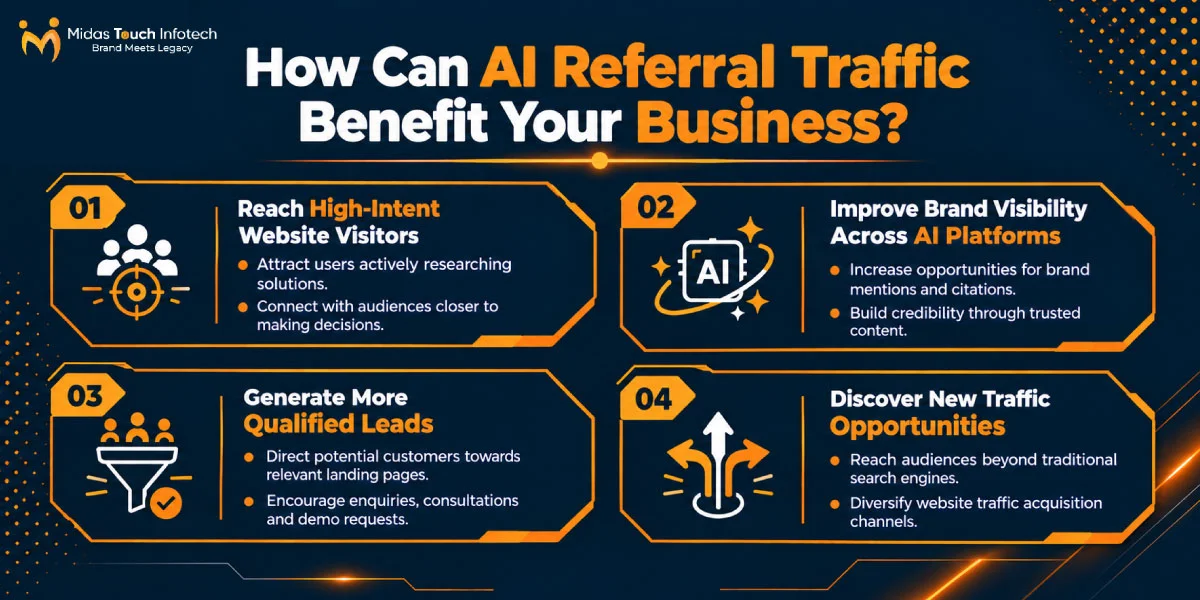
AI referral traffic creates new opportunities for businesses to reach potential customers, improve brand visibility and generate qualified leads. As more users rely on AI-powered platforms for research and recommendations, businesses can attract relevant website visitors beyond traditional search engines.
✦ Reach High-Intent Website Visitors
AI-powered platforms help businesses connect with users actively searching for products, services and solutions. Visitors arriving through relevant AI recommendations may already understand their requirements and be closer to making a purchasing decision. This creates opportunities to attract high-intent audiences and improve website engagement.
✦ Improve Brand Visibility Across AI Platforms
AI referral traffic can increase brand exposure through mentions, recommendations and citations across platforms such as ChatGPT, Gemini and Perplexity. When AI-generated answers reference your website as a relevant source, potential customers can discover your business and explore its offerings. Publishing accurate, helpful and trustworthy content can further strengthen brand credibility and AI search visibility.
✦ Generate More Qualified Leads
AI referrals can direct potential customers to relevant service pages, product information and landing pages that address their specific needs. Businesses can turn interested visitors into qualified leads by providing useful information, clear calls to action and simple enquiry forms. Encouraging consultation requests, demo bookings and direct enquiries can help improve lead generation opportunities.
✦ Discover New Traffic Opportunities
AI-powered search provides an additional channel for attracting website visitors beyond traditional organic search. By optimising content for AI-generated answers and recommendations, businesses can reach new audiences and diversify their traffic sources. This helps reduce dependence on a single acquisition channel while creating more opportunities for long-term website growth and customer engagement.
Is Your Website Ready to Capture AI Referral Traffic?
Generating AI referrals requires more than publishing content and hoping it appears in AI-generated answers.
Your website must be accessible, informative, credible and capable of converting interested visitors.
The following five questions can help assess your current readiness.
1. Is Your Website Content AI-Friendly?
AI search experiences often respond to conversational questions and detailed information requests.
Your website should therefore provide clear, useful information that addresses the needs of your target audience.
An experienced answer engine optimization agency can help evaluate whether existing website content supports relevant user questions and search intent.
Important content improvements include:
Use descriptive headings and subheadings.
Provide direct answers to common questions.
Explain complex topics in simple language.
Include practical examples and supporting facts.
Update outdated information regularly.
Avoid excessive keyword repetition.
For example, a business offering data analytics services should explain its solutions, applications, implementation process and potential benefits.
This makes the website more useful for visitors researching relevant business problems.
2. Can AI Search Platforms Access Your Website?
Website accessibility is a fundamental requirement for search discovery.
Technical issues such as blocked crawlers, incorrect indexing directives and inaccessible content can limit how websites appear in search experiences.
Businesses should review:
Robots.txt configurations.
Search engine indexing settings.
Internal linking structure.
Broken links and redirects.
Public accessibility of important pages.
Server and firewall restrictions.
For ChatGPT search, OpenAI identifies OAI-SearchBot as the crawler used to support website discovery in search results. Website owners can manage its access independently from GPTBot, which is associated with potential model training.
OpenAI Developers
Allowing relevant search crawlers improves eligibility for discovery but does not guarantee citations or traffic.
3. Does Your Website Build Trust and Authority?
Visitors who discover a business through an AI-generated recommendation still need reasons to trust it.
A website with unclear service information, limited company details and unsupported claims may struggle to convert visitors.
Businesses should strengthen credibility by including:
Detailed company information.
Relevant industry experience.
Genuine customer testimonials.
Verifiable case studies.
Professional certifications.
Expert-written content.
Accurate contact details.
For example, an IT consulting company could publish case studies explaining how it addressed infrastructure challenges for clients.
Relevant examples and measurable outcomes can help potential customers evaluate its expertise.
Trust signals should be accurate and verifiable rather than exaggerated or fabricated.
4. Are Your Landing Pages Ready to Convert Visitors?
AI referral traffic is valuable only when visitors can easily find the information or action they need.
A landing page should clearly explain the product or service and guide users towards an appropriate next step.
Important landing page elements include:
A clear headline.
Relevant service information.
Easy-to-understand benefits.
Customer testimonials or case studies.
Visible calls to action.
Simple enquiry or demo forms.
For example, a visitor researching ERP implementation services should reach a page explaining the implementation approach, relevant expertise and consultation process.
A generic homepage may not address the visitor’s specific question as effectively as a focused service page.
5. Are You Tracking AI Referral Traffic?
Without proper analytics, businesses may overlook visitors arriving from AI platforms.
Tracking AI referrals helps identify which platforms, pages and content topics contribute to meaningful website engagement.
Start by reviewing referral sources in Google Analytics 4.
Monitor:
AI referral sessions.
Landing-page performance.
Engagement rates.
Lead submissions.
Conversion rates.
Traffic trends over time.
Businesses should also examine whether AI-referred visitors engage with service pages or complete important conversion actions.
These insights can help prioritise content improvements and website optimisation activities.
How to Optimise Your Website for More AI Referral Traffic
Improving ai search visibility requires a combination of content optimisation, technical SEO, brand authority and a clear understanding of customer search behaviour.
Businesses should focus on providing valuable information that AI-powered platforms can discover and users can trust.
◈ Create Content That Answers User Questions
Conversational search is changing the way people look for information online.
Instead of searching with short keywords, users increasingly ask detailed questions about products, services and business challenges.
For example, a customer might ask:
“How can a medium-sized business reduce cloud infrastructure costs without affecting performance?”
A website that provides a relevant, well-structured explanation may be useful to someone conducting this research.
Important content practices include:
Identify frequently asked customer questions.
Create question-based headings.
Provide direct, practical answers.
Include relevant FAQs where helpful.
Support explanations with useful examples.
Address informational and commercial search intent.
Businesses can use customer support conversations, sales enquiries and search data to identify relevant topics.
The objective should be to create content that helps customers make informed decisions rather than simply targeting high-volume keywords.
◈ Strengthen Your Website’s SEO and GEO Strategy
Traditional SEO and Generative Engine Optimisation (GEO) work together to improve website discovery opportunities.
SEO focuses on making websites accessible, relevant and competitive in conventional search results.
GEO extends these efforts by considering how information about a website or brand is discovered and represented in AI-generated responses.
A combined ai search optimisation strategy may involve:
Improving website technical health.
Developing topic-focused content.
Strengthening internal linking.
Publishing original industry insights.
Building credible brand references.
Reviewing website content accuracy.
Monitoring AI-generated brand visibility.
For example, a software development company could create a series of articles covering application modernisation, cloud integration and software maintenance.
Connecting these articles with relevant service pages can help users explore related topics and better understand the company’s capabilities.
Google’s official guidance confirms that established SEO practices remain important for AI-powered search experiences, including creating helpful content and ensuring technical accessibility.
Google for Developers
◈ Publish Original and Trustworthy Content
Original content can help businesses differentiate themselves from competitors publishing similar information.
Instead of repeating common industry advice, companies should share practical knowledge developed through their own experience.
Valuable content formats include:
Original industry research.
Customer success stories.
Technical implementation guides.
Data-backed articles.
Expert interviews.
Product comparisons.
Market analysis reports.
For example, a software testing company could publish research examining common performance problems discovered during enterprise application testing.
Such information can provide useful insights for technical decision-makers.
When publishing statistics, businesses should mention their sources and explain relevant research findings accurately.
Original content does not guarantee AI citations, but it can make a website more useful to researchers and prospective customers.
◈ Improve Technical Website Performance
A technically reliable website supports both search discovery and visitor experience.
Slow loading speeds, inaccessible pages and poor mobile usability can discourage visitors from exploring a website.
Businesses should prioritise:
Mobile-responsive design.
Fast page loading.
Proper crawling and indexing configurations.
Clear website navigation.
Optimised images and scripts.
Relevant structured data.
Secure HTTPS connections.
Important content should be available in accessible text rather than relying exclusively on complex scripts or interactive elements.
Structured data can help supported search engines interpret certain website details. However, there is no special schema markup that guarantees inclusion in AI-generated answers.
Regular technical audits can help businesses identify problems affecting visibility and usability.
◈ Build Brand Authority Beyond Your Website
Brand authority is not developed exclusively through content published on your own website.
Relevant industry mentions, professional publications and independent references can help strengthen a company’s digital presence.
Businesses can improve their online reputation by:
Contributing expert articles to reputable publications.
Participating in relevant industry discussions.
Publishing research that others may reference.
Earning legitimate backlinks.
Maintaining accurate business profiles.
Sharing verifiable expertise and achievements.
For example, a cybersecurity company could contribute expert commentary to a recognised technology publication.
This can introduce the company to additional audiences while demonstrating its industry knowledge.
However, businesses should avoid artificial link-building schemes or low-quality promotional placements.
A sustainable authority-building strategy focuses on credibility, relevance and useful information.
Also Read : Top 15 GEO Agencies in Dubai to Boost Brand Presence Across AI Platforms
How to Convert AI Referral Traffic into Qualified Leads
Attracting visitors through AI-powered search is only the first stage of the customer journey.
The next challenge is converting interested visitors into enquiries, demo requests or potential customers.
Businesses should ensure that landing pages provide relevant information and guide visitors towards suitable actions.
✦ Match Landing Page Content with Visitor Intent
Visitors arriving through AI-generated responses may already have a specific question or requirement.
For example, someone researching Salesforce implementation costs is likely to expect pricing considerations, implementation stages and factors influencing overall expenses.
If the landing page provides unrelated promotional content, the visitor may leave without taking action.
To improve relevance:
Match page content with the visitor’s likely question.
Explain the problem and available solutions.
Provide important information near the top of the page.
Add relevant case studies and examples.
Link to related services and supporting resources.
A well-aligned landing page helps visitors continue their research without unnecessary effort.
✦ Use Clear and Action-Oriented CTAs
Calls to action help visitors understand what they can do after reviewing your content.
A strong CTA should connect naturally with the visitor’s needs and the information presented on the page.
For example, businesses can use CTAs such as:
Request a Consultation
Book a Demo
Get Expert Advice
Discuss Your Requirements
Explore Our Services
A generative engine optimization consultant can help evaluate how AI-referred visitors interact with landing pages and identify opportunities to improve the connection between informational content and conversion actions.
CTAs should appear at relevant points throughout important pages without overwhelming visitors.
For example, an article discussing AI automation implementation could include a consultation CTA after explaining the technical considerations and expected business benefits.
The aim is to guide interested users towards meaningful engagement rather than interrupting their research.
✦ Build Confidence Through Trust Signals
Even when visitors discover a business through an AI-generated recommendation, they still need evidence that the company can deliver reliable solutions.
Trust signals help reduce uncertainty during the evaluation process.
Useful elements include:
Genuine client testimonials.
Detailed project case studies.
Relevant certifications.
Industry-specific experience.
Verified customer reviews.
Measurable project outcomes.
For example, a data engineering company could showcase how it helped a client improve reporting accuracy or streamline data integration.
Real results provide more useful information than unsupported promotional claims.
Businesses should ensure that all testimonials, awards and certifications are accurate and verifiable.
✦ Simplify the Conversion Journey
A complicated enquiry process can discourage potential customers from taking the next step.
Businesses should make conversion paths simple, accessible and appropriate for the visitor’s needs.
Important improvements include:
Reduce unnecessary form fields.
Use clear navigation.
Optimise forms for mobile devices.
Provide visible contact options.
Explain what happens after an enquiry.
Avoid distracting pop-ups.
For example, a service consultation form may initially require only a name, business email and brief project description.
Additional information can be collected during the consultation process.
Businesses should also test landing pages regularly to identify usability issues and opportunities to improve conversion rates.
The ultimate objective is to make it easy for visitors to move from initial interest to meaningful business interaction.
How to Track and Measure AI Referral Traffic
Measuring AI referral traffic helps businesses understand which AI-powered platforms contribute to website visits, engagement and conversions.
Unlike traditional SEO reporting, AI search measurement often requires combining referral data with brand visibility monitoring.
A reliable measurement strategy should focus on both traffic quality and business outcomes.
◈ Track AI Referral Sources in Google Analytics 4
Google Analytics 4 (GA4) can help identify website visits originating from AI-powered platforms when suitable referral information is available.
Businesses can review traffic acquisition reports to identify referring domains and analyse how visitors interact with their websites.
For example, referral sources may include ChatGPT, Perplexity and other supported AI platforms.
Steps to monitor AI referrals in GA4:
Open the Traffic Acquisition report.
Review session source and medium information.
Identify known AI referral domains.
Create a custom report or exploration for AI-related traffic.
Analyse landing pages, engagement and key events.
Compare performance across reporting periods.
Businesses can also use filters or regular expressions to group relevant AI sources.
However, referral identification is not always complete. Some visitors may discover a company through an AI response and later access its website directly or through another channel.
AI-assisted discovery through Google Search features may also appear within ordinary Google organic traffic rather than as a separate AI referral source.
Therefore, ai search traffic reports should be interpreted as measurable referral activity rather than a complete representation of AI’s influence on the customer journey.
◈ Monitor Brand Mentions and AI Search Visibility
AI search visibility involves more than measuring website visits.
Businesses should also evaluate whether their brands, services and content appear in relevant AI-generated responses.
For example, a company offering managed IT services could monitor prompts such as:
“Which companies provide managed IT support for growing businesses?”
Monitoring these responses can help identify competitor mentions, cited sources and potential information gaps.
Important activities include:
Track brand mentions across relevant AI platforms.
Monitor website citations and source references.
Compare competitor visibility.
Review the accuracy of AI-generated brand descriptions.
Identify topics with limited brand representation.
AI visibility tools can support this process, although their coverage and measurement methods vary.
Businesses should use a consistent group of relevant prompts and review results over time rather than relying on individual AI-generated answers.
◈ Measure AI Referral Traffic Conversions
Traffic growth alone does not guarantee improved business performance.
Businesses should understand whether AI-referred visitors complete meaningful actions after reaching their websites.
Important AI referral performance metrics
| Metric | What It Measures |
|---|---|
| Referral Sessions | Visits attributed to identifiable AI platforms |
| Engaged Sessions | Visits meeting GA4 engagement criteria |
| Landing-Page Performance | Pages attracting AI-referred users |
| Lead Conversions | Enquiries, consultations or demo requests |
| Conversion Rate | Percentage of visits generating defined actions |
| Qualified Leads | Leads meeting your business’s qualification criteria |
| Revenue Contribution | Sales attributed to or associated with AI referrals |
For example, a website receiving 500 AI referral sessions and 20 enquiries would have a 4% enquiry conversion rate.
However, businesses should also evaluate whether those enquiries match their target audience and result in genuine sales opportunities.
Integrating analytics with CRM reporting can help connect referral activity with lead quality and customer acquisition.
It is also important to compare results with other marketing channels.
A lower-volume AI referral source may contribute valuable enquiries, while a higher-volume source may attract users who are primarily seeking information.
Regular measurement allows businesses to make better content, technical and conversion optimisation decisions.
Ready to Turn AI Referral Traffic into Business Opportunities?
AI-powered search is changing how customers discover information, compare businesses and explore potential solutions. With platforms such as ChatGPT, Gemini, Perplexity and Claude becoming part of online research, businesses have new opportunities to attract relevant visitors beyond traditional search engines. However, generating chatgpt traffic and other AI referrals requires more than simply appearing in AI-generated responses.
Websites must provide helpful content, reliable technical performance and clear conversion opportunities to turn visibility into business value.
Combining traditional SEO, AEO and generative engine optimization services can help businesses build a stronger foundation for AI-powered discovery. From improving content relevance and website crawlability to strengthening brand authority and optimising landing pages, these strategies support a more complete approach to attracting and engaging potential customers. Businesses should also monitor AI referrals, brand mentions and lead conversions to understand which activities deliver meaningful results.
As AI search continues to evolve, companies that invest in useful content, trustworthy information and conversion-focused website experiences will be better prepared to capture emerging traffic opportunities. Working with experienced SEO and GEO professionals can help businesses identify visibility gaps, improve technical performance and develop sustainable strategies for attracting qualified visitors and generating long-term business growth.
Key-Takeaways
- Understand AI Referral Traffic: Explore how ChatGPT, Gemini, Perplexity, and other AI platforms drive website visitors through AI-generated answers and recommendations.
- Improve AI Search Visibility: Optimise website content, technical SEO, and GEO strategies to increase discoverability across AI-powered search platforms.
- Build Brand Authority and Trust: Publish original research, case studies, expert insights, and trustworthy content to strengthen credibility and earn AI citations.
- Convert AI Traffic into Qualified Leads: Improve landing pages, add clear CTAs, and simplify enquiry forms to turn AI-driven visitors into potential customers.
- Track AI Referral Traffic and Conversions: Use Google Analytics 4 to monitor AI referral sources, website engagement, qualified leads, conversion rates, and business performance.

Mit Thakkar
Mit Thakkar, CEO of Midas Touch Infotech and a recognized LinkedIn SEO influencer, possesses extensive expertise in branding, website development, and digital marketing. He excels in transforming ideas into impactful digital strategies.