Summarize this blog post with:


- 12 AI Search Ranking Tools for Tracking Brand Visibility
- What Are AI Search Ranking Tools?
- 🢧 How AI Search Tracking Differs from Traditional Rank Tracking
- Why Should Brands Track Their AI Search Visibility?
- ▶ Understand How AI Platforms Represent Your Brand
- ▶ Measure Visibility Against Competitors
- ▶ Identify Content and Citation Opportunities
- Important AI Search Visibility Metrics to Track
- ✦ Brand Mention Frequency
- ✦ AI Visibility Score
- ✦ Citation Frequency
- ✦ AI Share of Voice
- ✦ Average Brand Position
- ✦ Prompt-Level Visibility
- ✦ Competitor Presence
- ✦ Brand Sentiment
- ✦ Cited Pages and Domains
- ✦ Visibility Trends Over Time
- ✦ AI Referral Traffic
- ✦ Geographic and Platform-Specific Performance
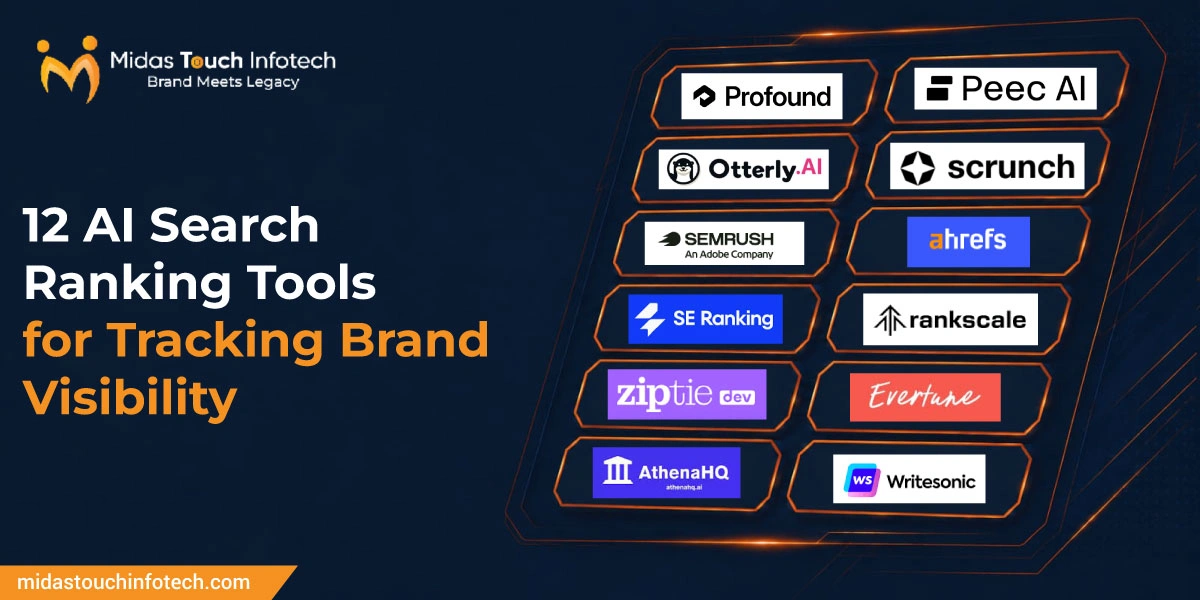
- 12 AI Search Ranking Tools for Tracking Brand Visibility
- 1. Profound
- 2. Peec AI
- 3. OtterlyAI
- 4. Scrunch
- 5. Semrush AI Visibility Toolkit
- 6. Ahrefs Brand Radar
- 7. SE Ranking AI Search Toolkit
- 8. Rankscale
- 9. ZipTie
- 10. Evertune
- 11. AthenaHQ
- 12. Writesonic AI Visibility Tracker
- How to Choose the Right AI Search Ranking Tool
- ➥ Define Your AI Visibility Goals
- ➥ Review AI Platform Coverage
- ➥ Consider Reporting and Integration Requirements
- ➥ Compare Pricing with Prompt Limits
- How to Start Tracking Brand Visibility in AI Search
- Step 1: Select High-Intent Prompts
- Step 2: Add Relevant Competitors
- Step 3: Establish a Visibility Benchmark
- Step 4: Optimise Content and Brand Signals
- Step 5: Monitor Changes Regularly
- Ready to Strengthen Your Brand Visibility in AI Search?
12 AI Search Ranking Tools for Tracking Brand Visibility
Customers no longer rely only on Google’s traditional search results when researching a company, comparing services or deciding which brand to contact. They increasingly ask conversational questions on ChatGPT, Gemini, Perplexity, Google AI Overviews and Google AI Mode. Instead of reviewing multiple search results, users may receive one summarised answer containing a small selection of recommended brands, supporting sources and direct explanations.
McKinsey’s August 2025 AI Discovery Survey of 1,927 consumers found that 50% were already using AI-powered search. The report also revealed that 44% of AI search users considered it their primary and preferred source of information, compared with 31% who preferred traditional search.
For a local business such as a branding agency in Ahmedabad, this shift changes what online visibility means. Ranking on the first page of Google remains valuable, but it does not reveal whether ChatGPT recommends the agency, whether Gemini describes its services accurately or whether Perplexity cites a competitor’s website instead.
Traditional rank trackers mainly measure keyword positions, but they do not provide a complete view of brand mentions, citations, sentiment, recommendations, or competitor visibility within AI-generated answers. This is why businesses are increasingly using AI search ranking tools alongside a professional SEO service to improve visibility across both traditional and AI-driven search.
In this guide, you will learn what AI search tracking involves, which metrics matter, how the leading tools compare and how to begin monitoring your brand’s presence across AI search platforms.
What Are AI Search Ranking Tools?
AI search ranking and visibility tools are platforms that analyse how frequently a company, product, service or website appears in AI-generated answers. They run relevant prompts across selected platforms, collect the responses and measure mentions, citations, positions, sentiment and competitive share of voice.
Depending on the selected tool, monitoring may cover:
✧ ChatGPT
✧ Google AI Overviews
✧ Google AI Mode
✧ Gemini
✧ Perplexity
✧ Claude
✧ Microsoft Copilot
Some platforms also track different countries, languages, devices, models and prompt categories.
The best AI-powered search ranking tools go beyond basic visibility scores. They reveal the exact prompts where a brand appears, identify cited pages, uncover third-party sources influencing recommendations, and highlight content gaps. With insights from a professional SEO consultant, businesses can use this data to strengthen their visibility across AI-driven search.
🢧 How AI Search Tracking Differs from Traditional Rank Tracking
Traditional SEO software tracks where a webpage ranks for a keyword on a search engine results page. AI search tracking measures whether a brand is mentioned, recommended, compared or cited within an AI-generated answer.
AI responses can also vary according to the prompt wording, location, model, platform and retrieval method. A company may appear for “top branding firms for startups” but remain absent from “who can redesign an established corporate brand?”
Therefore, brands need to track multiple conversational prompts instead of relying on a single keyword position. This broader approach, supported by professional SEO services, helps businesses understand their visibility across AI-generated results and is why these platforms are often referred to as AI search engine ranking tools or AI search ranking tracker tools.
Why Should Brands Track Their AI Search Visibility?
▶ Understand How AI Platforms Represent Your Brand
AI platforms may describe your business using information from your website, business directories, reviews, articles and third-party publications.
Monitoring helps you determine whether this information is accurate, current and aligned with your intended brand positioning.
You can identify:
✧ Incorrect service descriptions
✧ Outdated business locations
✧ Negative brand associations
✧ Inconsistent company information
✧ Claims that do not reflect your actual services
✧ Missing information about products or expertise
Early detection gives your team an opportunity to correct owned content and strengthen reliable external brand signals.
▶ Measure Visibility Against Competitors
AI visibility tracking shows how frequently your brand appears compared with competing companies.
For example, a provider offering branding services in Ahmedabad can monitor local recommendation queries, category-based prompts and comparison questions to calculate its AI share of voice.
The data reveals prompts where competitors are repeatedly recommended while your brand is missing. It can also show whether competing brands appear above you, receive more citations or are associated with stronger attributes.
This gives marketing teams a clearer understanding of which competitors are dominating AI-generated conversations.
▶ Identify Content and Citation Opportunities
Many AI-generated answers are influenced by sources such as industry publications, review websites, listicles, directories, forums and authoritative brand pages.
Citation analysis helps you identify the websites and pages that AI platforms frequently reference when creating answers.
You can use these insights to:
✧ Discover missing content topics
✧ Improve underperforming service pages
✧ Build content around conversational questions
✧ Strengthen expert contributions
✧ Target relevant digital PR opportunities
✧ Earn mentions from frequently cited websites
✧ Improve Generative Engine Optimisation strategies
✧ Support Answer Engine Optimisation campaigns
These findings help brands prioritise the pages that require GEO or AEO improvements.
Important AI Search Visibility Metrics to Track
An effective AI visibility measurement framework should include the following metrics.
✦ Brand Mention Frequency
This measures how frequently your brand appears within the AI-generated answers collected for your tracked prompts.
✦ AI Visibility Score
An AI visibility score provides a summarised indication of your overall presence across selected prompts, competitors and platforms.
✦ Citation Frequency
Citation frequency shows how often AI engines use your website or webpages as supporting sources.
✦ AI Share of Voice
AI share of voice compares your total brand mentions with the mentions received by all tracked competitors.
✦ Average Brand Position
This metric identifies where your brand typically appears within AI-generated recommendations or comparison lists.
✦ Prompt-Level Visibility
Prompt-level visibility shows your performance for each individual conversational query rather than presenting only an overall score.
✦ Competitor Presence
This reveals which competitors appear for your tracked prompts, how frequently they are mentioned and where they are positioned.
✦ Brand Sentiment
Sentiment analysis evaluates whether AI platforms describe your brand in a positive, neutral or negative manner.
✦ Cited Pages and Domains
This identifies the owned and third-party sources influencing AI-generated answers in your category.
✦ Visibility Trends Over Time
Historical tracking helps teams measure how visibility changes across weeks, months, campaigns or major content updates.
✦ AI Referral Traffic
AI referral traffic measures the visits your website receives from AI platforms such as ChatGPT, Perplexity, Gemini and Copilot.
✦ Geographic and Platform-Specific Performance
This shows how visibility varies across countries, cities, languages, AI engines and user locations.
No single metric provides the complete picture. A brand may receive many mentions but few citations. It may also perform strongly on ChatGPT while remaining almost invisible in Google AI Overviews. Therefore, multiple metrics should be evaluated together.
Also Read : Top 10 Branding Agency in India Trusted by CEOs and CMOs
12 AI Search Ranking Tools for Tracking Brand Visibility
1. Profound

Profound is an enterprise-focused platform designed to analyse brand presence across AI answer engines. It tracks visibility, share of voice, sentiment, keyword themes, citations, source authority and competitor rankings.
Teams can also review how their brand presence changes across time, regions, topics and audience personas.
Key features:
» Prompt tracking
» Citation analysis
» Brand sentiment
» AI share of voice
» Competitor intelligence
» Regional and audience-level analysis
Best use case: Large organisations managing advanced AI visibility, content intelligence and competitive research programmes.
2. Peec AI

Peec AI measures brand visibility, average position, sentiment, citation activity and share of voice across major AI search platforms.
Its dashboards allow teams to compare brands, inspect prompt-level responses and understand which external sources contribute to AI recommendations.
Key features:
» AI share-of-voice tracking
» Citation monitoring
» Average brand position
» Sentiment analysis
» Competitor benchmarking
» Multi-platform reporting
Best use case: Marketing teams and digital agencies that need clear competitor benchmarking and multi-client reporting.
3. OtterlyAI

OtterlyAI provides user-friendly monitoring for brand mentions, website citations, sentiment and prompt performance.
Users can create a library of conversational searches, run them across supported AI engines and review how visibility changes over time. The platform can also provide alerts when brand mentions change.
Key features:
» Brand mention tracking
» Website citation monitoring
» Sentiment analysis
» Prompt libraries
» Competitor comparisons
» Visibility alerts
Best use case: Small businesses, agencies and content teams starting structured AI search monitoring.
4. Scrunch

Scrunch combines AI visibility monitoring with technical and content-readiness analysis.
It reports brand presence, position, sentiment, citations and competitive performance. Its website auditing capabilities can also identify access, delivery or page-quality issues that may affect AI visibility.
Key features:
» Citation tracking
» Sentiment monitoring
» Competitive presence
» AI crawler analysis
» Site audits
» Technical GEO insights
Best use case: Enterprise teams and technical GEO specialists seeking monitoring combined with website diagnostics.
5. Semrush AI Visibility Toolkit

Semrush’s AI Visibility Toolkit includes an AI Visibility Score, competitor research, prompt research, mentions, cited pages and citation data.
Its competitor reports help identify prompts and topics where rival brands appear but the tracked company does not.
Key features:
» AI Visibility Score
» Prompt research
» Competitor comparisons
» Citation analysis
» Mention tracking
» Automated reporting
Best use case: SEO professionals and businesses already using Semrush for search, content and marketing reporting.
6. Ahrefs Brand Radar

Ahrefs Brand Radar monitors mentions, citations, impressions and AI share of voice across major AI platforms.
It helps teams identify highly cited pages and domains, compare competitors and track custom prompts related to specific products, regions or audiences.
Key features:
» AI mention tracking
» Citation monitoring
» AI share of voice
» Custom prompts
» Competitor comparisons
» Topic and source analysis
Best use case: Data-focused SEO teams that want to connect AI visibility with broader search and content research.
7. SE Ranking AI Search Toolkit

SE Ranking tracks brand mentions, linked sources, average positions, historical trends and competitor performance.
Teams can review prompt-level changes, inspect how brands are described in answers and connect structured AI search data to reporting systems through its API.
Key features:
» Historical visibility trends
» Average position tracking
» Brand and link monitoring
» Competitor comparisons
» Prompt-level reports
» API access
Best use case: Agencies managing combined SEO and AI visibility campaigns for several clients.
8. Rankscale

Rankscale monitors brand visibility across numerous AI engines and supports global, multilingual tracking.
Its capabilities include prompt research, competitor analysis, citation analysis, sentiment tracking, page audits and technical checks related to crawlability and AI readiness.
Key features:
» Multi-engine prompt tracking
» Multilingual monitoring
» Competitor intelligence
» Technical GEO audits
» Citation analysis
» Sentiment analysis
Best use case: International brands and GEO specialists requiring broad platform, market and language coverage.
9. ZipTie

ZipTie tracks citations, mentions, sentiment, full AI responses and competitor recommendations across several AI search experiences.
It combines these signals into an AI Success Score and provides prioritised recommendations to help marketing teams decide which visibility gaps to address first.
Key features:
» Brand mention tracking
» Citation monitoring
» Sentiment analysis
» Competitor share of voice
» AI Success Score
» Optimisation recommendations
Best use case: SEO and marketing teams that want a focused monitoring platform with prioritised guidance.
10. Evertune

Evertune is an enterprise GEO platform offering an AI Brand Index for measuring visibility against competitors.
Its metrics include visibility score, average position and AI Brand Score. Model-specific insights and source analysis help teams understand what influences AI brand recommendations.
Key features:
» AI Brand Index
» Competitive benchmarking
» Average brand position
» Model-specific analysis
» Source intelligence
» Visibility trend monitoring
Best use case: Enterprise brand, consumer-insight and market-research teams evaluating AI recommendations at scale.
11. AthenaHQ

AthenaHQ combines cross-platform monitoring, competitor intelligence, hallucination detection and automated content recommendations.
It also provides content-gap analysis, citation-source insights and tools that help teams respond to inaccurate or changing AI narratives.
Key features:
» Competitor analysis
» Hallucination detection
» Citation-source analysis
» Content-gap identification
» Automated content recommendations
» Brand narrative monitoring
Best use case: Teams seeking an end-to-end AEO and GEO workflow rather than monitoring alone.
12. Writesonic AI Visibility Tracker

Writesonic combines AI search monitoring with content and optimisation workflows.
It tracks visibility, citations, sentiment, share of voice, narrative themes and competitor performance across multiple platforms, markets, languages and search intents.
Key features:
» AI visibility tracking
» Citation analysis
» Brand sentiment
» Share-of-voice reporting
» Competitor benchmarking
» Content optimisation
Best use case: Content and SEO teams that want to research, monitor and improve AI visibility within one ecosystem.
How to Choose the Right AI Search Ranking Tool
➥ Define Your AI Visibility Goals
Begin by clarifying the business problem you want the platform to solve. Your goals may include:
❖ Brand monitoring
❖ Competitor research
❖ Citation tracking
❖ GEO content optimisation
❖ Local visibility monitoring
❖ Client reporting
❖ Brand sentiment analysis
A company positioning itself as the best branding agency in Ahmedabad may prioritise local prompt tracking, sentiment, competitor mentions and citation opportunities.
An international software business may require multilingual monitoring, API access and market-level dashboards.
➥ Review AI Platform Coverage
Confirm which AI search engines your audience uses, as platform support varies. Use AI-powered search ranking tools that cover the platforms most relevant to your business.
Check whether the tool supports your required:
❖ Countries
❖ Cities
❖ Languages
❖ Devices
❖ AI models
❖ Prompt categories
You should also review how frequently the platform refreshes its data. Daily tracking may be valuable for active campaigns, while weekly or monthly monitoring may be sufficient for strategic benchmarking.
➥ Consider Reporting and Integration Requirements
Look for automated reports, data exports, dashboard options and user-access controls.
Agencies may need multiple client workspaces and white-label reporting. Enterprise teams may prioritise APIs, GA4 connections, Google Search Console data and business-intelligence integrations.
Reporting should help decision-makers understand what changed, why it matters and what action the team should take next.
➥ Compare Pricing with Prompt Limits
Do not compare subscription prices alone. Review the number of prompts, engines, markets, competitors, users and tracking runs included.
Pricing for AI search ranking tracker tools varies. Some charge per prompt, while others use extra credits for tracking across multiple AI search engines, locations, or AI models.
Estimate your complete monitoring requirements before selecting a plan to avoid unexpected limitations.
Also Read : List of the Trusted Branding Company for Small Businesses in 2026
How to Start Tracking Brand Visibility in AI Search
Step 1: Select High-Intent Prompts
Create prompts based on real customer decisions. Include:
✧ Product and service recommendations
✧ Comparison questions
✧ Problem-based searches
✧ Branded queries
✧ Non-branded prompts
✧ Local recommendation searches
✧ Purchase-intent questions
Prioritise prompts that could realistically influence an enquiry, consultation, purchase or business decision.
Step 2: Add Relevant Competitors
Track direct business competitors, websites already ranking in traditional search results and brands frequently recommended by AI engines.
Your competitors in AI search may extend beyond the companies your sales team typically monitors. Directories, industry publications, and marketplace websites can also compete for visibility, making SEO consulting services India valuable for identifying these emerging competitors and improving your brand’s search presence.
Step 3: Establish a Visibility Benchmark
Record your current:
✧ Brand mention frequency
✧ Citation frequency
✧ Average position
✧ AI visibility score
✧ Share of voice
✧ Sentiment
✧ Competitor presence
Identify platforms and prompt groups where your brand currently has little or no visibility. This baseline will help you measure progress accurately.
Step 4: Optimise Content and Brand Signals
Improve pages that directly answer conversational questions. Use clear language, relevant facts, proof of expertise and well-structured answers.
Correct inconsistent company details across websites, directories and business profiles. Strengthen authoritative third-party mentions from publications and platforms that AI engines frequently trust and cite.
Avoid creating content only for AI systems. Your content should remain useful, accurate and valuable to human readers.
Step 5: Monitor Changes Regularly
Review performance weekly or monthly and compare results before and after optimisation.
A branding agency in Gujarat, for example, should separate Ahmedabad-specific prompts from broader Gujarat-level searches. This makes it easier to identify the locations and services where progress is occurring.
Connect visibility improvements with website traffic, enquiries, consultation bookings and conversions. Higher AI visibility is valuable, but business impact remains the final measure of success.
Ready to Strengthen Your Brand Visibility in AI Search?
AI search is becoming an important brand-discovery channel. Businesses must understand not only where their pages rank, but also whether AI platforms mention them, cite them accurately and recommend them ahead of competitors.
The top AI search ranking tools help marketing teams measure this evolving layer of visibility. By tracking prompts, citations, sentiment, share of voice, and competitor presence, a professional SEO company can help organisations identify content gaps and make more informed GEO and AEO decisions.
For a branding company in Ahmedabad, stronger AI visibility can support local discovery, brand trust and qualified enquiries.
Choose a platform that matches your goals, establish a visibility benchmark and improve the brand signals that shape AI-generated answers. The sooner you begin measuring your AI presence, the sooner you can turn search visibility into a practical competitive advantage.

Mit Thakkar
Mit Thakkar, CEO of Midas Touch Infotech and a recognized LinkedIn SEO influencer, possesses extensive expertise in branding, website development, and digital marketing. He excels in transforming ideas into impactful digital strategies.