SEO has moved far beyond manually collecting keywords, reviewing pages individually and preparing performance reports in spreadsheets. Artificial intelligence is now helping marketers research topics, organise information, analyse data, prepare content briefs and identify optimisation opportunities in less time.
According to HubSpot’s 2026 State of Marketing Report, 80% of marketers use AI for content creation, demonstrating how quickly AI-assisted workflows have become part of everyday marketing activities.
ChatGPT is one of the most flexible tools supporting this shift, helping marketers manage multiple stages of an SEO campaign through a single conversational interface. Marketing teams use ChatGPT SEO tools to generate topic ideas, cluster keywords, summarise technical reports, compare competitor content, interpret performance data and prepare stakeholder updates.
However, the quality of ChatGPT’s output still depends on the prompt, supporting data and human review. A professional SEO service can use ChatGPT to reduce repetitive work while keeping strategy, quality control and final decision-making in the hands of experienced specialists.
In this guide, you will learn about 12 ChatGPT tools and features that can improve SEO research, content development, data analysis, reporting and collaboration.
Why ChatGPT Has Become an Essential SEO Assistant
🢧 From Keyword Research to Content Optimisation
ChatGPT has become valuable to SEO teams because it can support a wide range of connected tasks. Instead of using it only to draft articles, marketers can ask it to classify keywords by intent, compare page structures, summarise customer questions, generate metadata options or turn raw analytics into an understandable report.
It speeds up repetitive SEO tasks such as cleaning keyword lists, rewriting duplicate headings and preparing standard content templates. It can also improve content quality by helping teams identify unclear sections, missing subtopics, weak transitions and opportunities to answer user questions more directly.
Businesses using professional SEO services India should treat ChatGPT as a productivity layer rather than a complete SEO system. It can improve speed and organisation, but it cannot replace Search Console data, technical crawlers, backlink databases, editorial judgement or an experienced SEO strategy.
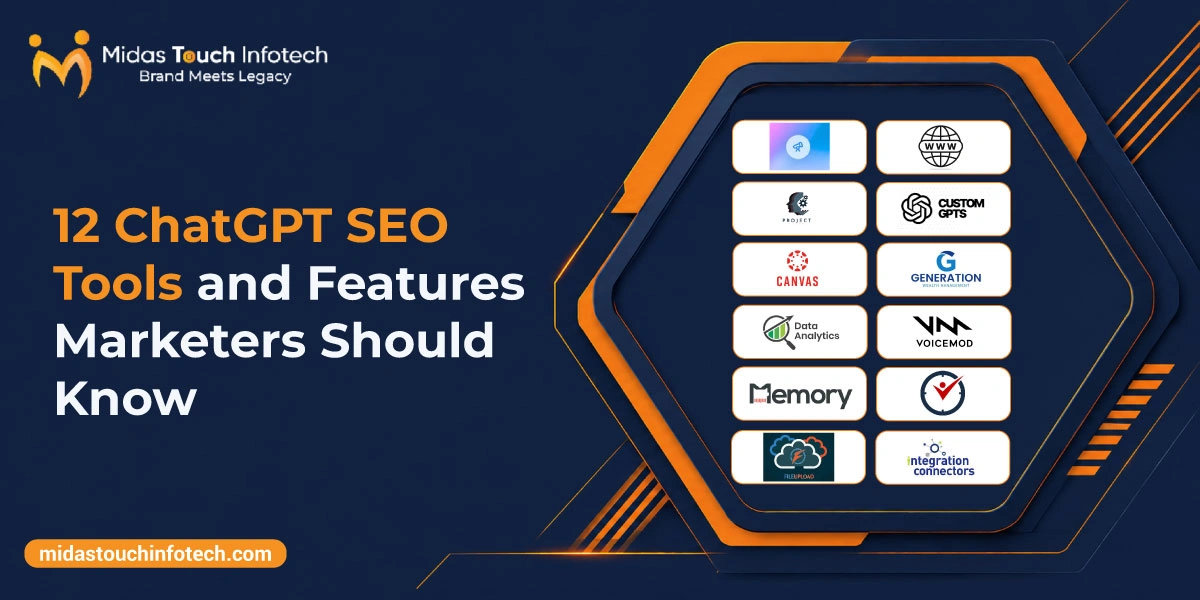
12 ChatGPT SEO Tools and Features Every Marketer Should Use
1. Deep Research

Deep Research is designed for complex questions that require information from multiple sources. It can search the public web, review uploaded files and work with enabled apps before producing a structured report with citations.
For SEO, marketers can use Deep Research to study an industry, investigate search behaviour, compare competitor positioning or collect evidence for a data-backed article. It is especially valuable when a subject requires deeper investigation rather than a quick search.
Marketers can use Deep Research to:
❖ Gather reliable information from selected sources
❖ Create research-backed content outlines
❖ Compare competitors and industry developments
❖ Identify customer problems and market concerns
❖ Find claims that require stronger evidence
Always review the cited sources and confirm that the information is relevant to your target audience and location.
2. Web Browsing

Web browsing helps ChatGPT access current public information instead of relying only on previously learned knowledge. This matters in SEO because search features, statistics, competitor pages, algorithms and industry developments change regularly.
Marketers can use web browsing to find recent SEO trends, verify statistics before publishing, check whether a platform has introduced new features and review competitor updates. It can also support news-led articles and time-sensitive landing pages.
Browsing should not replace source evaluation. Prioritise official documentation, original research, government websites and recognised industry publications. Marketers should never publish a claim simply because an AI platform found it online.
3. Projects

Projects help users organise related conversations, instructions and files around an ongoing campaign. Project context can keep ChatGPT focused on the chats and materials associated with a particular project.
An SEO team can create a separate project for every client, website, service line or campaign. Inside the project, marketers can maintain brand guidelines, audience information, approved terminology, previous briefs and content examples.
Projects can support:
❖ Better SEO campaign organisation
❖ Centralised prompts, files and brand guidelines
❖ Consistent messaging across multiple pages
❖ Faster completion of repeated content tasks
❖ Easier collaboration across marketing teams
Teams should avoid uploading confidential information unless their organisation’s privacy and workspace policies allow it.
4. GPTs or Custom GPTs

Custom GPTs are specialised versions of ChatGPT configured with specific instructions, knowledge and capabilities. They can support repeatable workflows such as content briefing, metadata writing, internal linking, outreach personalisation and SEO audit summaries.
For example, a marketing team can create a Custom GPT that follows its preferred content structure, tone of voice, prohibited terms and quality checklist. Another GPT could convert an uploaded keyword list into content briefs using a predefined template.
The best SEO agency will not depend on a Custom GPT without proper controls. It will test the responses, update the instructions and ensure that someone who understands search intent, brand requirements and business goals reviews every important output.
5. Canvas

Canvas is an editing workspace designed for longer writing and coding projects. It allows users to edit content directly, highlight specific sections, request focused changes and review suggestions within the complete context of a document.
For SEO content, Canvas can help marketers draft and refine long-form pages, improve readability, adjust the reading level and revise selected paragraphs without rewriting the entire article.
It can support:
❖ Long-form blog drafting
❖ Service page revisions
❖ Content restructuring
❖ Readability improvements
❖ Collaborative editing
Canvas access may depend on the model or interface available in a user’s account. Since product capabilities can change, teams should verify its current availability before making it a required part of their SEO workflow.
Also Read : Best SEO Agency in Dubai for Startups, SMEs, and Enterprises
6. Image Generation

ChatGPT’s image generation capabilities can support the visual side of content marketing. Marketers can create concept illustrations, featured-image ideas, blog graphics and social media creatives based on a written description.
This can reduce the time spent searching through stock image libraries, particularly for abstract topics such as artificial intelligence, cloud platforms, cybersecurity, software testing or data analytics.
An effective image prompt should specify:
❖ The subject of the image
❖ Intended audience
❖ Visual style
❖ Required dimensions
❖ Brand colour preferences
❖ Space for headings or text
Generated images must still be reviewed for brand consistency, visual accuracy, accessibility and potential intellectual property concerns before publication.
7. Advanced Data Analysis

Advanced Data Analysis allows ChatGPT to work with structured files such as CSVs and spreadsheets. It can inspect datasets, create tables, identify patterns and generate visualisations.
SEO teams can upload keyword exports, Search Console reports, content inventories or page-performance files. They can then ask ChatGPT to group search queries, compare performance periods, identify declining pages or highlight pages with high impressions but low click-through rates.
Useful data analysis requests include:
❖ Cluster keywords by topic and intent
❖ Compare clicks, impressions, CTR and rankings
❖ Identify pages with declining organic traffic
❖ Find high-impression and low-click opportunities
❖ Create charts for monthly SEO reports
❖ Summarise important performance changes
Before using the results, marketers should confirm the date range, filters, missing values and metric definitions.
8. Voice Mode

Voice Mode allows users to speak with ChatGPT and receive spoken responses, making it useful for hands-free brainstorming and quick strategic discussions.
A marketer can use Voice Mode while reviewing a website, travelling or moving between different tasks. It can help capture blog ideas, discuss campaign angles, explore customer pain points or transform rough thoughts into an initial outline.
Voice Mode is most effective for ideation rather than final optimisation. Important keywords, facts and instructions should still be checked in written form because spoken conversations can sometimes result in misunderstandings.
9. Memory

When enabled, Memory can retain useful context from previous conversations, files and connected apps. This means users do not need to repeat the same preferences in every conversation. Users can manage, update or disable Memory through their settings.
For ongoing SEO work, Memory may help ChatGPT remember:
❖ Preferred writing tone
❖ Target audience
❖ Content structure
❖ Brand terminology
❖ Recurring SEO processes
❖ Formatting preferences
This can make repeated tasks faster and more consistent. However, marketers should not use Memory as their only source of brand governance. Approved brand guidelines should be maintained separately, and remembered information should be reviewed regularly.
10. Scheduled Tasks

Scheduled Tasks allow users to create one-time or recurring tasks and request notifications when a meaningful change occurs. OpenAI provides a dedicated Scheduled area for creating and managing these tasks.
SEO teams can use Scheduled Tasks for:
❖ Content publishing reminders
❖ Monthly optimisation reviews
❖ Weekly SEO performance checks
❖ Recurring reporting schedules
❖ Blog refresh reminders
❖ Technical audit follow-ups
For example, a marketer could create a monthly reminder to review important service pages or a weekly task to check pages that have recently lost clicks.
Scheduled Tasks can improve consistency, but they should not be confused with a complete SEO monitoring system. Critical alerts should still come from analytics platforms, crawling tools and rank-tracking software.
11. File Upload and Document Analysis

ChatGPT can analyse common documents, presentations and spreadsheet formats. It can extract information, summarise reports, compare files and work with structured data, subject to account and file limits.
Marketers can upload:
❖ SEO audit documents
❖ Competitor articles
❖ Brand guidelines
❖ Editorial calendars
❖ Search Console exports
❖ Keyword spreadsheets
❖ PDF performance reports
ChatGPT can identify repeated issues, extract recommendations, organise findings by priority and convert a technical report into a simpler executive summary.
This feature can be particularly valuable when an SEO team receives long documents from consultants, developers or data analysts. However, image-heavy, scanned or poorly structured files may require additional manual verification.
12. Integrations and Connectors

ChatGPT apps and connectors can search or reference information from supported third-party services. Some can also work with Deep Research, synchronise information or perform approved actions depending on their configuration and permissions.
For SEO teams, connectors can reduce the need to copy information manually between platforms. They may help marketers access documents, collaborate on campaign assets and bring relevant business information into a conversation.
Integrations can support:
❖ Faster access to campaign documents
❖ Better collaboration across marketing teams
❖ Centralised business information
❖ More context-aware SEO recommendations
❖ Reduced manual information transfer
The quality of an integration depends on its source, permissions and workspace settings. Organisations should establish clear access rules before connecting client documents, analytics information or internal systems.
How These ChatGPT Features Improve Your SEO Workflow
➥ Content Creation
ChatGPT can assist with topic ideation, content outlines, first drafts and page refreshes. Marketers can provide a target audience, search intent, keyword set, tone and desired action before requesting a structured page.
It can also identify sections that feel repetitive, incomplete or overly generic. However, a professional SEO India strategy should use AI to strengthen the content process rather than mass-produce similar pages.
Original experiences, expert insights, customer examples and clear editorial standards remain essential for producing valuable content.
➥ Technical SEO
ChatGPT can translate technical audit findings into understandable summaries, explain structured data and suggest possible solutions.
It can assist with issues such as:
❏ Missing canonical tags
❏ Duplicate metadata
❏ Poor heading structure
❏ Incomplete schema markup
❏ Indexing recommendations
❏ Redirect requirements
However, ChatGPT does not automatically crawl a website in the same way as dedicated technical SEO software. Marketers should use verified crawl data and ask ChatGPT to explain, organise or prioritise the exported findings.
➥ Keyword Research
ChatGPT can cluster keywords, identify probable search intent, create topic relationships and suggest questions connected to a subject. It becomes especially valuable after marketers export real keyword information from a trusted SEO platform.
Search volume, keyword difficulty, trends and SERP competition should still be validated separately. ChatGPT can organise keyword data, but it should not be considered a reliable source of live keyword metrics.
➥ Competitor Research
By reviewing competitor pages or uploaded documents, ChatGPT can compare content depth, headings, positioning and calls to action.
It can help marketers identify:
❏ Missing subtopics
❏ Weak competitor explanations
❏ Unanswered customer questions
❏ Content structure differences
❏ New positioning opportunities
❏ Potential content gaps
The objective is not to copy competitors. The analysis should be used to create a more useful, original and audience-focused resource.
➥ Reporting
ChatGPT can transform raw performance data into clear summaries for clients, managers and leadership teams. It can explain what changed, identify possible performance drivers and present recommendations in an executive-friendly format.
A professional SEO consultant should still verify every number and clearly separate confirmed findings from possible interpretations. AI-generated explanations can sound confident even when the original dataset is incomplete.
Also Read : Best SEO Agency in New York for Business Growth in 2026
Tips for Using ChatGPT Effectively for SEO
☸ Write Detailed Prompts
Explain the page type, audience, search intent, funnel stage, target keywords, brand tone, competitors and desired conversion action. The more relevant context you provide, the more focused the response will be.
☸ Verify AI-Generated Information
Check statistics, quotations, product details, dates and technical recommendations against primary or trusted sources. For time-sensitive topics, use current web browsing and confirm the publication date.
☸ Combine ChatGPT With Reliable SEO Tools
Use ChatGPT alongside Google Search Console, Google Analytics, keyword platforms, technical crawlers and content-quality tools.
ChatGPT delivers greater value when it analyses trustworthy data rather than generating unsupported metrics.
☸ Add Human Expertise Before Publishing
Include first-hand observations, customer questions, industry examples, proprietary data and practical recommendations.
This is where SEO consulting services India can provide more value than a completely automated content workflow.

Ready to Turn ChatGPT into Your SEO Growth Assistant?
ChatGPT can support research, analysis, content creation and technical SEO while helping marketers build faster and more organised workflows.
Features such as Deep Research, Projects, Custom GPTs, Advanced Data Analysis, file uploads, Memory, Scheduled Tasks and connectors can reduce repetitive work and improve collaboration.
However, the quality of the result depends heavily on the source data, context and instructions provided. Every output should be reviewed for accuracy, originality and brand relevance.
The strongest results come from combining ChatGPT with human expertise, reliable SEO platforms and a clear business strategy. A professional SEO company can help you build this balanced workflow, select the right data sources and convert AI-assisted insights into measurable search growth.

Mit Thakkar
Mit Thakkar, CEO of Midas Touch Infotech and a recognized LinkedIn SEO influencer, possesses extensive expertise in branding, website development, and digital marketing. He excels in transforming ideas into impactful digital strategies.