Summarize this blog post with:


- Complete Off-Page SEO Checklist for 2026: What You Need to Do
- What Is Off-Page SEO?
- ◈ Understanding Off-Page SEO
- ◈ Off-Page SEO vs On-Page SEO
- Why Is Off-Page SEO Important in 2026?
- ➔ Builds Authority and Credibility
- ➔ Supports Better Search Visibility
- ➔ Generates Referral Traffic
- ➔ Increases Brand Visibility
- ➔ Supports Google and AI Search Visibility
- Complete Off-Page SEO Checklist for 2026
- 1. Build High-Quality Backlinks
- 2. Create a Strategic Link-Building Plan
- 3. Perform Competitor Backlink Analysis
- 4. Use Guest Posting Strategically
- 5. Leverage Digital PR and Brand Mentions
- 6. Optimise Local SEO Signals
- 7. Build Social Media Visibility
- 8. Manage Online Reviews and Reputation
- 9. Strengthen Brand Mentions and Citations
- 10. Use Community and Forum Engagement
- Turn Your Off-Page SEO Checklist Into Measurable Search Growth
Complete Off-Page SEO Checklist for 2026: What You Need to Do
Search engine optimisation is no longer limited to optimising pages, publishing keywords and fixing technical issues. How your business is discussed, referenced, reviewed and linked to across the web can also influence its visibility and credibility. This is where off-page SEO comes into the picture.
Off-page SEO refers to optimisation activities performed outside your website to improve its authority, reputation and overall search presence. These activities can include backlink building, digital PR, local citations, online reviews, brand mentions, community participation and social visibility. Businesses investing in professional SEO services increasingly need to look beyond traditional backlink building and create a broader digital authority strategy.
Search continues to be a major discovery channel. Statcounter reported that Google accounted for approximately 90.02% of worldwide search-engine host market share in July 2026. Ahrefs’ 2026 SEO statistics also reports that 96.55% of pages receive no search traffic from Google, highlighting just how competitive organic visibility has become.
At the same time, AI-powered search experiences are changing how users discover businesses, products and information. This means companies should think about more than rankings alone. Brand authority, credible mentions, trustworthy references and a positive digital reputation are becoming increasingly important parts of broader search visibility.
This off-page SEO checklist 2026 covers the essential activities businesses should prioritise to strengthen authority, attract relevant traffic and build sustainable organic visibility.
What Is Off-Page SEO?
◈ Understanding Off-Page SEO
Off-page SEO includes activities carried out away from your own website that help strengthen its authority, reputation and discoverability.
While you cannot directly control every external signal, you can influence them by consistently building relationships, publishing valuable resources and giving other websites genuine reasons to mention or reference your business.
Common off-page SEO activities include:
• Building high-quality backlinks
• Earning editorial mentions
• Digital PR campaigns
• Guest posting
• Local business citations
• Review management
• Community participation
• Social media visibility
• Influencer and industry outreach
• Unlinked brand mention reclamation
Google confirms that it uses links as signals for understanding relevance and discovering pages, while PageRank continues to form part of Google’s core ranking systems.
However, modern off-page SEO should not be viewed as a competition to acquire the greatest number of backlinks. Relevance, credibility and the quality of the referring source matter much more strategically than raw link volume.
◈ Off-Page SEO vs On-Page SEO
On-page SEO covers elements that you can directly manage on your website, including:
• Content optimisation
• Page titles
• Internal links
• Heading structures
• URLs
• Images
• Search intent
• User experience
Off-page SEO focuses primarily on signals generated outside your website, such as backlinks, citations, mentions, reviews and reputation.
A strong SEO strategy needs both.
Your website may contain excellent content, but without visibility and authority it can be difficult to compete in highly competitive searches. Likewise, acquiring backlinks to poor-quality or irrelevant pages rarely creates sustainable results.
On-page SEO builds the foundation; off-page SEO helps establish authority around that foundation.
Also Read: SEO Cost in India for Small, Mid-Sized & Enterprise Businesses
Why Is Off-Page SEO Important in 2026?
Search engines need ways to evaluate whether information is relevant, useful and trustworthy. External references can provide additional context about the reputation and prominence of a website.
For businesses working with a professional SEO agency, off-page optimisation can contribute to several wider marketing objectives.
➔ Builds Authority and Credibility
Links and editorial references from respected industry websites can strengthen the perceived credibility of your website and introduce your brand to new audiences.
➔ Supports Better Search Visibility
High-quality external references can support the visibility of well-optimised pages, particularly in competitive markets where several websites provide similarly useful content.
➔ Generates Referral Traffic
Relevant backlinks are not valuable only because of SEO. Links from industry publications, directories, communities and partner websites can also send qualified visitors directly to your website.
➔ Increases Brand Visibility
Digital PR, expert contributions, reviews and community participation expose your brand to audiences who may never have discovered it through your own website.
➔ Supports Google and AI Search Visibility
Search is becoming increasingly fragmented across traditional results, AI-assisted search experiences and conversational platforms. Building a strong presence across trusted third-party sources can expand the number of places where search systems and potential customers encounter your brand.
The goal should therefore be broader than acquiring backlinks. Your off page SEO list should focus on building genuine digital authority.
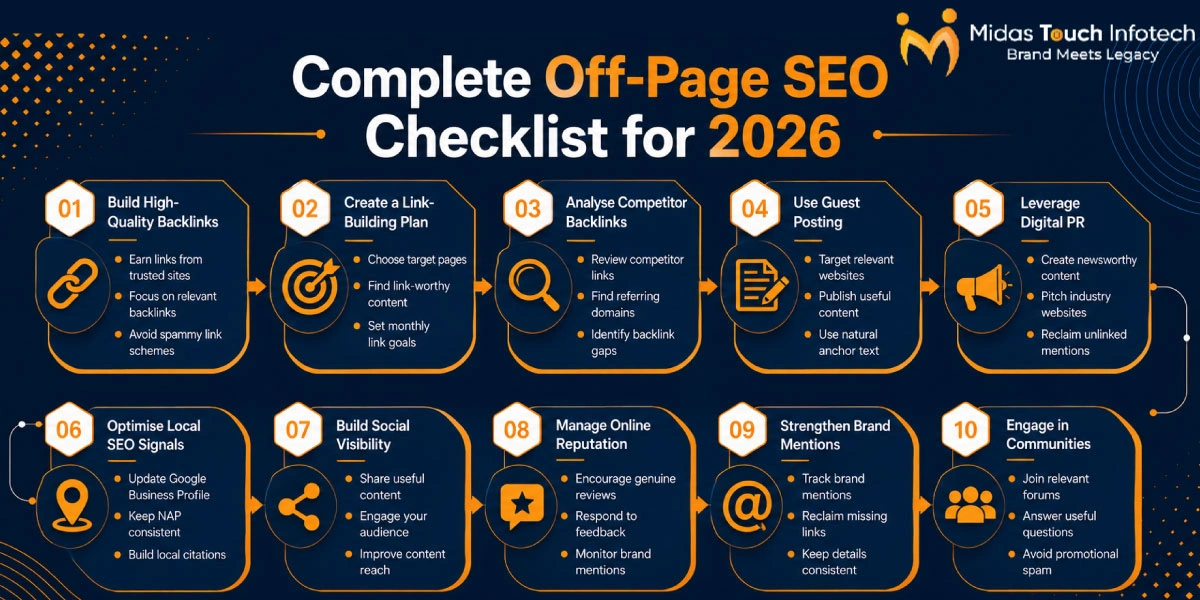
Complete Off-Page SEO Checklist for 2026
1. Build High-Quality Backlinks
Backlinks remain an important area of off-page SEO, but quality should always come before quantity.
Focus on acquiring links from websites that are:
• Relevant to your industry
• Trusted by their audience
• Publishing original content
• Receiving genuine organic traffic
• Contextually connected to your target page
Contextual editorial links within useful articles generally provide greater strategic value than random directory links or mass-produced placements.
Google explicitly classifies links created primarily to manipulate rankings as link spam, including certain paid-link and excessive link-exchange practices.
Therefore:
• Avoid buying bulk backlinks.
• Avoid automated link-building tools.
• Avoid irrelevant directory submissions.
• Avoid excessive reciprocal linking.
• Monitor new and lost backlinks regularly.
The objective should be earning links that make sense even without considering search rankings.
2. Create a Strategic Link-Building Plan
Random outreach rarely produces consistent SEO growth.
Start by identifying the pages you actually want to strengthen. These may include:
• Service pages
• Commercial landing pages
• Research reports
• Industry guides
• Product pages
• Comparison pages
• High-potential blog content
Next, determine which assets give publishers a genuine reason to link.
Useful linkable assets might include:
• Original research
• Industry statistics
• Templates
• Calculators
• Data studies
• Expert reports
• Infographics
• Comprehensive guides
Set realistic monthly goals and measure referring-domain quality rather than only total backlink numbers.
3. Perform Competitor Backlink Analysis
Competitor backlink research can reveal opportunities that already exist within your industry.
Identify competitors ranking for your priority keywords and analyse:
• Their strongest referring domains
• Frequently linked pages
• Guest contributions
• Industry directories
• Resource pages
• News mentions
• Partner links
• Broken backlinks
Look especially for domains linking to several competitors but not your website. These backlink gaps can become high-priority outreach opportunities.
Competitor analysis should inspire your strategy rather than encourage you to copy every link your competitors have.
4. Use Guest Posting Strategically
Guest posting can still be effective when it is based on expertise and audience relevance rather than mass link acquisition.
Prioritise websites closely related to your market.
Before pitching, review:
• Content quality
• Website relevance
• Audience profile
• Organic visibility
• Publishing frequency
• Existing guest contributors
• Editorial standards
Your article should provide genuine value rather than functioning as an advertisement.
Use natural anchor text and link only when the destination genuinely helps readers. Avoid networks publishing hundreds of unrelated guest posts purely for SEO purposes.
5. Leverage Digital PR and Brand Mentions
Digital PR is becoming an increasingly valuable component of the best off page SEO checklist because it can generate visibility, credibility, referral traffic and editorial mentions simultaneously.
Create stories journalists and industry publishers would genuinely want to cover.
Potential ideas include:
• Original research
• Surveys
• Industry forecasts
• Market reports
• Expert commentary
• Data-driven studies
• Company milestones
• New technology insights
Build relationships with journalists, editors and industry publishers instead of contacting them only when you need a backlink.
Also monitor unlinked brand mentions. If a reputable publication has already referenced your company, you may politely ask whether it can link to the relevant source.
Also Read: SEO for AI Overviews: How to Improve Your Brand Visibility
6. Optimise Local SEO Signals
Local businesses should make local authority a major part of their off-page strategy.
Start with your Google Business Profile and ensure your:
• Business name is accurate.
• Address is correct.
• Phone number is current.
• Website URL works.
• Business categories are relevant.
• Operating hours remain updated.
Google’s Business Profile guidelines emphasise accurate representation of real-world business details, including location and service-area information.
Next, build citations across relevant:
• Business directories
• Local chambers
• Industry associations
• Local publications
• Regional business websites
• Maintain consistent NAP (Name, Address and Phone Number) information wherever your company appears.
• Encourage genuine reviews and respond professionally to customer feedback.
7. Build Social Media Visibility
Social media should support your broader content distribution and brand-building strategy.
Share:
• Blog articles
• Research
• Company updates
• Expert opinions
• Case studies
• Videos
• Industry observations
Social platforms can help your content reach journalists, bloggers, customers, partners and industry professionals who may later mention or reference it.
Rather than focusing solely on follower counts, track:
• Content engagement
• Profile visits
• Branded searches
• Website referral traffic
• Industry conversations
• Relevant connections
Social media visibility works best when it creates relationships and content discovery opportunities.
8. Manage Online Reviews and Reputation
Your online reputation can influence how potential customers perceive your organisation before they ever visit your website.
Create a structured process to:
• Request authentic reviews.
• Monitor major review platforms.
• Respond to customer feedback.
• Escalate genuine complaints internally.
• Correct inaccurate business information.
• Track recurring customer concerns.
Google encourages businesses responding to reviews to keep their replies professional, relevant and clear.
Never attempt to manufacture fake reviews. Focus instead on making it easy for genuine customers to share their experiences.
9. Strengthen Brand Mentions and Citations
Not every useful online reference needs to begin with a backlink request.
Monitor mentions of:
• Your brand name
• Product names
• Founders
• Executives
• Proprietary research
•Tools
• Campaigns
Where appropriate, contact publishers mentioning your research, statistics or resources and request attribution.
You should also establish accurate profiles across trusted platforms relevant to your industry.
For B2B companies, these may include:
• Review websites
• Business directories
• Association websites
• Software directories
• Partner ecosystems
• Industry publications
• Consistency helps create a clearer digital presence around your organisation.
10. Use Community and Forum Engagement
Industry communities can support awareness, credibility and referral traffic when used correctly.
Participate on platforms where your target customers genuinely ask questions.
Instead of dropping links everywhere:
• Answer questions thoroughly.
• Share practical advice.
• Join relevant discussions.
• Help users solve problems.
• Reference your resources only when useful.
• Avoid promotional spam.
Google’s spam policies specifically address user-generated spam and manipulative practices, so community participation should focus on helping people rather than manufacturing backlinks.
A useful forum contribution can generate brand awareness even when it produces no followed backlink.
Turn Your Off-Page SEO Checklist Into Measurable Search Growth
The most effective off-page SEO strategies in 2026 are built around quality, relevance, authority and genuine relationships.
Backlinks remain useful because Google continues to use links as part of its search systems, but modern off-page SEO goes much further than link acquisition. Businesses also need to consider digital PR, brand mentions, reviews, citations, local visibility, community engagement and reputation management.
Most importantly, avoid chasing backlink volume for the sake of numbers. Google continues to maintain policies against manipulative link practices and other techniques designed primarily to influence rankings.
Whether you manage SEO internally or work with a professional SEO company, the strongest approach is to build an online presence that reputable publishers, customers and industry communities genuinely want to reference.
A disciplined checklist supported by professional SEO services can turn individual off-page activities into a sustainable authority-building system and create stronger visibility across traditional search and the rapidly evolving AI-powered discovery landscape.

Mit Thakkar
Mit Thakkar, CEO of Midas Touch Infotech and a recognized LinkedIn SEO influencer, possesses extensive expertise in branding, website development, and digital marketing. He excels in transforming ideas into impactful digital strategies.