Summarize this blog post with:


Quick Summary
As AI-powered search continues to grow, businesses need to focus on improving their brand visibility in ChatGPT alongside traditional search engines. Building ChatGPT citations can help companies increase brand awareness, strengthen credibility and attract potential customers. Strategies such as creating helpful content, building brand authority, implementing GEO and AEO, and publishing original research can improve opportunities for AI-generated citations.
This guide explores 10 practical strategies to increase ChatGPT brand citations in 2027, including technical SEO, digital PR, structured data, content updates and citation tracking. It also explains which content types may earn citations, how to measure AI search visibility and why consistent optimisation is important for long-term business growth.
- Key Takeaways
- How to Increase Brand Citations in ChatGPT: 10 Proven Strategies for 2027
- What Are Brand Citations in ChatGPT?
- Why Do Brand Citations Matter for Businesses in 2027?
- How Does ChatGPT Choose Sources for Citations?
- 10 Proven Strategies to Increase Brand Citations in ChatGPT
- 1. Create Helpful, Answer-Focused Content
- 2. Build Brand Authority on Trusted Websites
- 3. Optimise Content for GEO and AEO
- 4. Publish Original Research and Case Studies
- 5. Invest in Digital PR and Guest Posting
- 6. Improve Website Crawlability
- 7. Strengthen Your Brand Presence Online
- 8. Use Structured Data and Clear Formatting
- 9. Keep Your Content Fresh and Updated
- 10. Track Brand Citations and Improve Your Strategy
- How to Track Your Brand Citations in ChatGPT
- ❖ Popular AI Citation Tracking Tools
- ❖ Important Metrics to Track
- How Long Does It Take to Improve ChatGPT Brand Citations?
- ➥ Existing Brand Authority
- ➥ Quality of Published Content
- ➥ Industry Competition
- ➥ Website Accessibility
- ➥ Consistent GEO Efforts
- Ready to Get Your Brand Cited More Often in ChatGPT?
How to Increase Brand Citations in ChatGPT: 10 Proven Strategies for 2027
The way people discover brands, research products and compare services is changing rapidly. Instead of relying only on traditional search engines, users increasingly turn to AI-powered platforms like ChatGPT for direct answers, business recommendations and industry insights. This shift creates new opportunities for businesses to improve their online visibility through chatgpt citations and AI-generated brand mentions.
According to a 2026 Semrush study, outbound referral traffic from ChatGPT to external websites grew by 206% in 2025. The research analysed 17 months of clickstream data, highlighting the growing role of ChatGPT in online discovery and website traffic.
For businesses investing in professional seo services india, this changing search behaviour creates a need to expand beyond traditional keyword rankings. Companies must now consider how their websites, content and brand information appear in AI-generated search results.
Brand citations in ChatGPT can help potential customers discover reliable information about your business. When ChatGPT references a website while answering relevant questions, it may encourage users to explore the source and learn more about its services.
What Are Brand Citations in ChatGPT?
Brand citations in ChatGPT refer to instances where the AI platform references a company’s website, articles or other online sources while answering user questions. These citations may include clickable links that allow users to explore the original information. For businesses, appearing in relevant ChatGPT responses can create opportunities to reach potential customers who are researching products, services or industry solutions.
Unlike traditional search results, ChatGPT can provide direct answers supported by selected sources. Websites offering accurate, helpful and trustworthy information may have opportunities to be referenced in these responses. Building chatgpt citations for brand visibility can help businesses strengthen their online presence, demonstrate industry expertise and connect with audiences using AI-powered search.
Why Do Brand Citations Matter for Businesses in 2027?
As more people use ChatGPT to research products, compare services and explore business solutions, brand citations are becoming an additional opportunity for online visibility. When ChatGPT references your website in a relevant response, it can introduce your brand to potential customers and encourage them to explore your offerings. This may improve brand awareness and generate referral traffic from users interested in learning more about your business.
Brand citations can also support trust, credibility and long-term brand authority. Businesses that consistently publish accurate information, expert insights and valuable industry content can strengthen their reputation among potential customers. In 2027, focusing on chatgpt citations alongside traditional SEO and GEO strategies can help companies expand their digital presence and create more opportunities to attract qualified leads.
ALso Read : 15 Best SEO Automation Tools to Save Time and Boost Rankings in 2027
How Does ChatGPT Choose Sources for Citations?
ChatGPT selects sources based on their relevance, usefulness and ability to support accurate answers to user queries. Content that directly addresses user questions, provides valuable insights and includes reliable information has a stronger foundation for citation opportunities. Trusted online sources, industry expertise and well-researched content can help businesses improve their visibility in AI-powered search results.
Clear content structure and website accessibility also play important roles in AI search discovery. Websites with descriptive headings, organised information and accessible pages make it easier for search systems to find and understand relevant content. Keeping articles updated with recent statistics, accurate facts and industry insights can further improve content quality. However, these practices do not guarantee ChatGPT citations, as source selection depends on the specific query and available information.
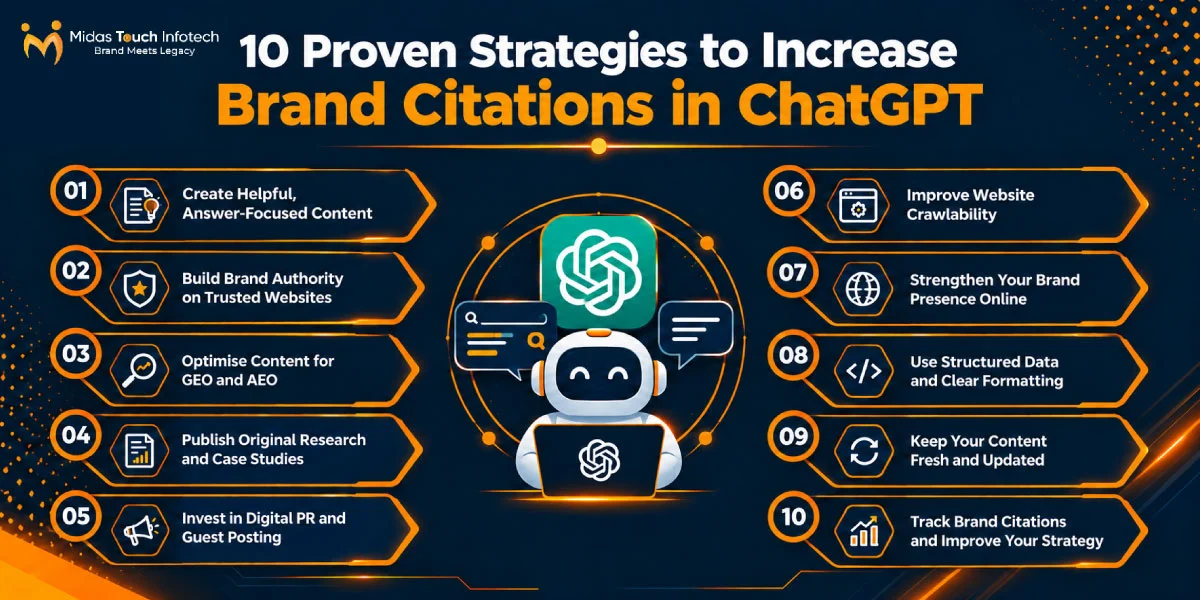
10 Proven Strategies to Increase Brand Citations in ChatGPT
Improving ChatGPT citations requires a connected approach that combines content quality, authority building and technical optimisation.
The following 10 strategies can help businesses strengthen their opportunities to be discovered and referenced in AI-generated search results.
1. Create Helpful, Answer-Focused Content
Creating content that directly answers user questions is one of the most practical ways to improve AI search readiness.
ChatGPT users often ask detailed, conversational questions rather than entering short keywords.
For example, instead of searching for “ERP software”, a user might ask:
“What factors should a manufacturing company consider before implementing ERP software?”
Businesses should create content that answers such questions clearly and comprehensively.
How to implement this strategy:
• Identify frequently asked customer questions.
• Create content around informational and commercial search intent.
• Provide direct answers before detailed explanations.
• Add real-world examples and supporting information.
• Avoid unnecessary promotional language.
Companies investing in seo consulting services india can also use traditional search data to identify valuable questions and content opportunities.
For example, Google Search Console can reveal existing queries that attract impressions but have limited engagement.
These insights can help businesses create more relevant articles, service pages and industry guides.
The goal is to make content useful enough to answer a specific question while providing additional information for readers who want greater detail.
2. Build Brand Authority on Trusted Websites
Brand authority develops when a company consistently demonstrates expertise across credible online sources.
For ChatGPT visibility, businesses should avoid relying exclusively on content published on their own websites.
Independent industry mentions can create additional opportunities for people and search systems to discover information about a company.
Effective authority-building approaches include:
• Earn relevant backlinks from established websites.
• Contribute expert insights to industry publications.
• Participate in professional discussions and interviews.
• Publish informative content on respected industry platforms.
• Develop relationships with credible industry organisations.
For example, a cybersecurity company could contribute an expert article to an established technology publication about common enterprise security challenges.
The article provides value to readers while creating an opportunity for the company to demonstrate its expertise.
However, not all backlinks or brand mentions provide equal value.
Businesses should prioritise relevant, credible placements rather than purchasing large volumes of low-quality links.
A strong digital reputation supports long-term discoverability, but backlinks alone do not determine ChatGPT citations.
3. Optimise Content for GEO and AEO
Generative Engine Optimisation (GEO) and Answer Engine Optimisation (AEO) are increasingly relevant to modern SEO strategies.
AEO focuses on making content suitable for answering specific user questions.
GEO focuses more broadly on improving the visibility and representation of information within generative AI responses.
Both approaches can help businesses optimize content for chatgpt citations through useful content structure and stronger information quality.
Important optimisation techniques include:
• Use question-based H2 and H3 headings.
• Provide concise answers near the beginning of sections.
• Organise complex topics into clear explanations.
• Include accurate data and supporting references.
• Add practical examples and comparisons.
• Maintain consistent terminology across related pages.
For instance, a company offering automation testing services could publish an article explaining:
“What is the difference between manual and automated software testing?”
The article should begin with a straightforward answer before discussing advantages, limitations, costs and practical use cases.
This approach helps readers obtain quick information while providing enough depth for more complex research.
GEO and AEO should complement traditional SEO rather than replace it.
4. Publish Original Research and Case Studies
Original research is particularly valuable because it provides information that may not be available from competing websites.
Instead of repeating common industry statistics, businesses can publish their own findings, surveys and performance insights.
This creates distinctive resources that other websites and researchers may reference.
Content opportunities include:
• Industry research reports.
• Customer behaviour surveys.
• Technology adoption studies.
• Performance benchmarking reports.
• Detailed implementation case studies.
For example, a software testing company could publish a report based on application testing projects completed during the previous year.
The report might examine common performance issues, testing challenges and measurable improvements.
Such content can help readers understand real industry conditions rather than relying exclusively on general advice.
When publishing case studies, businesses should explain the original problem, implementation process and measurable results.
All statistics should be supported by reliable methodologies and verifiable evidence.
Original information can increase content usefulness and citation opportunities, although publication alone does not guarantee that ChatGPT will reference it.
5. Invest in Digital PR and Guest Posting
Digital PR and guest posting can help businesses build awareness outside their existing audiences.
These strategies involve sharing useful information through relevant publications, professional communities and industry websites.
For example, an AI development company may contribute an article about enterprise AI adoption challenges to a technology publication.
Readers can gain useful insights while learning about the company’s technical expertise.
Practical digital PR activities include:
• Publish expert guest articles.
• Share industry research with journalists.
• Contribute insights to relevant publications.
• Participate in expert interviews.
• Build relationships with industry publishers.
• The emphasis should remain on providing genuine value.
Guest articles should address the publication’s audience rather than function as advertisements for the contributing company.
Digital PR also creates opportunities for independent brand mentions and credible references.
These signals can help establish a more complete online presence and support broader GEO efforts.
Businesses should avoid paid link schemes, mass-produced guest articles and irrelevant placements because they may damage credibility and provide little meaningful marketing value.
6. Improve Website Crawlability
Even high-quality content may struggle to gain search visibility if important pages cannot be accessed by search crawlers.
Technical SEO therefore remains an essential part of preparing websites for AI search discovery.
Businesses should ensure that relevant content is publicly accessible, technically reliable and easy to navigate.
Important technical improvements include:
• Review robots.txt rules.
• Allow OAI-SearchBot where appropriate.
• Fix broken internal links and unnecessary redirects.
• Resolve important indexing issues.
• Improve mobile usability and page performance.
• Make important information accessible in page HTML.
OpenAI distinguishes between OAI-SearchBot, which supports search discovery, and GPTBot, which is associated with content collection for potential model training.
Website owners can manage access for these crawlers independently.
OpenAI Developers
For example, a business can allow OAI-SearchBot while restricting GPTBot, depending on its content policies.
A website should also avoid hiding essential service information exclusively inside inaccessible scripts or restricted documents.
Clear internal linking helps users and search systems discover related content.
However, improved crawlability only makes content more accessible. It does not guarantee that ChatGPT will cite a particular page.
7. Strengthen Your Brand Presence Online
A consistent online presence helps potential customers find reliable information about your business.
When different platforms show conflicting details, users may struggle to understand which information is correct.
Businesses should therefore maintain accurate brand information across their websites and relevant third-party platforms.
Important activities include:
• Create complete business profiles.
• Maintain consistent company names and descriptions.
• Update official website and contact information.
• Participate in relevant professional directories.
• Keep LinkedIn and other business profiles accurate.
• Highlight verified certifications and industry expertise.
For example, an IT consulting company should clearly communicate its services, target industries and operating locations across its official website and professional profiles.
Relevant industry directories can also provide useful discovery opportunities.
However, businesses should avoid submitting their details to hundreds of low-quality directories simply to generate mentions.
Prioritise platforms that customers genuinely use when researching service providers.
Consistency supports brand recognition and helps reduce confusion during vendor evaluation.
8. Use Structured Data and Clear Formatting
Structured data provides machine-readable information that helps supported search systems interpret certain details about a webpage.
For businesses, appropriate schema markup can clarify information about the organisation, articles, products and other supported entities.
However, there is no special schema type that guarantees ChatGPT citations.
Schema should be treated as a supporting technical SEO practice rather than a direct AI citation shortcut.
Useful optimisation practices include:
• Implement relevant Organization schema.
• Add Article schema to suitable editorial content.
• Use valid structured data that matches visible page information.
• Organise articles with descriptive headings.
• Present important facts in readable formats.
• Ensure each page has a clear primary topic.
For example, a software development company’s service page can explain its capabilities, delivery process and industry experience through a clear heading structure.
Technical documentation should also provide direct explanations of important concepts.
When researching chatgpt for citations, businesses should focus on presenting accurate information in accessible formats rather than using special markup or hidden instructions intended to influence AI responses.
The ultimate objective is to make content easier for both people and automated systems to understand.
9. Keep Your Content Fresh and Updated
Outdated information can reduce the usefulness and credibility of business content.
This is particularly important in industries such as technology, cybersecurity, software development and digital marketing, where practices change frequently.
Businesses should regularly review pages that contain time-sensitive information.
Content updates may involve:
• Replacing outdated industry statistics.
• Updating product and service information.
• Revising technical recommendations.
• Adding recent research findings.
• Fixing broken references.
• Improving examples and comparisons.
For example, an article about AI automation trends written in 2024 may no longer reflect the capabilities and limitations of current AI systems.
Refreshing the article with accurate, recent information can improve its relevance for readers researching the topic in 2027.
However, businesses should avoid changing publication dates without making meaningful content improvements.
A useful update should improve accuracy, depth or relevance.
Content freshness is valuable when it reflects genuine changes, not simply because a page displays a newer date.
10. Track Brand Citations and Improve Your Strategy
Businesses cannot understand their AI search visibility without regularly measuring how their brands appear in relevant responses.
Citation tracking helps identify which topics generate brand mentions and which competitors receive greater exposure.
Start by creating a list of questions potential customers may ask ChatGPT.
These questions might relate to:
• Your main services.
• Industry challenges.
• Product comparisons.
• Vendor recommendations.
• Implementation costs.
• Business solutions.
• Monitor the responses using a consistent set of prompts.
Important activities include:
• Track brand mentions and source citations separately.
• Identify frequently cited competitor websites.
• Evaluate which content topics generate visibility.
• Review the accuracy of brand descriptions.
• Compare results across reporting periods.
• Prioritise pages with clear improvement opportunities.
For example, if competitor research reports are frequently cited for an industry topic, your business may benefit from publishing stronger original research.
The purpose of monitoring is not to manipulate AI responses.
Instead, tracking helps identify information gaps and improve the usefulness of your content.
Because ChatGPT responses can vary across sessions and circumstances, performance should be assessed over multiple observations.
How to Track Your Brand Citations in ChatGPT
Tracking brand citations in ChatGPT helps businesses understand how frequently their websites and content appear in AI-generated responses. Unlike traditional SEO, where performance is measured through rankings and organic traffic, AI citation tracking focuses on brand mentions, cited sources and visibility across relevant search queries.
Regular monitoring can help businesses identify content gaps, evaluate competitors and improve their GEO strategies.
❖ Popular AI Citation Tracking Tools
Several AI visibility monitoring tools help businesses analyse their presence across ChatGPT and other AI-powered search platforms.
• Profound: Provides AI search visibility analytics, brand citation monitoring and competitor insights to help businesses understand their presence in AI-generated responses.
• Peec AI: Helps track brand mentions, citation sources and competitor visibility across supported AI search platforms.
• Otterly.AI: Monitors AI search results, brand mentions and website citations to identify opportunities for content optimisation.
• Rankscale: Offers AI visibility tracking, citation analysis and performance monitoring to help businesses evaluate their GEO efforts.
• Semrush: Combines SEO research with AI visibility features to analyse brand performance, competitors and opportunities across AI search.
• Ahrefs Brand Radar: Helps businesses monitor brand mentions, cited domains and their visibility across supported AI search experiences.
❖ Important Metrics to Track
Tracking the right metrics helps businesses evaluate their ChatGPT citation performance and identify opportunities to improve AI search visibility. A professional seo company can help analyse these metrics alongside traditional SEO performance to develop a more effective GEO strategy.
• Brand Mention Frequency: Measure how often ChatGPT mentions your business in responses to relevant user queries.
• Citation Frequency: Track how frequently ChatGPT references your website or content as a source.
• AI Search Visibility: Monitor your brand’s presence across ChatGPT and other AI-powered search platforms.
• Competitor Visibility: Compare your brand mentions and citations with competitors to identify opportunities for improvement.
• ChatGPT Referral Traffic: Analyse website visits originating from ChatGPT using tools such as Google Analytics 4.
Regularly monitoring these metrics helps businesses understand their AI search performance, improve content strategies and identify opportunities to attract relevant website visitors and potential customers.
Also Read : 10 Best SEO Agencies in Dallas Helping Businesses Grow Online
How Long Does It Take to Improve ChatGPT Brand Citations?
There is no fixed timeline for improving brand citations in ChatGPT.
Results depend on website authority, content quality, industry competition, technical accessibility and how frequently relevant information is discovered.
Several factors can influence progress.
➥ Existing Brand Authority
Established brands with credible industry coverage may already have information available across multiple relevant sources.
Newer businesses may need more time to build comparable visibility.
➥ Quality of Published Content
Content that provides original insights and directly addresses customer questions may create stronger opportunities for discovery.
Publishing large volumes of generic articles is unlikely to deliver the same value.
➥ Industry Competition
Highly competitive industries often contain numerous established brands with extensive content and independent coverage.
Businesses operating in these sectors may need more distinctive research and expertise to stand out.
➥ Website Accessibility
Technical issues can delay or prevent content discovery.
Improving crawling access and resolving website problems should be among the earliest activities.
➥ Consistent GEO Efforts
Brand citations can fluctuate even when a business makes meaningful improvements.
For practical planning, companies can organise their efforts into an initial technical and content audit, followed by regular publishing, authority-building and monthly performance reviews.
These are workflow stages rather than guaranteed ranking or citation timelines.
Businesses should evaluate changes over several reporting periods and avoid assuming that individual citations will remain visible permanently.

Ready to Get Your Brand Cited More Often in ChatGPT?
As AI-powered search becomes an increasingly important part of online research, businesses need to think beyond traditional search rankings. Building stronger chatgpt citations can create opportunities to improve brand discovery, demonstrate expertise and attract potential customers through relevant AI-generated responses. However, achieving meaningful visibility requires accurate content, trusted brand references and a technically accessible website.
Combining Generative Engine Optimisation (GEO), Answer Engine Optimisation (AEO) and traditional SEO provides a practical foundation for long-term AI search visibility. Working with a professional seo consultant can help businesses identify content gaps, strengthen website performance, evaluate brand citations and develop strategies aligned with their marketing objectives.
Investing in expert GEO services and consistent content optimisation can help businesses prepare for the evolving AI search landscape in 2027. By publishing original insights, improving technical SEO and building genuine industry authority, companies can strengthen their opportunities to be discovered, referenced and considered by potential customers using ChatGPT.
Key-Takeaways
- Understand ChatGPT Citations: Learn how brand mentions and website citations can improve visibility in AI-generated search results.
- Create Helpful Content: Publish answer-focused articles, industry guides, original research, and case studies that address user questions.
- Optimise for GEO and AEO: Use clear headings, direct answers, structured content, and relevant information to improve AI search visibility.
- Build Brand Authority: Strengthen credibility through trusted websites, digital PR, guest posting, and relevant industry mentions.
- Improve Technical SEO: Ensure website accessibility, crawlability, mobile usability, and proper structured data implementation.
- Track AI Search Visibility: Monitor brand mentions, citation frequency, competitor visibility, and ChatGPT referral traffic.
- Focus on Long-Term Growth: Regularly update content, maintain accurate brand information, and combine traditional SEO with GEO strategies.

mds@admin
The goal of taking up SEO marketing is to increase the visibility of your web page and attract more customers and visitors to the same. There are different types of SEO strategies, and On-Page SEO strategies are a major part of the suggestions SEO agencies make to clients. To create a wholesome, well-targeted SEO strategy, both on-page SEO and off-page SEO have to be done.