Summarize this blog post with:


- Top Logo Design Trends Shaping Brand Identity in 2026
- Why Logo Design Matters for Brand Identity in 2026
- 🢧 First Impressions Influence Brand Perception
- 🢧 Logos Help Build Strong Brand Recall
- 🢧 Modern Logos Must Work Across Digital Platforms
- Top Logo Design Trends Shaping Brand Identity in 2026
- 1. Adaptive and Responsive Logos
- 2. AI-Assisted Logo Design
- 3. Neo-Minimalist Logos
- 4. Expressive Typography and Custom Wordmarks
- 5. Bold Colour Palettes
- 6. Organic and Human-Centred Logo Shapes
- 7. Retro-Futuristic Logo Styles
- 8. Motion-Friendly Logos
- 9. Symbol-Driven Brand Marks
- 10. Sustainable and Purpose-Led Logo Design
- How Businesses Should Choose the Right Logo Trend
- ✦ Focus on Brand Strategy First
- ✦ Prioritise Scalability and Usability
- ✦ Keep the Target Audience in Mind
- ✦ Balance Trend and Timelessness
- Common Logo Design Mistakes to Avoid in 2026
- ➥ Copying Competitor Logo Styles
- ➥ Overusing AI Without Brand Strategy
- ➥ Choosing Complex Designs
- ➥ Ignoring Brand Consistency
- Ready to Build a Logo That Defines Your Brand’s Future?
Top Logo Design Trends Shaping Brand Identity in 2026
A logo is no longer just a small design placed on a website, visiting card, brochure, or product package. In 2026, a logo has become one of the most important parts of a brand’s complete identity system. It helps people recognise a business, remember its message, understand its personality, and build trust even before they speak to the company.
Today’s customers interact with brands across multiple platforms. They may first see your business on Google, then visit your website, check your Instagram profile, view your LinkedIn page, watch a reel, read a review, or compare your product with competitors. In all these touchpoints, your logo plays a major role in creating a consistent and professional brand image.
A Lucidpress/Marq brand consistency report found that consistent branding can increase revenue by up to 33%. This shows how important visual consistency is for business growth. A strong logo supports this consistency by giving your brand a clear and memorable identity across digital and offline platforms.
For businesses looking for professional logo design Ahmedabad, 2026 is the right time to move beyond outdated logo styles and invest in a logo that is modern, flexible, scalable, and future-ready. Whether you are a startup, SME, corporate brand, product company, SaaS business, or service provider, your logo should communicate who you are and why customers should trust you.
This blog covers the top logo design trends 2026 that are shaping brand identity and helping businesses stand out in a competitive market.
Why Logo Design Matters for Brand Identity in 2026
Logo design is one of the most powerful elements of brand identity. It works as the face of your business and creates an instant connection with your target audience. In 2026, where competition is high and attention spans are short, businesses need logos that are simple, meaningful, and easy to remember.
A well-designed logo does more than look attractive. It communicates brand values, industry positioning, personality, professionalism, and trust. This is why working with a reliable logo design company in Ahmedabad can help businesses create a visual identity that supports long-term growth.
🢧 First Impressions Influence Brand Perception
A logo is often the first thing customers notice about a business. Before they read your website content, check your service details, or speak to your sales team, they form an opinion based on your visual presentation.
A professional logo can make your brand look trustworthy, stable, and credible. On the other hand, a poor or outdated logo can create the impression that your business is not modern or serious about quality.
For example, if two companies offer similar services, customers may naturally feel more confident about the company that has a clean, professional, and polished logo. This is because design influences perception. A strong logo gives your business a better chance to create a positive first impression.
🢧 Logos Help Build Strong Brand Recall
Brand recall is the ability of customers to remember your business when they need your product or service. A memorable logo makes this easier.
Think about some of the biggest brands in the world. Many people can recognise them only by their symbol, colour, or typography. This is the power of consistent logo design.
For growing businesses, logo recall is equally important. When your logo is used consistently across your website, social media, packaging, email signatures, business profiles, presentations, and marketing materials, people start becoming familiar with your brand.
This familiarity supports trust. Over time, customers begin to connect your logo with your service quality, brand promise, and customer experience.
🢧 Modern Logos Must Work Across Digital Platforms
In the past, businesses mainly used logos on printed materials, signboards, catalogues, and office stationery. Today, logos must perform well across many digital platforms.
Your logo should look clear on websites, mobile apps, social media profile pictures, Google Business Profile, WhatsApp display photos, email templates, online ads, videos, reels, presentations, favicons, and product images.
This is why modern logo design requires flexibility. A business may need a full logo, short logo, icon version, black-and-white version, horizontal version, vertical version, and animated version. If your logo is too detailed, it may not work well on small screens.
A scalable logo helps maintain brand consistency everywhere. It ensures your business looks professional whether a customer sees you on a large desktop screen or a small mobile icon.
Top Logo Design Trends Shaping Brand Identity in 2026
The world of logo design is changing quickly. Businesses now want logos that are clean, digital-friendly, emotionally connected, and strategically designed. The following logo design trends are expected to shape brand identity in 2026.
1. Adaptive and Responsive Logos
Adaptive logos are one of the most important current logo design trends. These logos are created in different versions so they can adjust according to the platform, screen size, and usage.
For example, a brand may use a full logo on its website header, a compact symbol on social media, a simplified mark on a mobile app, and a monochrome version on packaging or documents.
This trend is important because customers interact with brands across multiple touchpoints. A logo that looks perfect on a website may not look good as a small Instagram profile image. Similarly, a detailed logo may lose clarity when used as a favicon or mobile app icon.
Responsive logo design solves this issue. It allows businesses to maintain a consistent identity while adjusting the logo format based on the space available.
This trend is especially useful for digital-first brands, ecommerce businesses, SaaS companies, mobile apps, consulting firms, and service-based businesses that use multiple online platforms.
2. AI-Assisted Logo Design
AI is changing the way designers explore ideas, create concepts, and test logo variations. One of the major ai logo design trends 2026 is the use of AI-assisted design tools to speed up the creative process.
AI can help generate multiple logo concepts, suggest colour palettes, explore typography combinations, create layout variations, and visualise different brand styles. This gives designers a faster starting point and allows businesses to see more possibilities during the concept stage.
However, AI cannot fully replace human creativity and brand strategy. A logo needs meaning, originality, positioning, and emotional connection. AI may create designs quickly, but a professional designer understands the business goal, audience, industry, competition, and long-term brand direction.
The best approach in 2026 is a combination of AI support and human design thinking. AI can help with exploration, but the final logo should be refined by a creative expert who can make it unique, strategic, and brand-focused.
Also Read : Creative Brand Logo Design Ideas to Build Strong Brand Identity
3. Neo-Minimalist Logos
Minimalism has been popular for many years, but in 2026, it is evolving into neo-minimalism. This trend keeps the clean and simple look of minimal design but adds more personality, warmth, and uniqueness.
Neo-minimalist logos use clean layouts, soft curves, balanced spacing, simple shapes, and refined typography. They avoid unnecessary decoration but still feel distinctive.
This is one of the strongest modern logo design trends because it works well across digital and print platforms. A simple logo is easier to remember, easier to scale, and easier to use across different brand assets.
Neo-minimalist logos are especially suitable for technology companies, SaaS brands, finance firms, consulting businesses, architecture firms, healthcare brands, and premium service providers.
The main benefit of this trend is clarity. It helps brands look modern, professional, and confident without making the design too complex.
4. Expressive Typography and Custom Wordmarks
Typography-based logos are becoming more creative in 2026. Instead of using common fonts, brands are choosing custom lettering and expressive typography to build a unique personality.
A wordmark logo uses the brand name as the main design element. When done well, it can be simple, powerful, and memorable. Custom typography can make a brand look bold, elegant, playful, premium, innovative, or friendly depending on the design style.
This trend is useful for businesses that want a clean logo but still need a strong visual identity. It works well for fashion brands, creative agencies, personal brands, restaurants, consulting firms, technology companies, and lifestyle businesses.
Expressive typography also helps brands avoid looking generic. Since many businesses use similar icons and symbols, a custom wordmark can give your brand a more original look.
In 2026, typography will continue to play a major role in logo identity because it allows businesses to create a simple but highly recognisable brand mark.
5. Bold Colour Palettes
Colours play a major role in brand identity. They influence mood, emotion, recognition, and audience response. In 2026, brands are becoming more confident with bold and expressive colour palettes.
Bright colours, strong contrasts, gradients, and unique colour combinations are being used to create attention-grabbing logos. These colours help brands stand out in crowded digital spaces, especially on social media and mobile platforms.
However, bold colours should not be selected randomly. Every colour should support the brand’s message and personality. For example, blue may communicate trust and stability, green may reflect growth or sustainability, red may show energy and passion, and black may represent premium positioning.
The key is to balance creativity with brand relevance. A bold colour palette can make your logo memorable, but it should still feel suitable for your industry and audience.
This trend is highly effective for startups, tech brands, creative businesses, ecommerce stores, youth-focused brands, and companies that want to appear energetic and modern.
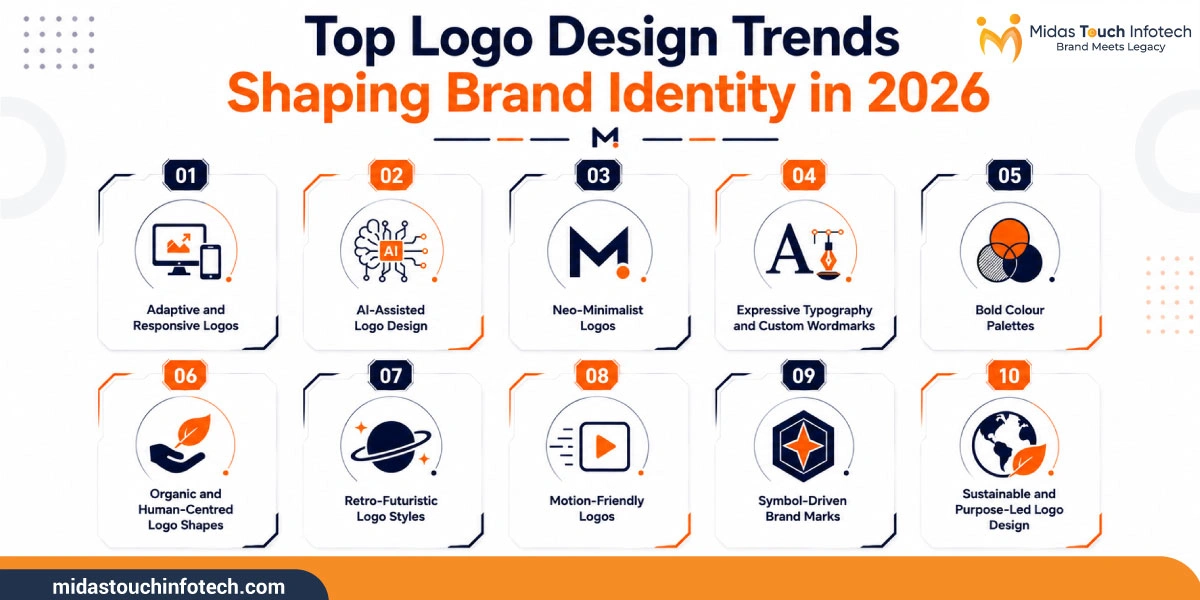
6. Organic and Human-Centred Logo Shapes
As digital experiences become more automated and technology-driven, many brands are moving towards human-centred design. This includes logos with soft shapes, natural curves, hand-drawn elements, and organic forms.
Organic logo shapes make brands feel approachable, warm, friendly, and authentic. Instead of sharp and rigid designs, these logos use smooth lines and natural flow.
This trend works well for wellness brands, food businesses, lifestyle companies, healthcare providers, education brands, handmade product businesses, sustainability companies, and community-driven organisations.
Organic design helps create an emotional connection with audiences. It gives the brand a softer and more trustworthy feel. For businesses that want to appear caring, natural, personal, or purpose-led, this trend can be very effective.
In 2026, organic logos will become more popular as customers continue to value authenticity and human connection.
7. Retro-Futuristic Logo Styles
Retro-futuristic logos combine vintage inspiration with modern design. This trend includes bold geometry, nostalgic typography, futuristic details, chrome effects, neon-inspired colours, and old-school design references with a fresh approach.
The reason this trend is gaining popularity is that it creates a mix of familiarity and innovation. Customers may feel a sense of nostalgia while still seeing the brand as modern and forward-thinking.
Retro-futuristic logos are useful for entertainment brands, gaming companies, fashion labels, music brands, cafes, technology products, creative studios, and youth-focused businesses.
This is one of the more expressive modern logo design trends 2026 because it allows brands to show personality and creativity. However, it should be used carefully. If the style does not match the brand’s positioning, it may look forced or confusing.
For businesses exploring logo design services for businesses, this trend can be a good option when the brand wants a bold, memorable, and visually different identity.
8. Motion-Friendly Logos
Video content is growing across websites, reels, presentations, digital ads, YouTube, product demos, and app experiences. Because of this, businesses now need logos that can work in motion.
Motion-friendly logos are designed in a way that they can be animated easily. This may include moving symbols, appearing typography, changing shapes, dynamic transitions, or simple animated effects.
Animated logos can make a brand look more modern and engaging. They are useful for brand videos, social media reels, app loading screens, website banners, event presentations, and digital advertisements.
A motion logo can also improve brand recall because movement naturally attracts attention. However, the animation should be simple and meaningful. Too much movement can make the logo look unprofessional.
In 2026, motion-friendly logo design will become more important for brands that use video marketing, digital campaigns, and interactive platforms.
9. Symbol-Driven Brand Marks
Simple symbols are becoming powerful identity tools. Many brands are moving towards icon-based logos, abstract marks, geometric symbols, and simplified brand marks.
A strong symbol can make a brand instantly recognisable. It can be used independently across digital platforms, packaging, apps, merchandise, and marketing materials.
Symbol-driven logos are especially useful for global brands because symbols can often communicate beyond language barriers. They are also effective for digital-first businesses because icons work well in small spaces.
However, a symbol should not be selected only because it looks attractive. It must connect with the brand idea, values, industry, or story. A random symbol may look good but fail to create meaning.
In 2026, businesses will prefer simple and meaningful symbols that can grow into strong brand assets over time.
10. Sustainable and Purpose-Led Logo Design
Consumers are becoming more aware of sustainability, ethics, responsibility, and social impact. As a result, many brands are choosing logo designs that communicate purpose and trust.
Sustainable and purpose-led logos often use clean visuals, earthy colours, natural shapes, simple typography, and meaningful symbols. These logos avoid excessive decoration and focus on clarity, responsibility, and authenticity.
This trend is suitable for eco-friendly brands, healthcare companies, education businesses, organic product brands, NGOs, wellness brands, ethical fashion labels, and social impact organisations.
A purpose-led logo should not just look natural; it should reflect the real values of the business. If the brand claims sustainability but does not practise it, the identity may feel weak or misleading.
In 2026, purpose-led design will continue to grow because customers want to support brands that stand for something meaningful.
How Businesses Should Choose the Right Logo Trend
Following logo trends can help your brand look fresh and modern, but choosing the right trend requires strategy. Not every trend is suitable for every business. A logo should be based on brand positioning, audience expectations, industry standards, and long-term goals.
A professional logo design agency in Ahmedabad can help businesses understand which trend fits their brand and how to apply it without losing originality.
✦ Focus on Brand Strategy First
A logo should never be created only because a particular style is trending. Trends can inspire the design direction, but brand strategy should always come first.
Before designing a logo, businesses should clearly define their brand purpose, target audience, values, personality, industry positioning, and competitive difference.
For example, a financial consulting firm may need a logo that communicates trust and stability. A children’s product brand may need a playful and colourful identity. A luxury brand may need a refined and premium logo. A tech startup may need a sharp, modern, and scalable design.
When strategy is clear, the logo becomes more meaningful. It does not just look good; it supports the business message.
✦ Prioritise Scalability and Usability
A logo should work in every size and format. It should look clear on a large billboard and also remain readable as a small social media icon.
Scalability is one of the most important parts of professional logo design. If a logo has too many details, thin lines, small text, or complex effects, it may not work well on mobile screens, packaging, documents, or digital ads.
Businesses should also check how the logo looks in colour, black and white, single colour, print format, digital format, and transparent background.
A good logo is not only beautiful; it is practical. It should be easy to use across all brand materials without losing clarity.
✦ Keep the Target Audience in Mind
Your logo should connect with the people you want to attract. Different audiences respond to different visual styles.
A luxury audience may prefer elegant typography, premium colours, and refined spacing. A young audience may connect better with bold colours, expressive shapes, and modern layouts. A corporate audience may expect clean, professional, and trustworthy design.
Understanding your audience helps you choose the right design direction. It also prevents your logo from becoming too personal or random.
A logo should represent your brand, but it should also make sense to your customers. When your target audience understands and remembers your logo, it becomes a stronger business asset.
✦ Balance Trend and Timelessness
Trends can make your logo look current, but timeless design keeps it relevant for many years. The best logos balance both.
A logo that follows trends too heavily may look outdated after a short time. On the other hand, a logo that ignores modern design expectations may look old-fashioned.
The goal is to create a logo that feels fresh in 2026 but does not lose value quickly. This can be achieved through clean design, meaningful symbolism, strong typography, balanced colours, and flexible logo systems.
A future-ready logo should support your brand today and continue to work as your business grows.
Also Read : Logo Design for School: Choosing the Right Design Agency for Your Institution
Common Logo Design Mistakes to Avoid in 2026
Many businesses invest in logo design but still fail to build a strong identity because of common mistakes. Avoiding these mistakes can help you create a more professional and effective logo.
➥ Copying Competitor Logo Styles
Copying competitor logos is one of the biggest mistakes a business can make. It reduces originality and creates confusion in the market.
Your logo should help your brand stand apart, not look similar to others. If customers cannot differentiate your logo from competitors, your brand recall becomes weak.
Competitor research is important, but it should be used to understand the market, not to copy design styles. A strong logo should reflect your own brand story, values, and positioning.
Originality is important for long-term brand identity. A unique logo gives customers a clear reason to remember you.
➥ Overusing AI Without Brand Strategy
AI tools can create logo options quickly, but using AI without strategy can lead to generic designs. Many AI-generated logos may look visually attractive but lack meaning, originality, and business relevance.
A logo should not be selected only because it looks modern. It should communicate something important about the brand.
Human review is necessary to check whether the logo is unique, scalable, legally safe, relevant to the audience, and suitable for long-term branding.
AI can be a helpful tool, but it should not replace brand thinking. Businesses should use AI for idea generation and then refine the final logo with professional design expertise.
➥ Choosing Complex Designs
Complex logos often create usability problems. Too many colours, shapes, fonts, icons, or effects can make the logo difficult to understand and remember.
A complex logo may look good in a large presentation, but it may fail on small screens, favicons, mobile apps, social media icons, and product labels.
Simple logos are easier to recognise, reproduce, and remember. This does not mean the design should be boring. A simple logo can still be creative, meaningful, and premium.
In 2026, clarity is more important than decoration. Customers should be able to understand and recognise your logo quickly.
➥ Ignoring Brand Consistency
A logo should not be used randomly. It should match your brand colours, typography, tone, messaging, and visual style.
Inconsistent logo usage can weaken your identity. For example, if different teams use different logo colours, spacing, sizes, or versions, the brand may look unprofessional.
Businesses should create clear logo usage guidelines. These guidelines may include logo variations, colour codes, spacing rules, typography, background usage, incorrect usage, and file formats.
Brand consistency helps customers recognise your business across every platform. It also makes your marketing materials look more polished and reliable.
Ready to Build a Logo That Defines Your Brand’s Future?
A logo is one of the most important parts of your brand identity. In 2026, businesses need logos that are modern, simple, scalable, and memorable. The right logo can help your brand build trust, improve recognition, support marketing, and create a stronger connection with your audience.
The top logo design trends 2026 show that businesses are moving towards responsive logos, AI-assisted design, neo-minimalism, bold colours, custom typography, motion-friendly marks, symbol-driven identity, and purpose-led design. These trends can help brands look more relevant and competitive in the digital-first world.
However, trends should always be used with strategy. A logo should not only look stylish; it should reflect your business goals, audience, values, and long-term brand vision. The best logo is one that feels modern today and remains useful for years.
If you are planning to create a new logo or refresh your existing brand identity, choosing the best logo design company in Ahmedabad can help you get a professional, strategic, and future-ready design. A well-designed logo is not just a visual element; it is a long-term brand asset that supports trust, recognition, and business growth.
A future-ready logo can help your business stand out, communicate clearly, and create a strong brand identity in 2026 and beyond.

Mit Thakkar
Mit Thakkar, CEO of Midas Touch Infotech and a recognized LinkedIn SEO influencer, possesses extensive expertise in branding, website development, and digital marketing. He excels in transforming ideas into impactful digital strategies.