Summarize this blog post with:


- How to Redesign Websites without Losing SEO?
- Why Website Redesign Can Impact SEO
- 🢧 Changes That Affect Rankings
- 🢧 Risks of Ignoring SEO During Redesign
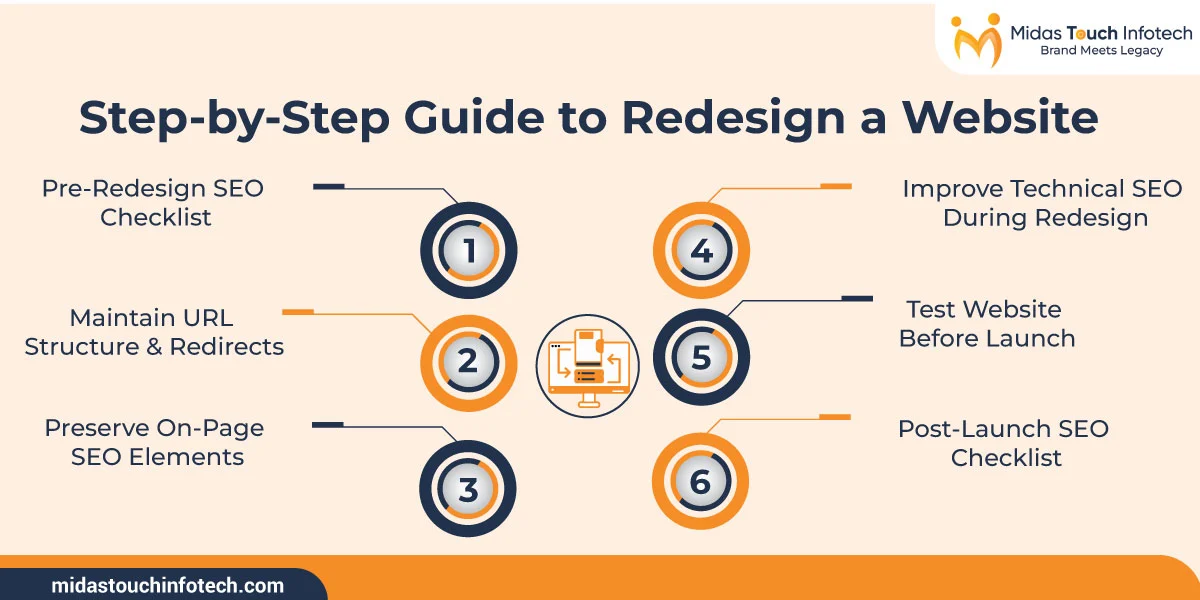
- Step-by-Step Guide to Redesign a Website Without Losing SEO
- ❏ Pre-Redesign SEO Checklist (Before You Start)
- ❏ Maintain URL Structure & Redirects
- ❏ Preserve On-Page SEO Elements
- ❏ Improve Technical SEO During Redesign
- ❏ Test Website Before Launch
- ❏ Post-Launch SEO Checklist
- Tools to Help with SEO-Safe Redesign
- ❏ Essential Tools You Must Use
- Pro Tips for SEO-Safe Website Redesign
- ⮞ Redesign in Phases
- ⮞ Keep Content Structure Similar
- ⮞ Maintain Internal Links
- ⮞ Communicate Changes to Google
- ⮞ Focus on Conversion Optimization
- Advanced Strategies Used by Experts
- ⮞ Competitor Gap Analysis
- ⮞ Improve Topical Authority
- ⮞ Optimize for Search Intent
- ⮞ Build Content Clusters
- Ready to Redesign Your Website Without Losing SEO Rankings?
How to Redesign Websites without Losing SEO?
How to redesign websites without losing SEO is one of the most critical challenges businesses face when upgrading their digital presence. A website redesign is essential for growth whether it’s to improve user experience, modernize branding, increase conversions, or align with new business goals. Many businesses invest in professional website redesign services to stay competitive in today’s fast-paced digital ecosystem. But here’s the biggest concern: Will redesigning my website destroy my SEO rankings?
The fear is real and justified.
According to research by BrightEdge, 68% of all online experiences begin with a search engine. That means your organic visibility directly impacts your revenue pipeline. A poorly executed redesign can wipe out years of SEO effort in days.
➜ Common issues businesses face after redesign:
• Sudden drop in organic traffic
• Loss of keyword rankings
• Broken pages and indexing issues
• Reduced conversions
But here’s the truth most agencies won’t tell you: A redesign doesn’t hurt SEO bad execution does.
In this guide, you’ll learn how to redesign websites strategically without losing rankings and even improve your SEO performance with the right approach.
Why Website Redesign Can Impact SEO
🢧 Changes That Affect Rankings
When working with a web redesign agency or a website redesign expert, multiple elements change simultaneously and each of them impacts SEO.
1. URL Structure Updates
» Changing URLs without proper redirection confuses search engines and breaks indexing signals.
2. Content Removal or Modification
» Removing pages or rewriting content can eliminate keyword relevance that Google already recognizes.
3. Design & UX Changes
» Improved UX is good—but if navigation changes drastically, it can disrupt internal linking and crawlability.
4. Site Speed and Mobile Responsiveness
» A redesign can either enhance or damage performance depending on implementation quality.
🢧 Risks of Ignoring SEO During Redesign
If SEO is not integrated into your redesign process, you may experience:
• Drop in organic traffic within weeks
• Loss of keyword rankings built over years
• Broken links and 404 errors harming user experience
• Reduced domain authority due to lost backlinks
This is why working with a professional website redesign company or an experienced website redesign specialist is critical.

Step-by-Step Guide to Redesign a Website Without Losing SEO
Website redesign is essential for growth but if done incorrectly, it can destroy years of SEO progress overnight. Many businesses experience sudden traffic drops, lost rankings, and reduced conversions simply because they ignored SEO during the redesign process.
A successful redesign is not just about aesthetics. It’s about preserving your existing search equity while improving performance, user experience, and conversions.
This step-by-step guide will help you redesign your website without sacrificing SEO ensuring you grow, not reset.
❏ Pre-Redesign SEO Checklist (Before You Start)
Before making any design or structural changes, you must first understand what is currently working. Skipping this phase is one of the biggest mistakes businesses make.
⚀ Conduct a Full SEO Audit
An SEO audit gives you a complete picture of your website’s current performance. It helps you identify what must be preserved and what needs improvement.
➜ Start by analysing:
• Current keyword rankings and positions
• Organic traffic trends (top pages, traffic sources)
• High-performing landing pages generating leads or revenue
• Backlink profile and domain authority
➜ Use tools like:
• Ahrefs
• SEMrush
• Google Search Console
This process ensures that you don’t accidentally remove or alter high-value SEO assets that are already driving results.
⚀ Backup Your Existing Website
Before touching anything, create a full backup of your website. This acts as your safety net in case anything goes wrong during the redesign.
➜ Make sure to:
• Save all website content, including blogs and landing pages
• Backup images, videos, and media files
• Preserve metadata such as title tags and meta descriptions
• Export all URLs and page structures
A professional website redesign specialist always ensures complete data security before proceeding. Without a backup, even a small mistake can lead to irreversible losses.
⚀ Keyword Mapping
Keyword mapping is critical to maintaining your search visibility after the redesign.
➜ This involves:
• Mapping existing keywords to their corresponding pages
• Ensuring high-performing keywords remain targeted
• Preventing keyword cannibalisation (multiple pages competing for the same keyword)
For example, if a page ranks for “website redesign services,” the new version of that page must continue targeting that keyword.
Every experienced website redesign expert ensures keyword continuity to protect rankings.
❏ Maintain URL Structure & Redirects
URL structure plays a major role in SEO. Changing URLs without proper handling can break rankings instantly.
⚀ Keep URLs Same Where Possible
➜ Whenever possible:
• Retain existing URLs, especially those already ranking
• Avoid unnecessary changes in page structure
• Maintain consistency across your site
Search engines already trust your existing URLs—changing them without reason can reset that trust.
⚀ Implement 301 Redirects Properly
If URL changes are unavoidable, proper redirects are essential.
➜ Best practices:
• Redirect old URLs to the most relevant new pages
• Avoid redirect chains (multiple redirects in sequence)
• Use Google Search Console to monitor redirect performance
• 301 redirects help transfer link equity from old pages to new ones, preserving your SEO value.
Also Read: Website Redesign Checklist One Can’t Afford to Miss
❏ Preserve On-Page SEO Elements
On-page SEO elements directly influence how your pages rank and how users interact with them.
⚀ Meta Tags & Headings
➜ Ensure that:
• Title tags are retained or improved
• Meta descriptions remain relevant and optimized
• Heading structure (H1, H2, H3) is properly maintained
These elements not only impact rankings but also affect click-through rates from search results.
⚀ Content Optimization
One of the biggest mistakes during redesign is deleting or rewriting high-performing content unnecessarily.
➜ Instead:
• Retain content that is already ranking well
• Improve readability and structure
• Add depth, updated insights, and better formatting
A strong web redesign agency focuses on enhancing content not replacing it blindly.
⚀ Internal Linking Structure
Internal linking helps search engines understand your website hierarchy and distribute authority across pages.
➜ During redesign:
• Maintain existing internal links
• Fix broken or outdated links
• Ensure important pages are well-connected
Proper internal linking preserves link equity and improves crawlability.
❏ Improve Technical SEO During Redesign
This is your opportunity to fix technical issues and improve overall performance.
⚀ Mobile-Friendly Design
With Google’s mobile-first indexing, your website must perform flawlessly on mobile devices.
➜ Ensure:
• Fully responsive design
• Smooth navigation across screen sizes
•Fast mobile loading speed
A poor mobile experience can negatively impact both rankings and conversions.
⚀ Site Speed Optimization
Website speed is a direct ranking factor and a major contributor to user experience.
➜ Improve speed by:
• Compressing images without losing quality
• Minifying CSS, JavaScript, and HTML
• Implementing browser caching
A faster website reduces bounce rates and increases engagement.
⚀ Core Web Vitals
Google evaluates user experience through Core Web Vitals, which directly impact SEO.
➜ Focus on improving:
• Largest Contentful Paint (LCP) – loading performance
• First Input Delay (FID) – interactivity
• Cumulative Layout Shift (CLS) – visual stability
Optimizing these metrics ensures your website meets modern performance standards.
❏ Test Website Before Launch
Never launch a redesign websites without proper testing. This step ensures everything is functioning correctly before going live.
⚀ Run SEO Tests
➜ Use tools like Screaming Frog to:
• Crawl the entire website
• Identify broken links and errors
• Check missing metadata
⚀ Validate Redirects
➜ Before launch:
• Test all 301 redirects
• Ensure there are no missing or incorrect redirects
• Confirm all old URLs lead to the correct new pages
⚀ Check Indexing Settings
Many redesigned websites accidentally block search engines.
➜ Make sure to:
• Remove “noindex” tags
• Allow pages to be crawlable
• Verify robots.txt settings
❏ Post-Launch SEO Checklist
The work doesn’t end after launch. In fact, this is where real monitoring begins.
⚀ Monitor Performance
➜ After launching your redesigned website:
• Track keyword rankings daily
• Monitor organic traffic trends
• Analyse user behavior
➜ Use tools like:
• Google Analytics
• Google Search Console
⚀ Fix Issues Quickly
Even with proper planning, minor issues may occur.
➜ Be ready to:
• Fix crawl errors
• Resolve broken links
• Update missing or incorrect metadata
Quick action prevents long-term SEO damage.
⚀ Submit Updated Sitemap
➜ Finally:
• Generate and submit your XML sitemap
• Ensure all important pages are indexed
• Monitor indexing status regularly
This helps search engines understand your new site structure quickly.
Tools to Help with SEO-Safe Redesign
A successful website redesign is not based on assumptions it is driven by data. Every professional website redesign company relies on powerful SEO tools to ensure that performance is not only maintained but improved during the transition.
❏ Essential Tools You Must Use
⮩ Google Search Console
This is your direct communication channel with Google.
➜ It helps you:
‣ Monitor indexing status
‣ Track keyword performance
‣ Identify crawl errors and coverage issues
‣ Analyse impressions and click-through rates
During redesign, it becomes critical for validating redirects, indexing, and overall visibility.
⮩ Google Analytics
If Search Console shows visibility, Analytics shows behavior.
➜ Use it to:
‣ Track organic traffic trends
‣ Identify high-converting pages
‣ Analyse bounce rates and session duration
‣ Understand user journeys
This helps ensure your redesign improves user experience—not just appearance.
⮩ Screaming Frog
Think of this as your technical SEO scanner.
➜ It allows you to:
‣ Crawl your entire website
‣ Detect broken links and missing tags
‣ Audit redirects and canonical tags
‣ Identify duplicate content
Before and after redesign, this tool ensures your website structure is SEO-compliant.
⮩ Ahrefs
Ahrefs is essential for backlink and keyword analysis.
➜ It helps you:
‣ Identify top-performing pages
‣ Analyse backlink profiles
‣ Track keyword rankings
‣ Monitor competitors
This ensures you protect your link equity during the redesign process.
⮩ SEMrush
SEMrush is an all-in-one SEO suite for tracking performance and strategy.
➜ You can:
‣ Conduct keyword research
‣ Perform site audits
‣ Track rankings and visibility
‣ Analyse competitors
It’s especially useful for maintaining keyword consistency and identifying growth opportunities.
These tools together create a complete SEO ecosystem helping you track, analyse, and optimize every stage of your website redesign.
Pro Tips for SEO-Safe Website Redesign
Want to execute your redesign like a professional website redesign expert? These advanced strategies can significantly reduce risk and maximize results.
⮞ Redesign in Phases
One of the biggest mistakes businesses make is launching everything at once.
➜ Instead:
▸ Roll out changes gradually
▸ Test performance at each stage
▸ Identify and fix issues early
This phased approach minimizes the risk of sudden traffic drops and allows for controlled optimization.
⮞ Keep Content Structure Similar
Search engines are already familiar with your existing content structure.
➜ During redesign:
▸ Maintain similar page hierarchy
▸ Preserve content flow and sections
▸ Avoid unnecessary restructuring
Even small structural changes can impact rankings—consistency helps maintain SEO stability.
⮞ Maintain Internal Links
Internal links are the backbone of your SEO architecture.
➜ Make sure to:
▸ Retain key internal links
▸ Update links if URLs change
▸ Avoid broken or orphan pages
Breaking internal links can disrupt link equity and confuse search engines.
⮞ Communicate Changes to Google
After redesign, you must inform search engines about the updates.
➜ Do this by:
▸ Submitting updated XML sitemaps
▸ Monitoring indexing status in Search Console
▸ Requesting reindexing for important pages
This ensures Google understands your new structure quickly and accurately.
⮞ Focus on Conversion Optimization
Here’s the truth most agencies ignore:
Redesign is not about design it’s about revenue.
➜ While maintaining SEO, you should also:
▸ Improve CTA placements
▸ Optimize landing pages for conversions
▸ Reduce friction in user journeys
▸ Enhance page speed and usability
Because traffic without conversions is just vanity.
Also Read: 10 Proven Strategies for Creating an SEO-Friendly Website Design
Advanced Strategies Used by Experts
Top website redesign experts don’t just protect rankings—they use redesign as a growth opportunity.
⮞ Competitor Gap Analysis
➜ Before redesigning, analyse your competitors:
▸ What keywords are they ranking for?
▸ What content are they publishing?
▸ Where are they getting backlinks from?
This helps you identify missed opportunities and outperform them post-redesign.
⮞ Improve Topical Authority
Instead of isolated pages, focus on building authority around a topic.
➜ Do this by:
▸ Creating in-depth pillar pages
▸ Supporting them with related content
▸ Covering topics comprehensively
Google rewards websites that demonstrate expertise in a niche.
⮞ Optimize for Search Intent
Ranking is no longer about keywords it’s about intent.
➜ Ensure your pages:
▸ Match user expectations
▸Answer queries completely
▸Provide real value
If your content aligns with intent, rankings and conversions both improve.
⮞ Build Content Clusters
Content clusters are a powerful SEO strategy.
➜ Structure your content like this:
▸ One main pillar page (broad topic)
▸ Multiple supporting pages (subtopics)
▸ Internal links connecting all content
This strengthens your website’s authority and improves ranking potential.

Ready to Redesign Your Website Without Losing SEO Rankings?
Website redesign doesn’t have to harm your SEO; it can actually boost your rankings, traffic, and conversions when done correctly.
A professional website redesign company understands how to balance design, user experience, and SEO. With proper planning, technical execution, and continuous monitoring, you can turn your redesign into a powerful growth engine.
The strategy is simple:
▸ Preserve what works
▸Improve what doesn’t
▸ Execute with precision
Whether you choose a website redesign specialist or a full-service web redesign agency, ensure SEO is at the core of your redesign process.

Mit Thakkar
Mit Thakkar, CEO of Midas Touch Infotech and a recognized LinkedIn SEO influencer, possesses extensive expertise in branding, website development, and digital marketing. He excels in transforming ideas into impactful digital strategies.