Summarize this blog post with:


Quick Summary
Website redesign costs in USA typically range from $3,000 to $75,000, depending on website size, design complexity, functionality, and business requirements. From small business website redesigns and corporate websites to e-commerce platforms and enterprise solutions, pricing varies based on UI/UX design, SEO optimisation, content migration, and custom development needs.
This guide explains how much a website redesign costs in the USA, including pricing by website type, key cost factors, hidden expenses, and practical budgeting tips. It also highlights when a website redesign is worth the investment and how to choose the right website redesign company to improve user experience, increase conversions, strengthen search engine visibility, and support long-term business growth.
- Key Takeaways
- How Much Should a Website Redesign Cost in the USA?
- How Much Does a Website Redesign Cost in the USA?
- What Factors Affect Website Redesign Costs?
- ✦ Website Size and Number of Pages
- ✦ Design Complexity and Customisation
- ✦ Website Platform and Technology
- ✦ UI/UX Design Requirements
- ✦ SEO and Content Optimisation
- ✦ Third-Party Integrations
- ✦ Website Performance and Mobile Optimisation
- Website Redesign Cost Breakdown by Website Type
- ✦ Small Business Website Redesign Cost
- ✦ Corporate Website Redesign Cost
- ✦ E-commerce Website Redesign Cost
- ✦ WordPress Website Redesign Cost
- ✦ Enterprise Website Redesign Cost
- What Hidden Costs Should You Consider During a Website Redesign?
- 1. Domain and Hosting Expenses
- 2. Premium Themes and Plugins
- 3. Website Content Creation
- 4. Content and Data Migration
- 5. SEO Audits and Optimisation
- 6. Security and SSL Certificates
- 7. Website Testing and Revisions
- 8. Ongoing Maintenance Costs
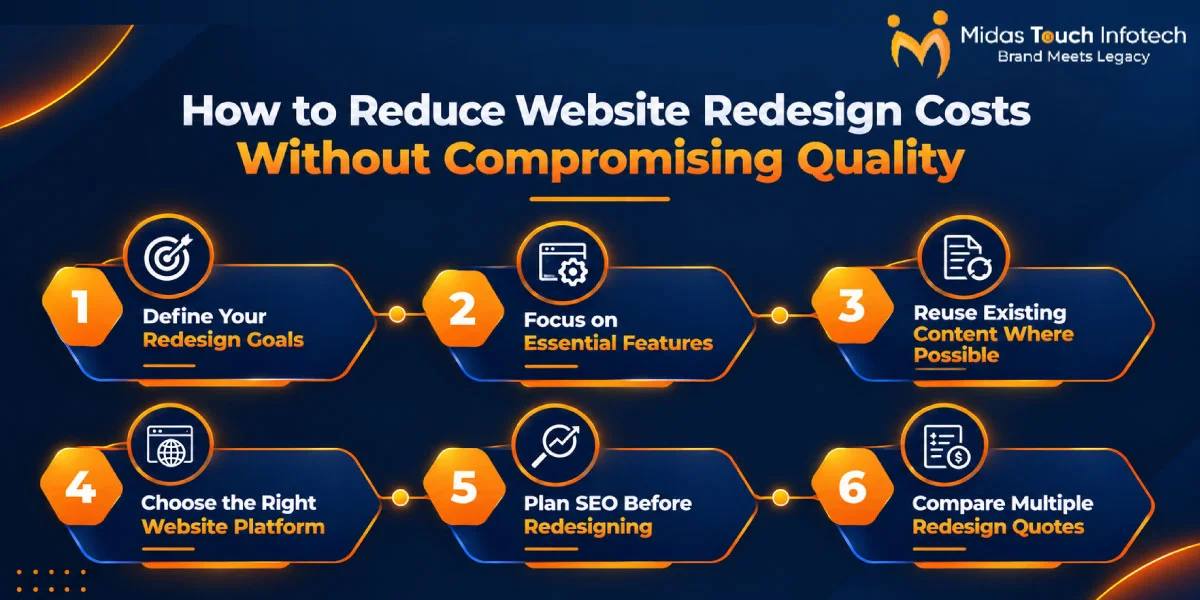
- How to Reduce Website Redesign Costs Without Compromising Quality
- ✦ Define Your Redesign Goals
- ✦ Focus on Essential Features
- ✦ Reuse Existing Content Where Possible
- ✦ Choose the Right Website Platform
- ✦ Plan SEO Before Redesigning
- ✦ Compare Multiple Redesign Quotes
- When Is a Website Redesign Worth the Investment?
- 1. Outdated Website Appearance
- 2. Poor Mobile User Experience
- 3. Slow Website Loading Speed
- 4. Declining Website Conversions
- 5. High Bounce Rates
- 6. Difficult Website Navigation
- 7. Outdated Website Technology
- 8. Changes in Business Branding
- How to Choose the Right Website Redesign Company in the USA
- ✦ Review Previous Redesign Projects
- ✦ Check Industry Experience
- ✦ Read Client Reviews
- ✦ Compare Pricing and Packages
- ✦ Evaluate Technical Expertise
- ✦ Understand Project Timelines
- ✦ Check SEO Capabilities
- ✦ Confirm Post-Launch Support
- Ready to Redesign Your Website Without Breaking the Bank?
How Much Should a Website Redesign Cost in the USA?
A business website is more than just an online presence. It represents your brand, attracts potential customers, and helps generate enquiries and sales. However, an outdated website with slow loading speeds, confusing navigation, and poor mobile responsiveness can negatively affect customer experience and business growth. This is why investing in a modern website redesign has become important for businesses looking to stay competitive in the digital market.
According to Clutch’s September 2026 Web Design Pricing Guide, the average web design project in its reviewed dataset costs approximately $38,105, while most projects reviewed cost less than $10,000. These figures cover web design projects generally, rather than website redesigns exclusively, but they demonstrate how significantly project costs can vary.
Businesses across the USA are increasingly focused on improving website design, mobile accessibility, loading speed, and overall user experience. However, before starting a redesign project, understanding the potential costs is essential.
The cost of website redesign company in the USA depends on several factors, including website size, design complexity, functionality, platform selection, and technical requirements. A simple redesign may require only a few thousand dollars, while a complex enterprise website can demand a significantly larger investment.
Having a clear budget helps businesses prioritise important improvements, avoid unexpected expenses, and choose the right development partner.
In this guide, we will explore website redesign pricing in the USA, key factors affecting costs, pricing by website type, hidden expenses, and practical strategies to achieve a high-performing website within your budget.
How Much Does a Website Redesign Cost in the USA?
The average cost for website redesign projects in the USA generally ranges from $3,000 to $75,000, depending on website requirements, development complexity, and the service provider.
According to WebFX’s website redesign pricing guide, professional website redesign costs typically fall within this range. Freelancer projects commonly range from $3,000 to $10,000, while agency-led projects can cost between $5,000 and $75,000.
However, the final website redesign price depends on whether the project involves basic visual improvements or a complete restructuring of design, content, navigation, and functionality.
Here is an estimated pricing breakdown for different redesign requirements.
| Website Redesign Type | Estimated Cost in USA |
|---|---|
| Basic Website Refresh | $1,000–$5,000 |
| Small Business Website Redesign | $3,000–$15,000 |
| Corporate Website Redesign | $10,000–$35,000 |
| E-commerce Website Redesign | $8,000–$40,000+ |
| Custom Website Redesign | $15,000–$50,000+ |
| Enterprise Website Redesign | $30,000–$100,000+ |
Indicative budgeting ranges based on published US website design and redesign pricing guides. These are planning estimates, not independently measured category averages or fixed quotations.
A basic redesign generally involves improving layouts, updating visuals, and enhancing mobile responsiveness. In comparison, an advanced redesign may require customised UI/UX design, SEO improvements, platform migration, and third-party integrations.
The average website redesign cost also varies depending on whether you hire a freelancer, an agency, or an in-house development team.
Therefore, businesses should focus on understanding their project requirements before selecting a website redesign budget.

What Factors Affect Website Redesign Costs?
Several factors influence the cost of a website redesign. Understanding these factors helps businesses plan their budgets and avoid unnecessary development expenses.
✦ Website Size and Number of Pages
The number of pages is one of the major factors affecting website redesign costs.
A small website containing five to ten pages generally requires less design and development effort than a corporate website containing hundreds of pages.
Important considerations include:
Total number of website pages.
Complexity of individual page layouts.
Requirements for new landing pages.
Existing content and data migration.
Number of unique design templates.
For example, redesigning 20 pages using five reusable templates may require less effort than designing 20 completely different layouts.
Businesses should evaluate their existing website structure and identify unnecessary pages before beginning the redesign.
✦ Design Complexity and Customisation
The complexity of your website’s visual design significantly affects development costs.
Template-based designs generally offer more affordable solutions because they use existing layouts and design components.
Custom website designs, on the other hand, require additional planning, creative development, and testing.
Advanced design features may include animations, interactive elements, custom illustrations, and personalised user experiences.
Businesses with specific branding requirements may also need custom typography, design systems, and visual assets.
While customisation can improve brand identity, unnecessary design features may increase costs without delivering measurable business value.
✦ Website Platform and Technology
The platform used to develop your website also influences redesign pricing.
Popular website platforms include WordPress, Shopify, Webflow, and custom content management systems.
Each platform offers different levels of flexibility, maintenance requirements, and pricing.
For example, updating an existing WordPress website may cost less than migrating the entire website to another platform.
Platform migration can involve additional development tasks, including content transfers, URL restructuring, plugin replacement, and system testing.
Premium themes, extensions, and third-party software licences can further increase the overall project budget.
✦ UI/UX Design Requirements
User interface and user experience design play an important role in creating websites that are easy to navigate.
A professional UI/UX redesign focuses on understanding visitor behaviour and simplifying interactions.
Common activities include wireframing, prototyping, navigation improvements, mobile-responsive layouts, and usability testing.
For businesses with complex customer journeys, additional research may be required to identify problems affecting conversions.
Investing in user-focused design can make websites more accessible, improve engagement, and encourage visitors to complete important actions.
✦ SEO and Content Optimisation
Search engine optimisation should be considered throughout the redesign process.
Poorly planned website changes can affect existing keyword rankings, indexed pages, and organic search traffic.
Professional website redesign services often include SEO-related activities such as:
On-page SEO improvements.
Existing content optimisation.
Website structure and internal linking.
URL redirects and migration planning.
Technical SEO audits.
Metadata and heading optimisation.
For example, changing important page URLs without implementing appropriate redirects can make existing links lead to errors.
Integrating SEO into the redesign process helps businesses protect valuable website content and support long-term search visibility.
✦ Third-Party Integrations
Many business websites require integrations with external platforms to improve functionality.
Common integrations include CRM systems, payment gateways, marketing automation software, booking applications, and customer support tools.
The cost depends on the complexity of each integration.
Basic integrations using existing plugins may require minimal development effort. However, custom API connections and advanced data synchronisation can increase project costs.
Businesses should identify essential integrations during the planning stage to avoid unexpected expenses later.
✦ Website Performance and Mobile Optimisation
Modern websites must provide fast loading speeds and consistent experiences across devices.
Website performance optimisation involves compressing images, improving code efficiency, reducing unnecessary scripts, and configuring caching.
Developers may also need to optimise Google’s Core Web Vitals, which evaluate important aspects of loading performance, responsiveness, and visual stability.
Additional testing across different browsers and devices helps ensure consistent functionality.
Although performance optimisation increases development effort, it can improve usability and reduce technical problems.
Website Redesign Cost Breakdown by Website Type
Different businesses require different website structures, functionality, and design approaches.
Understanding pricing by website type can help organisations estimate their potential redesign investment more accurately.
✦ Small Business Website Redesign Cost
Estimated Cost: $3,000 – $15,000
Small business websites generally focus on presenting services, building customer trust, and generating enquiries.
A typical small business redesign may include:
Updated homepage and service page layouts.
Mobile-responsive website design.
Contact forms and enquiry buttons.
Basic SEO and performance improvements.
Improved navigation and branding.
Businesses using existing content and simple design templates may spend less than those requiring customised functionality.
✦ Corporate Website Redesign Cost
Estimated Cost: $10,000 – $35,000
Corporate websites usually require professional designs that reflect an established brand identity.
These websites often contain multiple service pages, department information, resource sections, and detailed company profiles.
Additional costs may arise from content restructuring, custom page templates, advanced navigation, and CRM integrations.
Corporate website redesigns also require consistent branding across different pages and customer touchpoints.
✦ E-commerce Website Redesign Cost
Estimated Cost: $8,000 – $40,000+
E-commerce website redesigns focus on improving online shopping experiences and simplifying purchasing processes.
Common features include:
Product page optimisation.
Improved category navigation.
Shopping cart enhancements.
Secure payment gateway integrations.
Product search and filtering options.
Mobile checkout optimisation.
Large product catalogues, inventory management integrations, and customised checkout processes can significantly increase redesign costs.
✦ WordPress Website Redesign Cost
Estimated Cost: $2,000 – $15,000+
WordPress is a popular content management system for business websites because of its flexibility and wide range of themes and plugins.
WordPress redesign costs depend on whether businesses use existing themes or require custom development.
Typical expenses include theme modifications, plugin updates, page builder improvements, SEO optimisation, and security enhancements.
Websites with complex custom features may exceed the estimated range.
✦ Enterprise Website Redesign Cost
Estimated Cost: $30,000 – $100,000+
Enterprise website redesigns involve large-scale projects with extensive functionality and technical requirements.
These websites may contain hundreds or thousands of pages, multiple language versions, advanced security systems, and complex integrations.
Common requirements include enterprise-level content management, accessibility testing, data migration, and advanced website analytics.
Because of their complexity, enterprise redesign projects often require dedicated teams for design, development, SEO, testing, and project management.
What Hidden Costs Should You Consider During a Website Redesign?
When estimating the cost of a website redesign, businesses should consider expenses beyond the initial design and development quotation.
These additional costs can affect the overall project budget.
1. Domain and Hosting Expenses
Website hosting and domain registration generally involve recurring charges. Hosting costs depend on storage, traffic requirements, server performance, and technical support.
2. Premium Themes and Plugins
Premium WordPress themes, page builders, security plugins, and advanced extensions may require one-time or recurring payments.
3. Website Content Creation
New service pages, landing pages, blogs, product descriptions, and website copy may require professional content writing.
4. Content and Data Migration
Migrating website pages, images, customer records, and product information may involve additional technical work.
5. SEO Audits and Optimisation
SEO services such as keyword research, technical audits, content optimisation, and redirect implementation may not be included in standard redesign packages.
6. Security and SSL Certificates
Website security improvements, malware protection, backups, and premium SSL solutions may generate additional expenses. However, basic SSL certificates are often provided free with hosting.
7. Website Testing and Revisions
Some providers limit the number of design revisions included in their packages. Additional revisions and testing may increase project costs.
8. Ongoing Maintenance Costs
Websites require regular software updates, performance monitoring, security checks, and technical maintenance.
Businesses should consider both initial development expenses and ongoing operational costs when evaluating the average cost to redesign website projects.
How to Reduce Website Redesign Costs Without Compromising Quality
Reducing website redesign expenses does not mean choosing the cheapest available development service.
Instead, businesses should focus on careful planning, clear requirements, and features that contribute directly to their objectives.
✦ Define Your Redesign Goals
Before hiring a redesign company, evaluate your existing website and identify the problems affecting its performance.
These may include poor navigation, low conversion rates, slow loading speeds, or outdated branding.
Working with providers offering professional website redesign services can help businesses identify priority improvements and develop a realistic project plan.
Set clear objectives, define essential deliverables, and establish a budget before development begins.
This reduces unexpected changes and helps control project costs.
✦ Focus on Essential Features
Prioritise website functionality that directly supports your business requirements.
For example, a service-based business may need clear service descriptions, enquiry forms, testimonials, and contact information.
Advanced animations or unnecessary interactive features may not provide the same value.
Remove outdated functionality and consider implementing less important features during future development phases.
✦ Reuse Existing Content Where Possible
Creating entirely new content for every website page can increase redesign expenses.
Instead, audit existing content and identify pages that remain useful.
Update outdated information, improve readability, and retain high-performing pages wherever appropriate.
Businesses can also reuse relevant images, videos, illustrations, and other visual assets.
This approach reduces content production expenses while maintaining valuable website information.
✦ Choose the Right Website Platform
Selecting an appropriate development platform helps manage both initial and ongoing website expenses.
Compare platform subscription costs, customisation options, plugin availability, maintenance requirements, and scalability.
For example, WordPress may suit businesses seeking flexible content management, while Shopify may be appropriate for businesses focused on e-commerce.
Avoid unnecessary platform migration unless the existing technology limits important business requirements.
✦ Plan SEO Before Redesigning
SEO planning is essential for protecting existing website visibility.
Before making structural changes, review important website URLs, keyword rankings, organic traffic, and internal links.
Preserve valuable pages wherever possible and prepare appropriate 301 redirects for URLs that change permanently.
Also review site architecture, metadata, mobile performance, and content quality.
Integrating SEO early can reduce costly corrections after launch.
✦ Compare Multiple Redesign Quotes
Request detailed quotations from different website redesign service providers.
Review what each proposal includes rather than comparing only the final price.
Check whether the quotation covers design, development, SEO, content migration, testing, revisions, and maintenance.
Also clarify potential additional charges and post-launch support.
A transparent quotation helps businesses make informed decisions and avoid unexpected project expenses.
When Is a Website Redesign Worth the Investment?
A website redesign becomes valuable when your existing website no longer supports customer expectations or business growth.
Several warning signs indicate that your website may need significant improvements.
1. Outdated Website Appearance
Old-fashioned designs can make your business appear less professional compared with competitors offering modern digital experiences.
2. Poor Mobile User Experience
If visitors struggle to navigate your website on smartphones, a responsive redesign may improve accessibility and engagement.
3. Slow Website Loading Speed
Slow pages can frustrate users and create unnecessary barriers to browsing your products or services.
4. Declining Website Conversions
If your website generates traffic but fewer enquiries or purchases, design and usability issues may be contributing factors.
5. High Bounce Rates
High bounce rates may indicate that visitors are not finding relevant information or engaging with the website. However, they should be analysed alongside other performance metrics.
6. Difficult Website Navigation
Confusing menus and complicated page structures can prevent visitors from finding important information.
7. Outdated Website Technology
Old themes, unsupported plugins, and difficult content management systems may create maintenance and security concerns.
8. Changes in Business Branding
If your company has introduced new services, expanded operations, or updated its brand identity, your website should reflect these changes.
A website redesign is worth considering when improvements in usability, conversions, efficiency, or brand presentation are likely to justify the project investment.
How to Choose the Right Website Redesign Company in the USA
Selecting the right website redesign partner is important for achieving your business objectives while managing development costs.
Here are the key factors to evaluate before making a decision.
✦ Review Previous Redesign Projects
Explore the company’s portfolio and examine its experience delivering similar website redesign projects.
✦ Check Industry Experience
A provider familiar with your industry may better understand customer behaviour, website functionality requirements, and relevant design expectations.
✦ Read Client Reviews
Review independent testimonials and customer feedback to evaluate communication, project management, and service quality.
✦ Compare Pricing and Packages
Request detailed cost estimates and understand which services are included in each package.
✦ Evaluate Technical Expertise
Ensure the development team has experience with your preferred CMS, responsive design, website performance, and technical integrations.
✦ Understand Project Timelines
Discuss estimated project stages, revision schedules, testing requirements, and launch planning.
✦ Check SEO Capabilities
Choose a provider that understands website migration, technical SEO, redirects, and search visibility preservation.
✦ Confirm Post-Launch Support
Ask whether the company provides maintenance, technical assistance, security updates, and performance monitoring after launch.
The right website redesign partner should offer transparent pricing, relevant experience, and solutions aligned with your business goals.

Ready to Redesign Your Website Without Breaking the Bank?
Understanding website redesign costs in the USA helps businesses plan their investments and avoid unnecessary expenses.
Whether you need a basic website refresh, a customised corporate website, or a complete e-commerce redesign, the right strategy can improve website performance, user experience, and business opportunities.
Rather than focusing entirely on the lowest website redesign price, prioritise improvements that provide meaningful value to your customers.
A successful redesign should combine professional design, clear navigation, mobile responsiveness, fast loading speeds, and SEO-friendly website architecture.
Partnering with an experienced website redesign services company can help you identify essential improvements, establish a realistic project budget, and implement solutions that support your long-term objectives.
By choosing the right development approach, businesses can create professional, conversion-focused websites without spending unnecessarily.
Key-Takeaways
- Understand Website Redesign Costs: Website redesign costs in the USA typically range from $3,000 to $75,000, depending on project complexity and business requirements.
- Compare Redesign Pricing by Website Type: Explore estimated costs for small business, corporate, e-commerce, WordPress, and enterprise website redesigns.
- Identify Key Cost Factors: Website size, UI/UX design, custom functionality, SEO optimisation, CMS platforms, and integrations influence redesign pricing.
- Plan for Hidden Expenses: Consider additional costs for hosting, content migration, premium plugins, security, SEO services, and ongoing maintenance.
- Reduce Website Redesign Costs: Set clear goals, prioritise essential features, reuse existing content, and compare multiple redesign quotes to manage your budget.
- Choose the Right Redesign Company: Evaluate experience, technical expertise, transparent pricing, SEO capabilities, and post-launch support before hiring.
- Maximise Website Redesign ROI: Focus on mobile responsiveness, faster loading speeds, improved user experience, and conversion optimisation to support long-term business growth.

Mit Thakkar
Mit Thakkar, CEO of Midas Touch Infotech and a recognized LinkedIn SEO influencer, possesses extensive expertise in branding, website development, and digital marketing. He excels in transforming ideas into impactful digital strategies.