Summarize this blog post with:


Quick Summary
A digital marketing funnel helps businesses understand the complete customer journey, from the first brand interaction to becoming a loyal customer. It includes different stages such as awareness, interest, consideration, conversion, and retention, allowing businesses to create targeted strategies for each customer intent.
By using content marketing, SEO, social media, automation, and analytics, businesses can attract the right audience, nurture potential customers, improve conversions, and build long-term relationships. A structured funnel strategy helps businesses measure performance, optimise campaigns, and create sustainable growth.
- Key Takeaways
- Organic vs Paid Marketing: Key Differences Every Business Should Know
- What Is Organic Marketing?
- 1. Understanding Organic Marketing
- 2. Role of SEO in Organic Growth
- 3. Benefits of Organic Marketing
- 4. Challenges of Organic Marketing
- What Is Paid Marketing?
- 1. Understanding Paid Marketing
- 2. Benefits of Paid Marketing
- 3. Challenges of Paid Marketing
- Organic Marketing vs Paid Marketing: Which One Is Better for Your Business?
- When Should Businesses Choose Organic Marketing?
- When Should Businesses Choose Paid Marketing?
- Why Businesses Should Combine Organic and Paid Marketing Strategies
- 1. Create a Balanced Marketing Approach
- 2. Use Organic Content to Build Long-Term Traffic
- 3. Promote High-Performing Content With Paid Ads
- 4. Retarget and Nurture Interested Audiences
- How to Decide the Right Marketing Strategy for Your Business
- 1. Define Your Business Goals
- 2. Evaluate Your Budget and Resources
- 3. Track the Right Performance Metrics
- 4. Optimise Your Strategy Regularly
- Future of Organic and Paid Marketing in the Digital Landscape
- ✧ Helpful Content
- ✧ Personalisation
- ✧ AI-Driven Advertising
- ✧ Search Experience Optimisation
- ✧ Customer-Focused Marketing Strategies
- Ready to Build a Marketing Strategy That Drives Growth?
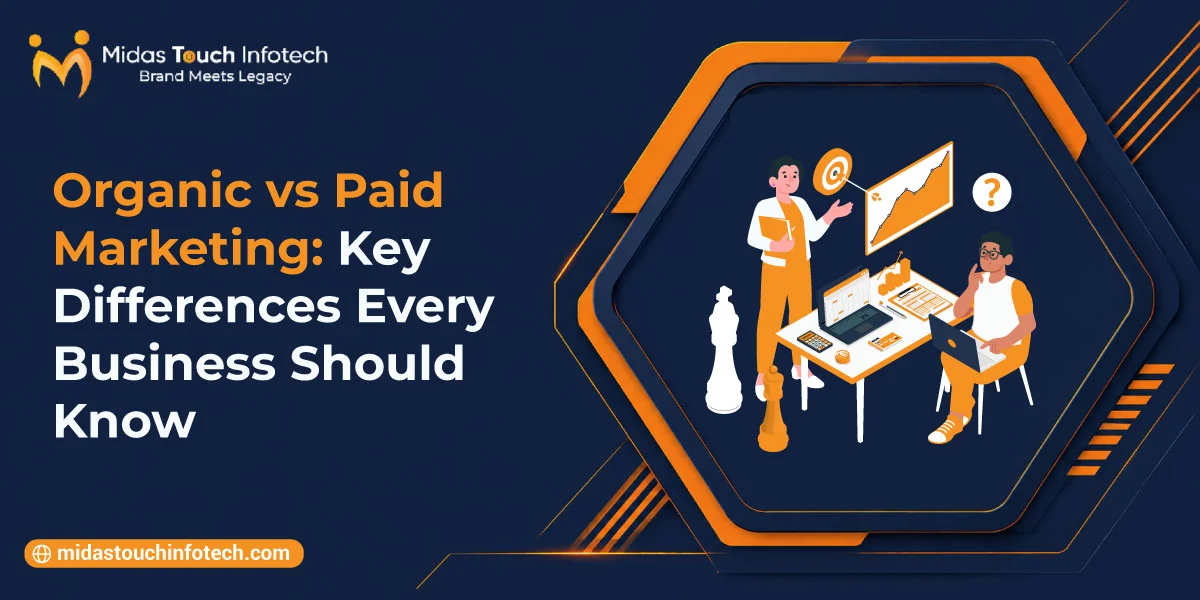
Organic vs Paid Marketing: Key Differences Every Business Should Know
Businesses today rely heavily on digital marketing to attract potential customers, build brand awareness, generate leads, and increase sales. Search engines, social media platforms, websites, email marketing, and online advertising have given companies more opportunities than ever to reach audiences at different stages of the buying journey.
The scale of digital marketing investment also shows how important online channels have become. According to DataReportal’s Digital 2025 Global Overview Report, digital channels accounted for
72.7% of worldwide advertising investment in 2024, with global online advertising spend exceeding US$790 billion. Search advertising alone represented approximately 40% of digital ad spend, generating more than US$316 billion in advertising revenue during 2024.
However, spending more on advertising does not automatically guarantee sustainable business growth. Companies also need long-term visibility through SEO, valuable content, brand authority, and trusted customer relationships. This is where professional seo services can support businesses by improving organic visibility and creating a stronger foundation for consistent website traffic.
When comparing organic vs paid marketing, businesses are essentially evaluating two different approaches to customer acquisition. Organic marketing focuses on building visibility naturally over time, while paid marketing uses advertising budgets to generate immediate exposure.
Both approaches have unique advantages, costs, timelines, and limitations. Understanding the organic vs paid marketing definition, the role of each channel, and how they work together can help businesses allocate budgets more effectively and develop a marketing strategy that supports both short-term and long-term growth.
What Is Organic Marketing?
1. Understanding Organic Marketing
Organic marketing refers to strategies that help businesses attract customers naturally without paying directly for every click, impression, or website visit. Common organic channels include search engine optimisation, blog content, social media posts, email newsletters, video content, customer reviews, referral traffic, and thought leadership. For example, when a business publishes a useful blog that ranks on Google and continues bringing visitors without paid promotion, that traffic is considered organic.
2. Role of SEO in Organic Growth
SEO plays an important role in building organic visibility. Businesses can work with seo services consultants to improve keyword targeting, website structure, technical SEO, content quality, internal linking, and overall page experience. Unlike paid advertising, organic marketing usually requires more time to generate noticeable results, but high-quality content can continue attracting visitors long after it is published.
3. Benefits of Organic Marketing
Organic marketing helps businesses build brand credibility, generate sustainable website traffic, reduce dependence on paid advertising, and create stronger customer relationships. Helpful blogs, guides, case studies, FAQs, and educational resources allow businesses to answer customer questions while building authority. A professional seo company can help create content that targets different stages of the customer journey.
4. Challenges of Organic Marketing
Organic marketing also has challenges. Results can take time, competition for valuable search terms can be high, and businesses need consistent content creation and optimisation. Search behaviour, algorithms, and competitor strategies also change regularly, which means professional seo services should be treated as a long-term growth strategy rather than a one-time activity.
Also Read : SEO Migration Checklist: 30 Steps to Protect Your Organic Rankings
What Is Paid Marketing?
1. Understanding Paid Marketing
Paid marketing involves businesses paying advertising platforms to promote products, services, offers, or content to selected audiences. Common channels include Google Search Ads, Display Ads, Shopping campaigns, YouTube Ads, Meta Ads, LinkedIn Ads, retargeting campaigns, and sponsored content. Businesses usually pay based on clicks, impressions, views, conversions, or campaign objectives.
2. Benefits of Paid Marketing
Paid marketing offers several advantages, including faster traffic, precise audience targeting, quick lead generation, measurable performance, and support for time-sensitive campaigns. Businesses can target users based on keywords, location, device, interests, demographics, previous website activity, and purchasing intent. Experienced pay per click service providers can help improve targeting and ensure budgets are focused on audiences with stronger conversion potential.
3. Challenges of Paid Marketing
Paid marketing requires continuous investment, and traffic may decline quickly when campaigns are paused. Advertising costs can also increase in competitive industries, while poor targeting can lead to wasted clicks and low-quality leads. Businesses using pay per click services in india should therefore focus on conversion tracking, keyword quality, landing page performance, audience targeting, bidding strategy, and regular campaign optimisation to improve overall return on investment.
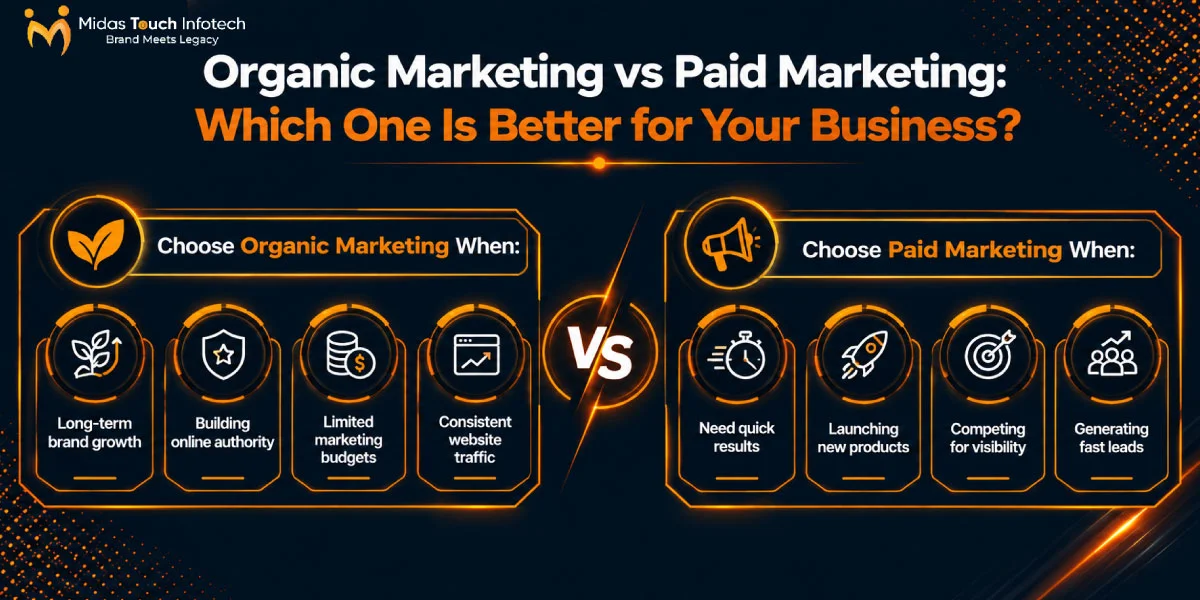
Organic Marketing vs Paid Marketing: Which One Is Better for Your Business?
There is no universal answer to whether organic or paid marketing is better.
The right choice depends on business objectives, competition, available budget, growth stage, customer journey, and expected timeline.
The most useful way to understand organic vs paid marketing strategies is to examine when each approach is most appropriate.
When Should Businesses Choose Organic Marketing?
Organic marketing can be particularly valuable for businesses focused on sustainable growth.
It may be appropriate when you want to:
• Build long-term website visibility
• Strengthen brand authority
• Generate recurring search traffic
• Educate potential customers
• Reduce long-term dependence on advertisements
• Build a content library
SEO is especially useful when customers frequently search online for information before making purchasing decisions.
Working with seo services consultants can help businesses identify search opportunities and develop an organic strategy around customer intent.
Organic marketing is also useful for businesses that cannot maintain large monthly advertising budgets.
However, businesses should understand that reducing advertising spend does not mean organic marketing is free. SEO requires investment in content, technology, strategy, design, analytics, and expertise.
When Should Businesses Choose Paid Marketing?
Paid marketing may be more appropriate when speed is the main priority.
Businesses often choose paid campaigns when they need:
• Immediate website traffic
• Fast lead generation
• Product launch visibility
• Promotional campaign reach
• Event registrations
• Quick market testing
• New geographic market exposure
Paid advertising can also help new brands compete for visibility before their organic rankings become established.
For example, a company entering a competitive market may use pay per click advertising services to begin generating enquiries while its SEO strategy develops.
Businesses should closely monitor acquisition costs to ensure that fast traffic is also financially sustainable.
Why Businesses Should Combine Organic and Paid Marketing Strategies
1. Create a Balanced Marketing Approach
Businesses do not need to treat paid vs organic marketing as competing strategies. Organic marketing supports long-term visibility, credibility, and sustainable traffic, while paid marketing helps generate faster reach and immediate opportunities. A professional seo company can strengthen organic rankings and content performance while paid campaigns support short-term lead generation and brand exposure.
2. Use Organic Content to Build Long-Term Traffic
SEO blogs, guides, service pages, and educational resources can help businesses attract users searching for relevant information. Using professional seo services can improve keyword targeting, content quality, technical performance, and search visibility. Strong organic content can continue generating traffic even when paid campaigns are reduced.
3. Promote High-Performing Content With Paid Ads
Businesses can identify organic content that already performs well and use paid advertising to expand its reach. High-performing blogs, case studies, webinars, reports, and lead magnets can be promoted to selected audiences, helping brands reach more potential customers while making better use of existing content.
4. Retarget and Nurture Interested Audiences
Organic traffic can also support paid remarketing campaigns. Visitors who explore important pages but do not convert can later be reached through targeted ads. Businesses can also use both organic and paid channels to grow email lists and nurture prospects through newsletters, offers, and useful content. Combining both approaches creates a more diversified and reliable customer acquisition strategy.
How to Decide the Right Marketing Strategy for Your Business
1. Define Your Business Goals
Your marketing goals should determine which channels receive more attention. Organic content and SEO can support long-term brand awareness and sustainable traffic, while paid campaigns are useful for immediate sales, product launches, and quick lead generation. Businesses planning market expansion may benefit from combining both approaches to create short-term visibility and long-term growth.
2. Evaluate Your Budget and Resources
Budget plays an important role when comparing organic vs paid marketing. Paid advertising requires ongoing media spend, while organic marketing needs investment in content, SEO, technical improvements, design, analytics, and website optimisation. Businesses can use professional seo services for long-term visibility or work with experienced pay per click service providers to manage paid campaigns more efficiently.
3. Track the Right Performance Metrics
Businesses should monitor metrics that connect marketing activity with real outcomes. Important measurements include website traffic, conversion rate, customer acquisition cost, engagement rate, and return on investment. Tracking these metrics helps identify which channels generate valuable traffic, leads, and sales instead of focusing only on impressions or clicks.
4. Optimise Your Strategy Regularly
Marketing performance should be reviewed continuously rather than treated as a one-time decision. Businesses should compare organic and paid results, identify underperforming campaigns, improve landing pages, update content, and reallocate budgets where needed. Regular optimisation helps ensure marketing resources are focused on strategies that contribute most effectively to business growth.
Also Read : Complete Off-Page SEO Checklist for 2026: What You Need to Do
Future of Organic and Paid Marketing in the Digital Landscape
Organic and paid marketing are both changing as artificial intelligence, automation, search behaviour, and digital platforms continue to evolve.
Search users increasingly expect faster and more personalised answers.
At the same time, advertising platforms are relying more heavily on automated bidding, audience signals, machine learning, and AI-powered campaign optimisation.
This means future organic vs paid marketing strategies will need to focus less on simply increasing traffic and more on attracting the right users and delivering useful experiences.
✧ Helpful Content
Search visibility increasingly depends on whether content genuinely answers customer questions.
Businesses should create content that demonstrates expertise, addresses real problems, and supports purchase decisions rather than publishing articles only for keyword rankings.
✧ Personalisation
Customers expect experiences that reflect their interests and needs.
Businesses can use first-party data, behavioural information, CRM insights, and customer segmentation to create more relevant marketing experiences.
✧ AI-Driven Advertising
Advertising platforms are using AI to automate bidding, targeting, creative optimisation, and campaign management.
Google, for example, continues to integrate AI-driven bidding and optimisation tools into its advertising products.
However, automation still requires clear goals, reliable conversion data, strong creative assets, and regular performance review.
✧ Search Experience Optimisation
SEO is also evolving beyond traditional keyword optimisation.
Users are discovering information through standard search results, AI-generated answers, social platforms, videos, marketplaces, and conversational tools.
Businesses may increasingly need to optimise their visibility across multiple discovery environments.
✧ Customer-Focused Marketing Strategies
Ultimately, technology will continue changing, but customer relevance will remain central.
Businesses that understand customer needs, provide valuable information, deliver strong experiences, and measure performance carefully will be better positioned to adapt.
Ready to Build a Marketing Strategy That Drives Growth?
Understanding organic vs paid marketing helps businesses make better decisions about where to invest their time, budget, and resources. Organic marketing focuses on building lasting visibility, credibility, and sustainable traffic, while paid marketing can provide faster reach and immediate opportunities.
A strong organic strategy supported by professional seo services can help businesses improve search visibility, create useful content, and reduce long-term dependence on paid traffic. Paid advertising, meanwhile, enables companies to target specific audiences, test campaigns quickly, and generate measurable leads or sales.
Businesses considering pay per click services in india should focus on campaign quality, conversion tracking, targeting, and return on investment rather than simply increasing advertising spend. Similarly, organic marketing requires consistent content, technical optimisation, and strategic planning to deliver long-term value.
The right approach ultimately depends on your goals, available budget, competitive environment, and stage of growth. Rather than choosing one channel permanently, businesses should regularly evaluate performance and adjust the balance between organic and paid marketing. When both strategies support the same customer journey, they can create a stronger, more adaptable digital marketing system that drives sustainable business growth.
Key-Takeaways
- Build Long-Term Visibility: Organic marketing helps businesses improve search visibility, strengthen credibility, and generate sustainable website traffic.
- Generate Faster Results: Paid marketing helps businesses achieve quick traffic, targeted reach, and immediate lead generation through advertising campaigns.
- Attract Relevant Customers: Both strategies help businesses reach users by targeting customer needs, search intent, interests, and buying behaviour.
- Balance Both Strategies: Combining organic and paid marketing creates a stronger approach for short-term results and long-term business growth.
- Measure Marketing Performance: Tracking traffic, conversions, customer acquisition costs, and ROI helps businesses optimise their marketing efforts.
- Adapt to Future Trends: AI, personalisation, and changing search behaviour require businesses to focus on valuable content and better customer experiences.

Mit Thakkar
Mit Thakkar, CEO of Midas Touch Infotech and a recognized LinkedIn SEO influencer, possesses extensive expertise in branding, website development, and digital marketing. He excels in transforming ideas into impactful digital strategies.