Summarize this blog post with:


- GEO vs SEO: Which Strategy Should Your Business Invest in for 2026?
- What Is SEO?
- ✦ How Search Engine Optimisation Works
- ✦ What Is the Primary Goal of SEO?
- ✦ Where Does SEO Help Your Business Appear?
- What Is GEO?
- ✦ What Does Generative Engine Optimisation Mean?
- ✦ How Does GEO Work?
- ✦ Where Can GEO Improve Your Visibility?
- GEO vs SEO: What Is the Difference?
- ✦ Search Visibility vs AI Visibility
- ✦ Keywords vs Topics and Entities
- ✦ Rankings vs Mentions and Citations
- ✦ Click-Based Discovery vs Answer-Based Discovery
- Why Is GEO Becoming Important for Businesses in 2026?
- ✦ Search Is Moving From Links to Answers
- ✦ Buyers Are Using AI for Product and Vendor Research
- ✦ AI Search Is Creating New Brand Discovery Opportunities
- How GEO and SEO Work Together
- ✦ SEO Builds Search Authority
- ✦ GEO Extends Authority Into AI Search
- ✦ Content Can Be Optimised for Both SEO and GEO
- GEO vs SEO: Which One Generates Better ROI?
- ✦ SEO ROI
- ✦ GEO ROI
- ✦ Why ROI Should Be Measured Across Both Channels
- Should Your Business Invest in GEO or SEO?
- ✦ When SEO Should Be the Priority
- ✦ When to Start Investing in GEO
- ✦ When SEO and GEO Should Work Together
- How to Measure GEO and SEO Performance
- ✦ Important SEO KPIs
- ✦ Important GEO KPIs
- GEO vs SEO: Which Strategy Should Your Business Invest in for 2026?
- ✦ When Your Business Should Prioritise SEO
- ✦ When Your Business Should Increase GEO Investment
- ✦ When SEO and GEO Should Work Together
- The Future of SEO and GEO Beyond 2026
- Ready to Make SEO and GEO Work Harder for Your Business?
GEO vs SEO: Which Strategy Should Your Business Invest in for 2026?
Search behaviour is changing rapidly. For years, businesses focused primarily on improving their Google rankings to attract website visitors. In 2026, customers are also discovering brands through Google AI Overviews, AI Mode, ChatGPT, Gemini, Microsoft Copilot, Perplexity and other AI-powered platforms. Instead of opening multiple search results, users can now ask detailed questions and receive summarised answers, comparisons and recommendations within seconds.
The growth of AI-assisted discovery is already influencing website traffic. According to Semrush’s April 2026 analysis of 17 months of clickstream data, outbound referral traffic from ChatGPT to websites grew by 206% during 2025. Semrush also found that ChatGPT used web search for around 34.5% of queries as of February 2026, indicating that AI platforms are increasingly becoming part of the broader research and discovery journey.
This shift does not mean traditional search engine optimisation is disappearing. Google organic search continues to play an important role in product discovery, local searches, comparison research and high-intent buying decisions. However, businesses now need to think beyond rankings alone. An experienced SEO consultation company may increasingly need to consider both traditional search visibility and how a brand appears within AI-generated answers.
This guide explores the SEO vs GEO debate, how both approaches work, their ROI potential and how businesses can combine them to improve visibility across the changing search landscape.
What Is SEO?
Search Engine Optimisation, commonly known as SEO, is the process of improving a website so that it can gain greater visibility within traditional search engine results.
SEO combines content, technical improvements, authority building and user experience to help search engines understand whether a website is relevant and trustworthy for particular searches.
✦ How Search Engine Optimisation Works
SEO starts by understanding what potential customers search for and why they search for it.
Keyword research identifies relevant queries, while search intent analysis helps businesses understand whether users want information, comparisons, local services or a specific product.
On-page optimisation then improves elements such as headings, page copy, titles, internal links and metadata. Technical SEO addresses areas including crawling, indexing, website architecture, page speed, mobile usability and structured data.
Link building helps establish external authority, while content optimisation ensures that pages provide useful and relevant information.
Businesses may also use local SEO to reach customers in specific geographic markets or international SEO when targeting multiple countries and languages.
Companies searching for professional seo india support should therefore evaluate providers based on more than keyword rankings. Technical performance, content quality, authority and conversion outcomes should all form part of the strategy.
✦ What Is the Primary Goal of SEO?
The main objective of SEO is to increase qualified organic visibility.
Strong SEO can help a website appear when potential customers actively search for relevant products, services, solutions or information. Higher visibility can increase website traffic and generate opportunities for leads and conversions.
SEO is particularly valuable because it can capture users who already have some level of intent.
Over time, strong rankings and authoritative content can also create a sustainable source of organic traffic without requiring businesses to pay for every website visit.
✦ Where Does SEO Help Your Business Appear?
SEO can improve visibility across several traditional search features.
Businesses can appear within standard Google and Bing organic results, featured snippets and People Also Ask sections.
For location-based businesses, optimisation can also influence local organic results and visibility around relevant geographic searches.
The exact search features available may continue changing, but organic search visibility remains an important part of online customer acquisition.
What Is GEO?
Generative Engine Optimisation is an emerging approach focused on improving a brand’s visibility within answers generated by AI-powered discovery platforms.
Instead of concentrating only on whether a webpage ranks in a list of search results, GEO considers whether AI systems understand, reference, cite or recommend a brand when answering relevant questions.
✦ What Does Generative Engine Optimisation Mean?
GEO involves structuring digital information in ways that make a business easier for generative AI systems to understand.
AI systems need clear information about what a business does, which topics it is associated with, whether external sources recognise it and whether its content provides useful evidence.
GEO therefore places significant emphasis on entities, expertise, factual clarity and authority.
The goal is to increase the likelihood that a brand, product, website or expert becomes part of an AI-generated response when relevant questions are asked.
✦ How Does GEO Work?
Businesses can strengthen entity signals by keeping brand information consistent across their website and trusted third-party sources. Developing in-depth topical coverage can also demonstrate expertise within a particular subject.
Fact-rich content is especially useful because AI systems frequently need clear statements they can understand and reference.
Businesses can strengthen GEO efforts through original research, first-party data, expert commentary, statistics, authoritative external references and question-based content.
Brand mentions across reputable websites can further reinforce authority.
Instead of publishing isolated articles for individual keywords, GEO encourages businesses to build a broader knowledge footprint around the subjects where they want to be recognised.
✦ Where Can GEO Improve Your Visibility?
GEO can potentially strengthen brand visibility across ChatGPT, Google AI Overviews, Google AI Mode, Gemini, Microsoft Copilot and Perplexity.
Other AI-powered search and research platforms are likely to continue emerging.
The exact way these platforms select and cite sources differs, which means businesses should avoid building a strategy around only one AI platform.
Also Read: Best GEO Tools for Tracking AI Search Visibility in 2026
GEO vs SEO: What Is the Difference?
The fundamental geo vs seo comparison is based on where visibility occurs and how users discover information.
SEO aims primarily to improve website visibility in search results, while GEO focuses on visibility within AI-generated responses.
✦ Search Visibility vs AI Visibility
SEO traditionally measures whether a business appears prominently when users type a query into Google or another search engine.
For example, a Local SEO consultation company might optimise a business website, location pages and local signals so the company can become more visible for searches within specific cities or service areas.
GEO looks at a different visibility opportunity. It asks whether AI systems mention, cite or recommend that same company when a user requests recommendations or asks a related question conversationally.
Businesses therefore need to distinguish between search visibility and AI visibility rather than assuming they are identical.
✦ Keywords vs Topics and Entities
Traditional SEO commonly starts with keyword research.
Keywords remain useful, but modern search engines already understand related concepts, context and search intent.
GEO extends this further by putting greater emphasis on entities and relationships between topics.
An AI platform might need to understand that a company belongs to a particular industry, provides specific services, operates within certain markets and has recognised expertise around particular subjects.
Building topical authority is therefore increasingly important for both SEO and GEO.
✦ Rankings vs Mentions and Citations
A business might want to know how frequently its brand appears in AI-generated answers, which prompts trigger those mentions, whether its website is cited as a source and how frequently it is recommended compared with competitors.
A business may therefore have strong organic rankings but limited AI visibility, or strong AI mentions without receiving large volumes of direct referral traffic.
✦ Click-Based Discovery vs Answer-Based Discovery
Traditional search encourages users to click links and visit websites to obtain information.
Generative search can answer more of the user’s question directly within the platform.
That creates a major distinction in geo vs seo marketing.
Businesses cannot measure every successful AI interaction purely through website clicks. Being included in an AI answer may influence brand awareness, later branded searches and purchasing decisions even when the user does not immediately visit the website.
Why Is GEO Becoming Important for Businesses in 2026?
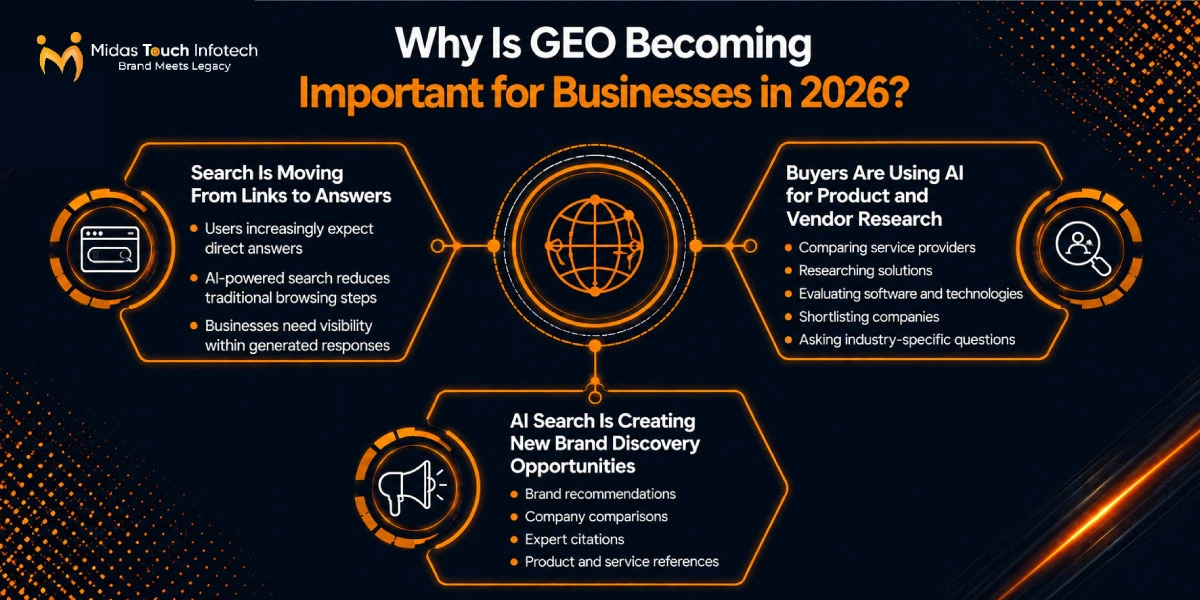
GEO is gaining attention because the way people research companies and solutions is expanding.
✦ Search Is Moving From Links to Answers
Search users increasingly expect direct, contextual answers.
Instead of typing several short searches and opening multiple web pages, users can ask AI systems detailed questions such as which software is suitable for a particular organisation, which service providers specialise in a specific industry or how two solutions compare.
AI platforms can summarise this information into one answer.
As answer-based discovery increases, brands need to consider whether they are visible within those generated responses.
✦ Buyers Are Using AI for Product and Vendor Research
AI platforms are particularly useful for complex research.
Potential customers can ask them to compare vendors, explain technologies, shortlist products and identify considerations before making a purchase.
This can be especially important in B2B sectors where buying decisions often involve extensive research.
AI might influence which businesses enter a potential customer’s consideration set before that customer ever reaches Google or the company’s website.
✦ AI Search Is Creating New Brand Discovery Opportunities
Generative search can introduce users to businesses they did not previously know.
A brand may appear in a recommended list, product comparison, expert citation or industry-specific explanation.
GEO therefore creates another opportunity to influence customer discovery alongside organic search, paid advertising, social media and other digital channels.
How GEO and SEO Work Together
The seo vs geo digital marketing discussion should not be treated as a choice where one strategy completely replaces the other.
In many cases, GEO benefits from the same foundations that make SEO successful.
✦ SEO Builds Search Authority
Strong technical foundations make content easier for search engines to crawl and understand.
Well-organised pages, useful content, internal linking, backlinks and recognised expertise can strengthen the overall authority of a website.
These signals support traditional organic visibility and create a stronger digital presence.
✦ GEO Extends Authority Into AI Search
GEO takes that authority and makes it more useful within AI-driven discovery.
Clear brand information, detailed explanations, reliable evidence and third-party mentions can help generative systems better understand the organisation.
Therefore, businesses with mature SEO strategies may already have some of the foundations required for GEO.
✦ Content Can Be Optimised for Both SEO and GEO
Businesses do not necessarily need separate content for every SEO and GEO objective.
A well-structured article can satisfy both.
Use clear heading structures and answer important questions directly. Add relevant FAQs where they genuinely help users. Include expert perspectives, original research and statistics when available.
Content should mention relevant entities and concepts naturally rather than repeatedly inserting exact-match keywords.
Schema markup can improve machine understanding, while internal links establish topic relationships. Trusted external citations can provide supporting evidence.
The result is useful content designed for people first while being easier for both search engines and generative AI systems to interpret.
GEO vs SEO: Which One Generates Better ROI?
Comparing seo vs geo marketing ROI requires different measurements because each strategy influences customer journeys differently.
✦ SEO ROI
SEO ROI is relatively established.
Businesses can measure organic sessions, conversions and revenue generated through search.
Additional indicators include keyword visibility, conversion rates, cost per lead and the value generated from organic traffic.
SEO performance can often be connected directly to landing pages and conversion events, making commercial impact easier to quantify.
✦ GEO ROI
GEO requires a broader measurement model.
Relevant metrics include AI citations, brand mentions, AI referral traffic, prompt visibility and the share of AI-generated answers in which the brand appears.
Businesses can also monitor recommendation frequency and changes in branded search demand.
AI referral traffic itself is becoming commercially relevant. Adobe Analytics data reported by Reuters in June 2026 found that U.S. retail visitors referred by large language models generated 53% more revenue per visit than visitors arriving from non-AI sources.
However, direct AI referrals represent only one part of GEO’s potential value.
✦ Why ROI Should Be Measured Across Both Channels
Modern customer journeys rarely involve only one interaction.
A buyer might first discover a company through ChatGPT, search the brand on Google several days later, read case studies and eventually submit an enquiry.
In this case, AI assisted discovery while search assisted validation and conversion.
Businesses should therefore consider search-assisted conversions, AI-assisted discovery, brand influence and multi-touch journeys rather than assigning every sale to the last click alone.
Should Your Business Invest in GEO or SEO?
Investment decisions should depend on your existing search maturity, audience behaviour and business objectives.
✦ When SEO Should Be the Priority
SEO should generally remain the priority if your business has limited organic visibility.
Businesses that cannot rank for important commercial searches may still need to establish their basic search foundation before allocating significant resources to GEO.
If your business requires consistent high-intent traffic and leads, professional SEO consulting services can help identify keyword opportunities, technical problems and gaps within your content strategy.
SEO should also take priority when the website has indexing problems, poor site architecture, weak content or limited authority.
These weaknesses may also reduce your ability to gain visibility within AI systems.
✦ When to Start Investing in GEO
Businesses with established organic performance can begin expanding their efforts into GEO.
Investment becomes particularly relevant when customers increasingly use ChatGPT, Gemini or similar tools to research your industry.
Companies should also consider GEO if competitors frequently appear in AI-generated recommendations while their own brand remains absent.
Businesses operating in knowledge-intensive B2B industries may have especially strong reasons to strengthen their authority across AI platforms.
✦ When SEO and GEO Should Work Together
For many organisations, the strongest strategy is not choosing between them.
Customers may use Google for some stages of research and AI assistants for others.
Competitive markets also make it important to increase the number of places where buyers can discover and evaluate the brand.
Combining SEO and GEO can therefore support both immediate organic lead generation and longer-term visibility across emerging discovery channels.
How to Measure GEO and SEO Performance
Measurement is important because the two strategies produce different visibility signals.
✦ Important SEO KPIs
Businesses should continue tracking organic traffic, keyword rankings, impressions and organic click-through rates.
More importantly, connect SEO activity with conversions, qualified leads and revenue wherever possible.
Backlink growth and visibility across important commercial keywords can help measure authority, but these metrics should support business outcomes rather than become goals by themselves.
✦ Important GEO KPIs
GEO measurement is still developing.
Businesses can monitor how frequently their brand appears for important AI prompts and whether their website receives citations.
Other useful metrics include AI referral traffic, share of AI answers, branded search growth and competitor visibility.
Tracking the same commercially important prompts over time can help businesses identify whether their generative search visibility is improving.
Also Read: 12 AI Search Ranking Tools for Tracking Brand Visibility
GEO vs SEO: Which Strategy Should Your Business Invest in for 2026?
There is no universal answer to the GEO vs SEO question. The right allocation depends on where your business currently stands.
✦ When Your Business Should Prioritise SEO
Prioritise SEO when your website still struggles to generate meaningful organic visibility.
Businesses requiring consistent high-intent traffic, local enquiries and organic leads should first build a reliable search foundation.
Companies targeting specific geographic markets may also benefit from Local SEO consulting services to strengthen location pages, local search signals, content relevance and conversion pathways.
Technical SEO and content problems should be addressed before assuming AI optimisation alone will solve discoverability challenges.
Traditional search also deserves significant investment when your target customers continue using Google heavily for commercial research.
✦ When Your Business Should Increase GEO Investment
Increase GEO investment when you already have strong SEO foundations and want to extend visibility into generative platforms.
Monitor how customers research your industry and whether competitors appear in AI recommendations.
If AI tools frequently influence vendor research, product comparisons or educational queries within your market, building entity authority and citation-worthy content becomes increasingly valuable.
✦ When SEO and GEO Should Work Together
Most established businesses should increasingly consider an integrated approach.
SEO helps customers find the website through traditional search, while GEO increases the possibility of being discovered within generative answers.
Together, they can support visibility throughout a broader research journey.
An integrated geo vs seo digital marketing strategy is especially valuable in competitive industries where customers research extensively before contacting a provider.
The Future of SEO and GEO Beyond 2026
Instead of entering disconnected keywords, users will continue asking detailed questions and refining responses through follow-up prompts.
AI agents could further change discovery by researching products, comparing providers and potentially assisting customers through more stages of the buying journey.
This development means entities and brand authority may become increasingly valuable alongside individual keyword rankings.
Original research and first-party information may also become more important because AI platforms need reliable, differentiated information to support answers.
Businesses publishing genuinely useful statistics, research, case studies and expert insights can create information that other websites and AI systems have a reason to reference.
SEO is therefore unlikely to disappear. It is evolving alongside the search experience.
Technical optimisation, high-quality content, authority and user experience will continue supporting online visibility. GEO adds another layer by considering how this information is understood and surfaced by generative engines.
Over time, the distinction between SEO vs GEO may become less rigid as businesses begin managing both under broader organic and AI visibility strategies.
Ready to Make SEO and GEO Work Harder for Your Business?
The way customers search for information is expanding, but businesses do not need to abandon proven SEO strategies to adapt.
Instead, evaluate where your audience discovers information today. Strengthen technical SEO, high-value content and search authority while gradually improving your brand’s presence across AI-powered platforms.
An integrated SEO and GEO strategy can help your business remain visible when customers search Google, ask ChatGPT, explore Gemini or use other AI-powered tools to compare their options.
Businesses that begin measuring both traditional search visibility and AI visibility will be better positioned to understand how customer discovery changes over time.
Working with an experienced professional seo consultant can help you identify gaps across both channels, prioritise the right opportunities and develop a strategy that supports sustainable visibility, authority and lead generation in 2026 and beyond.

Mit Thakkar
Mit Thakkar, CEO of Midas Touch Infotech and a recognized LinkedIn SEO influencer, possesses extensive expertise in branding, website development, and digital marketing. He excels in transforming ideas into impactful digital strategies.